
Udemy Course Quality: How to Spot a Great Course Before You Buy
Not every Udemy course offers the same learning experience. Learn how to evaluate course ratings, reviews, instructor credibility, curriculum depth, updates, previews, and student feedback before spending your money.

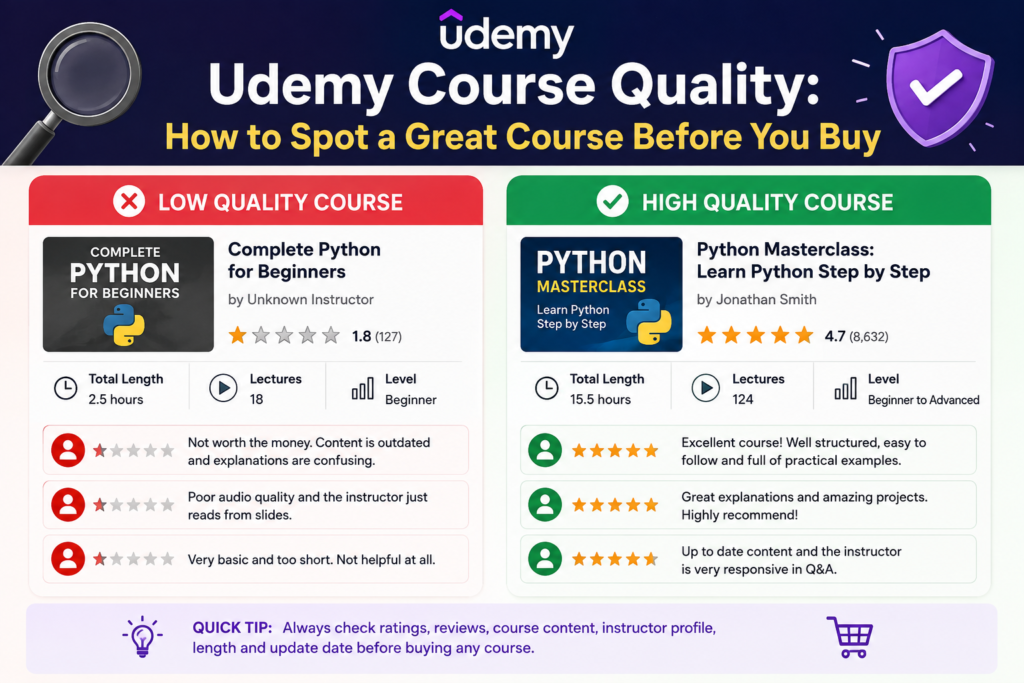
Choosing an online course should be as thoughtful as choosing a college class or a professional certification. With more than 250,000 courses and over 80 million learners internationally, Udemy has become one of the largest online learning marketplaces, covering everything from programming and artificial intelligence to photography, finance, language learning, and personal development. However, the sheer number of options means that Udemy course quality can vary widely. Some courses are taught by industry leaders with years of practical experience, while others may be outdated, poorly structured, or lacking relevant projects.
Before spending your money, even during Udemy’s frequent sales, it pays to know what separates an excellent course from an average one. By evaluating the instructor, curriculum, reviews, update history, and learning resources, you can make a smarter purchase and ensure the course genuinely helps you achieve your goals.
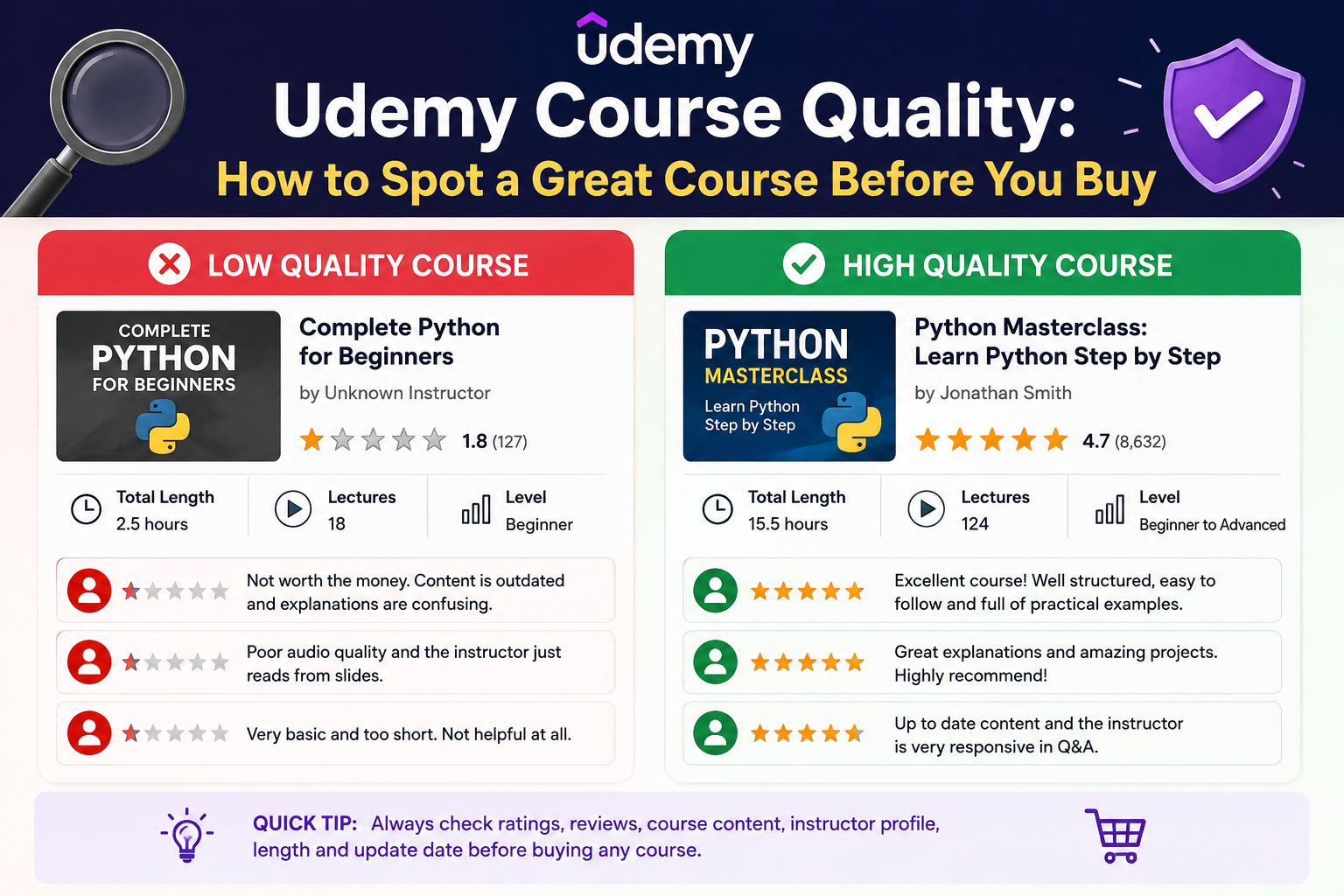
Why Udemy Course Quality Varies So Much
Start with the Instructor, Not the Star Rating
Most buyers immediately check the course rating, but experienced learners usually start with the instructor profile.
Take a few minutes to understand who is teaching the course.
- Does the instructor actively work in the field?
- Have they built products, managed projects, or consulted for companies?
Their real-world experience often translates into practical lessons that go beyond textbook explanations.
Also check the instructor’s overall teaching history on Udemy.
- Look at the number of students they’ve taught, the average rating across all their courses, and whether they consistently receive positive feedback.
An instructor who has successfully taught thousands of learners across multiple courses is generally a safer choice than someone with only one newly published course and limited reviews.
Read Reviews Like A Researcher
A 4.8-star rating may look impressive, but it doesn’t tell the complete story. Instead of relying only on the average rating, spend a few minutes reading recent student reviews.
- Look for comments about teaching clarity, practical exercises, audio quality, and whether the course helped learners solve real problems.
- Three- and four-star reviews are often the most informative because they usually explain both strengths and weaknesses rather than offering only praise or criticism.
If multiple learners mention outdated lessons, poor explanations, or missing resources, consider those warning signs even if the overall rating remains high.
| What To Evaluate | Why It Matters |
|---|---|
| Instructor experience | Indicates practical industry knowledge |
| Recent student reviews | Reflect the current course quality |
| Last updated date | Ensures content is relevant |
| Course curriculum | Shows learning depth and structure |
| Projects and assignments | Helps build practical skills |
| Q&A activity | Demonstrates instructor engagement |
Review the Curriculum Before Purchasing
A well-designed curriculum tells a story. It begins with fundamentals, gradually introduces more advanced concepts, and finishes with projects or case examples that reinforce learning.
Avoid buying courses simply because they advertise dozens of hours of content. A concise, well-organized 12-hour course often provides more value than a 40-hour course filled with repetitive explanations.
While you review the curriculum, ask yourself whether the lessons follow a logical sequence and check if the course includes quizzes, assignments, downloadable resources, or practical exercises. These items indicate that the instructor has designed the course for learning rather than simply recording lectures.
Preview Lessons Reveal the Real Teaching Style
One of the most overlooked features on Udemy is the preview lecture.
Watching just a few preview videos can tell you far more than a star rating. Pay attention to the instructor’s communication technique, audio quality, pacing, screen recordings, and ability to explain difficult concepts in simple language.
Everyone learns differently. Some people prefer detailed explanations, while others enjoy fast-paced demonstrations. Preview lessons help you determine whether the instructor’s teaching style fits your study preferences before making a purchase.
Always Check When the Course Was Last Updated
Technology evolves quickly, especially in fields such as artificial intelligence, programming, cybersecurity, digital marketing, and cloud computing.
One of the strongest indicators of Udemy course quality is how recently the course has been updated.
- A Python course created five years ago without updates may no longer cover the latest libraries, while an SEO course from 2023 might already miss major algorithm changes.
That doesn’t mean older courses have no value.
- Subjects like communication, leadership, photography basics, or productivity often remain relevant for years.
- The key is ensuring the update frequency matches the pace of change within the subject.
Look Beyond Course Length
Many buyers assume longer courses automatically provide better value. In reality, course length should never be the deciding factor.
Instead, focus on whether the course includes practical learning opportunities. The best courses typically combine video lessons with real-world projects, downloadable templates, coding exercises, worksheets, quizzes, and case studies.
These resources encourage active learning instead of passive watching. By completing projects, learners gain confidence and build a portfolio they can use professionally, making the course far more valuable than one consisting only of lengthy video lectures.
Compare Similar Courses Before Making a Decision
One of the smartest ways to improve your chances of finding a great course is to compare at least three options before purchasing.
- Rather than choosing the first course that appears in search results, compare the instructors, curriculum, update history, projects, student reviews, and course outcomes.
- You may discover that a slightly lower-rated course offers better practical exercises or more comprehensive coverage.
- Taking just ten minutes to compare similar courses is able to significantly improve your study journey and help you invest in content that actually delivers long-term value.
Red Flags That Should Make You Think Twice
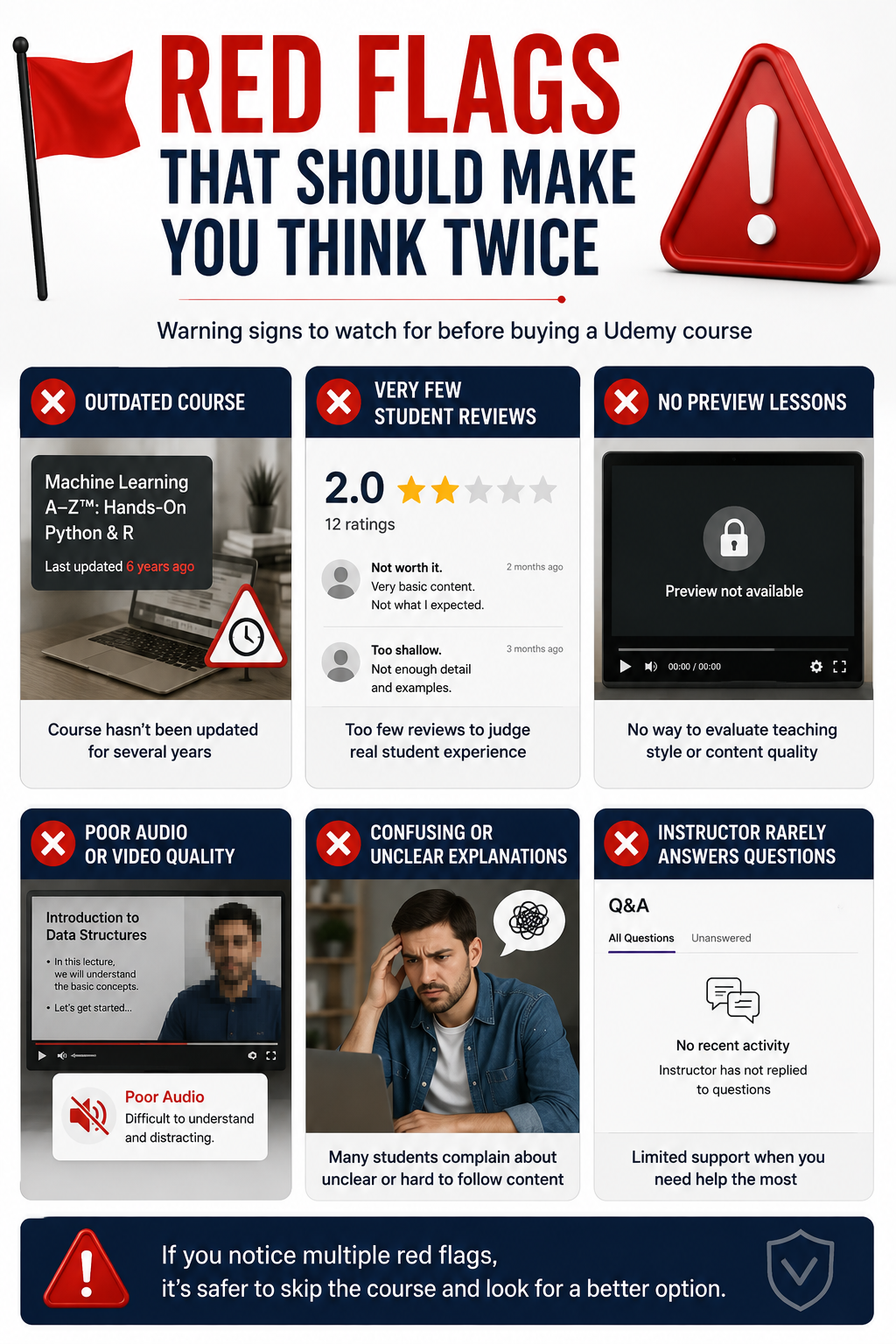
Certain warning signs often indicate that a course may not meet your expectations.
Be cautious if the course hasn’t been updated for several years in a rapidly changing field, contains very few genuine student reviews, lacks preview lessons, or has recurring complaints about poor audio or confusing explanations. Similarly, if the instructor rarely answers questions in the discussion section, you may receive limited support when you face difficulties.
Spotting these red flags before purchasing can save both time and money while helping you avoid disappointing learning experiences.
Final Thoughts
Choosing the right online course requires more than looking at the price or overall rating. The best way to evaluate Udemy course quality is by considering multiple factors together, including instructor expertise, course structure, recent reviews, update history, practical projects, and learner support.
Frequently Asked Questions
1. How can I tell if a Udemy course is worth buying?
Review the instructor’s credentials, recent student reviews, course curriculum, update history, preview lessons, and the availability of projects or practical assignments before making your decision.
2. Are highly rated Udemy courses always the best?
Not necessarily. While ratings are helpful, they should be considered alongside the number of reviews, course updates, instructor experience, and student feedback about learning outcomes.
3. Why is the course update date important?
Also Read: How to Choose the Right Hair Care Devices for Your Hair Type