
How to Do Keyword Research for a New Website: Free + Paid Methods
Learning how to do keyword research is ultimately about understanding demand before investing time in content.


Launching a new website without keyword research is a little like opening a shop without knowing what customers are looking for. Doing keyword research effectively means understanding the language people use, the problems behind their searches, the level of competition you can realistically handle, and whether a keyword can bring the kind of visitor your business actually needs. In 2026, this matters beyond traditional Google rankings because search behaviour is increasingly spread across standard results, AI-generated answers, local results, shopping surfaces and other search experiences. The goal is no longer to collect hundreds of keywords, but to identify realistic opportunities and turn them into a useful content plan and to do this our how to do keyword research for a new website guide will be helpful.

Start With Your Business, Not a Keyword Tool
Before opening any SEO platform, write down what your website actually offers. List your products, services, customer problems, locations, and the questions prospects regularly ask.
Suppose you are launching a website for a digital marketing agency. “Digital marketing” may have enormous search demand, but it is also broad and highly competitive. A new website may have a better opportunity with terms such as “digital marketing agency” or “local SEO services,” particularly if those topics match the agency’s actual expertise.
This first stage prevents keyword research from becoming a spreadsheet exercise disconnected from the business.
Build a Seed Keyword List
Seed keywords are broad starting points that help you discover more specific searches. You do not need hundreds of them, but ten to twenty strong seeds are usually enough to begin.
Think about the words a customer would use without knowing your brand. For a website selling accounting software, seeds could include “accounting software,” “invoice software,” “small business accounting,” “GST accounting software” and “online bookkeeping.”
Now expand each seed into questions, comparisons, problems, locations and purchase-related searches. This is where the difference between a keyword list and actual research begins.
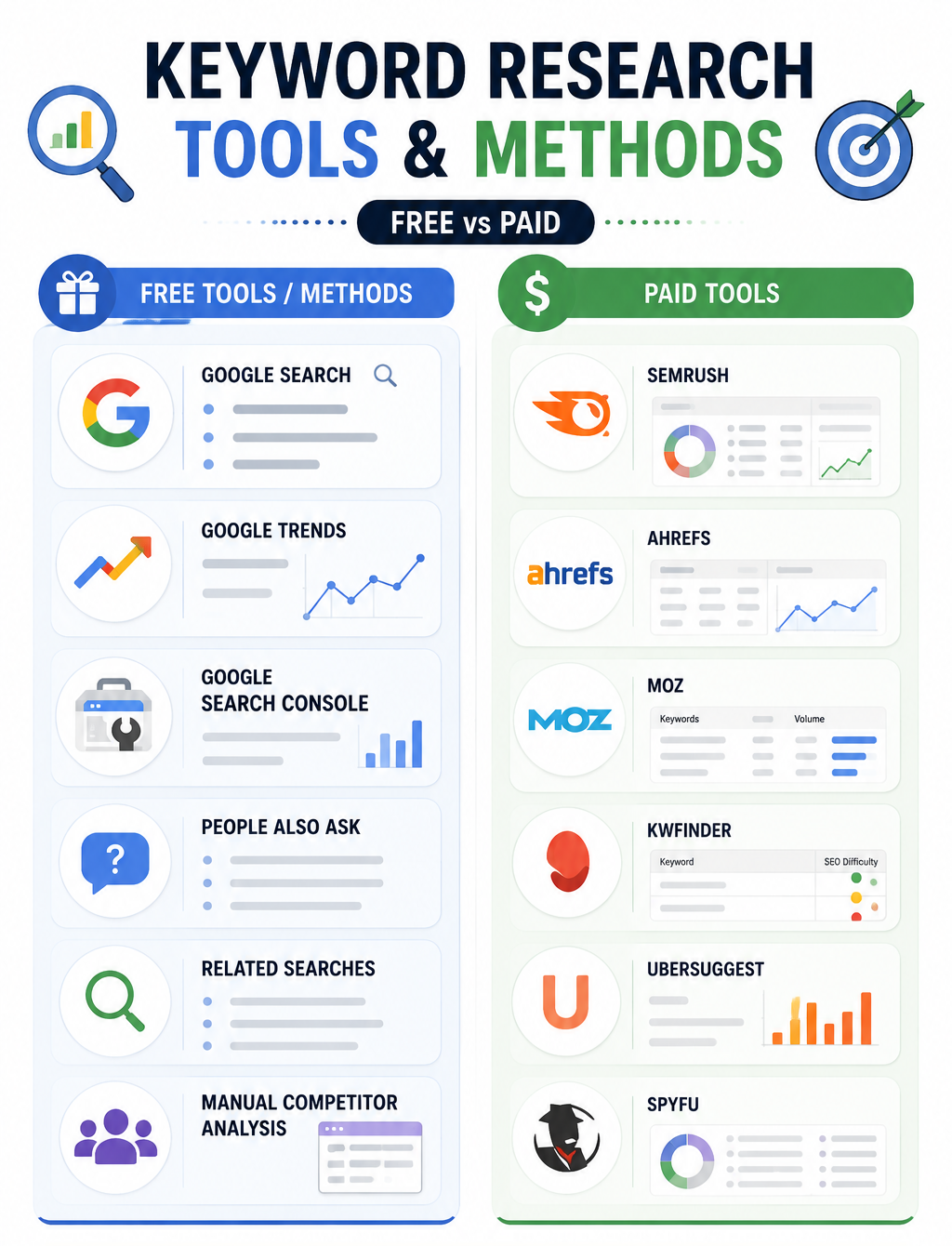
Free Method 1: Use Google Search Itself
Google can reveal useful information without requiring a paid subscription. Enter a broad term and examine autocomplete suggestions, related searches and the questions appearing around the results.
More importantly, study the actual pages ranking for your target phrase. Look at what type of content Google is rewarding. If the first page is dominated by detailed guides, creating a short promotional article probably will not match the search intent. If product pages dominate, a purely informational article may also struggle.
Search results are therefore a form of competitor research as well as keyword research.
Free Method 2: Explore Google Trends
Google Trends is useful when search demand changes with seasons, locations or current events. It allows you to compare search terms, examine interest by region and discover related searches.
For example, a travel website might compare “summer vacation,” “monsoon travel” and “winter holidays” to understand when interest rises rather than treating search volume as a fixed number throughout the year.
One important detail is that Google Trends measures relative interest rather than giving you the same monthly search-volume metric found in many SEO platforms. Use it to understand direction and timing, not as your only source of demand data.
Free Method 3: Use Google Keyword Planner
- Google Keyword Planner is a free tool for discovering keyword ideas, search volume ranges, competition levels and related terms.
- Enter a broad topic, such as “digital marketing services,” and review the suggestions to find specific keywords with clear search intent.
- For a new website, focus on relevant, lower-competition phrases rather than chasing only high-volume terms.
- Keep in mind that Keyword Planner often shows search-volume ranges, so combine its data with Google Search and competitor analysis before choosing your final keywords.
Free Method 4: Use Google Search Console Later
A brand-new website will not have meaningful Search Console data immediately, but once pages begin appearing in Google, the Performance report becomes extremely useful.
Search Console shows the queries that lead people to your site and lets you examine clicks, impressions and CTR.
This creates opportunities you could not have predicted before publishing. A page might rank for several related phrases that were never part of your original keyword list. Those terms can become targets for improving the existing article or developing a related page.
Paid Method: Use Semrush for Deeper Research
For a new website, a paid SEO platform becomes valuable when you need competitive data rather than just keyword ideas. Semrush’s Keyword Magic Tool currently provides access to more than 27 billion keywords, with metrics such as search volume, keyword difficulty, search intent, CPC and SERP features. This tool also offers a limited number of free searches daily.
- Enter your seed keyword, select your target country and start filtering.
- Do not automatically choose the keywords with the largest volume.
- A phrase with 50,000 monthly searches may be useless if the current results are dominated by websites with enormous authority.
- Instead, look for combinations of reasonable demand, manageable competition and strong business relevance.
There are also similar paid tools available with similar features like AHREFS, MOZ, SPYFU, etc.
Study Competitors Before Choosing Your Targets
Competitor research is one of the most useful paid methods for a new domain because it reveals what is already working in your market. Semrush’s Keyword Gap can compare your website with competing domains and identify searches where competitors have visibility, but you do not.
Choose competitors that are realistically relevant. If you operate a small regional business, comparing yourself only with Amazon, Forbes or Wikipedia will produce an intimidating list of keywords that tells you very little about what you can achieve.
Look for smaller sites ranking consistently for valuable terms. Their content structure, topic selection and backlink profile can provide much more useful benchmarks.
Evaluate Keywords Using More Than Search Volume
Search volume should never be the deciding metric. A keyword with modest demand can be commercially valuable if the searcher is close to making a purchase.
| Factor | What to Check | Why It Matters |
|---|---|---|
| Search volume | Monthly demand | Shows potential audience size |
| Difficulty | Competition level | Indicates ranking challenge |
| Search intent | Informational, commercial, transactional | Determines suitable content |
| Relevance | Connection to your offer | Prevents irrelevant traffic |
| SERP | Current ranking pages | Reveals content expectations |
| CPC | Advertising value | Can indicate commercial interest |
| Trend | Rising, stable or declining | Helps identify future opportunities |
This is where how to do keyword research effectively becomes a strategic exercise rather than simply finding popular phrases.
Create Keyword Clusters Instead of One Keyword Per Article
A common mistake is creating separate pages for every minor variation of the same search. If “best CRM for small business,” “best small business CRM”, and “CRM software for small companies” all have essentially the same intent, one genuinely useful page may be more appropriate than three thin articles.
Group closely related terms around one main topic, then use supporting phrases naturally throughout the page. Semrush also provides keyword grouping and clustering features that can help turn large keyword lists into content structures.
This approach gives a new website a clearer topical structure and reduces the temptation to publish dozens of repetitive pages.
Practical Tips for New Websites
- Target specific problems first: Long-tail searches often reveal clearer intent and can be easier for a new domain to compete for.
- Check the SERP manually: Always inspect the first page before committing to a keyword because difficulty scores cannot fully explain what Google is rewarding.
- Look for commercial intent: Prioritize searches that connect naturally to your products, services or future monetization plans.
- Use location modifiers: Local businesses should research combinations involving cities, neighbourhoods and service areas rather than relying only on broad industry terms.
- Track keyword variations: Search Console can reveal unexpected queries once your pages begin receiving impressions.
- Do not force exact-match phrases: Modern search systems understand related language, so readable writing is more valuable than awkward repetition.
- Review your list regularly: Search behaviour changes, competitors publish new pages and seasonal demand can shift, so keyword research should be revisited rather than completed once.
Frequently Asked Questions on
1. How many keywords should a new website target?
There is no fixed number. Start with a focused group of keywords closely connected to your products, services and audience, then expand as your website gains visibility and authority.
2. Should a new website target high-volume keywords?
Usually not as its first priority. High-volume terms often attract strong competition, so a new domain may achieve faster results by targeting specific, relevant searches with clearer intent.
3. Is keyword difficulty always accurate?
No. Difficulty scores are useful for comparison, but they cannot replace manual SERP analysis. Examine the authority, content quality and relevance of the pages currently ranking before deciding whether a keyword is realistic.
Learning how to do keyword research is ultimately about understanding demand before investing time in content. When you combine free search data, competitor analysis, paid SEO metrics and actual performance data, your keyword list becomes more than a collection of phrases. It becomes a practical roadmap for deciding what your new website should publish, which audiences it should attract and where it has a realistic chance to compete.
Also Read: How to Start a Blog in 2026: The Complete Beginner’s Guide