
How Money Transfer Fees Really Work (and How to Pay Less)
Learn how money transfer fees really work, including exchange-rate markups, hidden charges, and delivery costs in this blog.

Money transfer fees are rarely just the number displayed beside the “send” button. For international transfers, the real cost can include an upfront transfer charge, an exchange-rate markup, payment-method fees and, in some cases, receiving or intermediary-bank charges. The World Bank’s latest Remittance Prices Worldwide data puts the average global cost of sending money at 6.36% of the amount transferred, showing why comparing only the advertised fee can give a misleading picture.
For example, a service advertising a $0 fee may still make money by offering an exchange rate below the market reference rate. Another provider might charge $5 upfront but give a much better exchange rate and leave the recipient with more money. The useful number is therefore not the fee on the screen; it is how much the recipient actually gets for the total amount you spend.
The Four Costs Hidden Inside a Money Transfer
The first cost is the transfer fee, which may be a flat charge or a percentage of the amount sent. It can change depending on the destination, transfer size, speed and how you fund the transaction. Paying with a bank account may be priced differently from using a debit or credit card.
The second is the foreign-exchange (FX) margin. This is where many people underestimate the cost. If the market reference rate is 1 USD = 0.92 EUR but the provider uses 0.90 EUR, the 0.02 difference is effectively part of what you are paying. The World Bank specifically separates the transfer fee from the exchange-rate margin when calculating the total cost of remittances.
There can also be recipient and intermediary charges. A bank receiving an international wire may deduct a fee, while correspondent banks can sometimes take charges while the money is moving between institutions. These costs depend heavily on the transfer route and payment method.
| Cost | How it works | What to check |
|---|---|---|
| Transfer fee | Flat or percentage charge | Fee before sending |
| FX margin | Provider’s exchange rate differs from reference rate | Rate received |
| Funding fee | May apply to certain cards or payment methods | Payment method |
| Receiving fee | Recipient’s bank or provider may charge | Amount received |
| Intermediary fee | Third-party banks may deduct money | Wire terms |
| Speed premium | Faster delivery can cost more | Delivery option |
Why a “Zero-Fee” Transfer Isn’t Always Cheapest
A zero-fee promotion can be useful, but it should never be treated as proof that the transaction is inexpensive. If a provider makes $1,000 available to the recipient at a noticeably weaker exchange rate, the lost value can exceed the fee charged by another service.
The World Bank has found that exchange-rate margins are a significant component of remittance costs and notes that consumers often struggle to compare services because pricing combines several variables.
A simple calculation helps. Suppose you want the recipient to receive euros and you are comparing two providers:
- Provider A: $5 transfer fee, better exchange rate
- Provider B: $0 transfer fee, weaker exchange rate
If Provider A leaves the recipient with €920 after all costs while Provider B delivers €905, Provider A is actually cheaper despite charging a fee.
That is why the best comparison question is: “How much will the recipient receive, and how much will I have to pay?”
How to Compare Transfers Properly
When comparing services, start with the same sending amount, destination, payment method and delivery method. A quote for $500 to a bank account cannot fairly be compared with a quote for $500 in cash pickup if the providers price those services differently.
Then look at the exchange rate. Compare it with a reliable market reference rate and calculate the difference. You don’t necessarily need the mathematically perfect mid-market rate; you simply need a consistent benchmark across providers.
Speed also matters. If the recipient does not need the money immediately, don’t automatically select an instant or same-day option. Some providers price faster delivery differently, while a slower bank-funded transfer may be cheaper.
Practical Ways to Pay Less
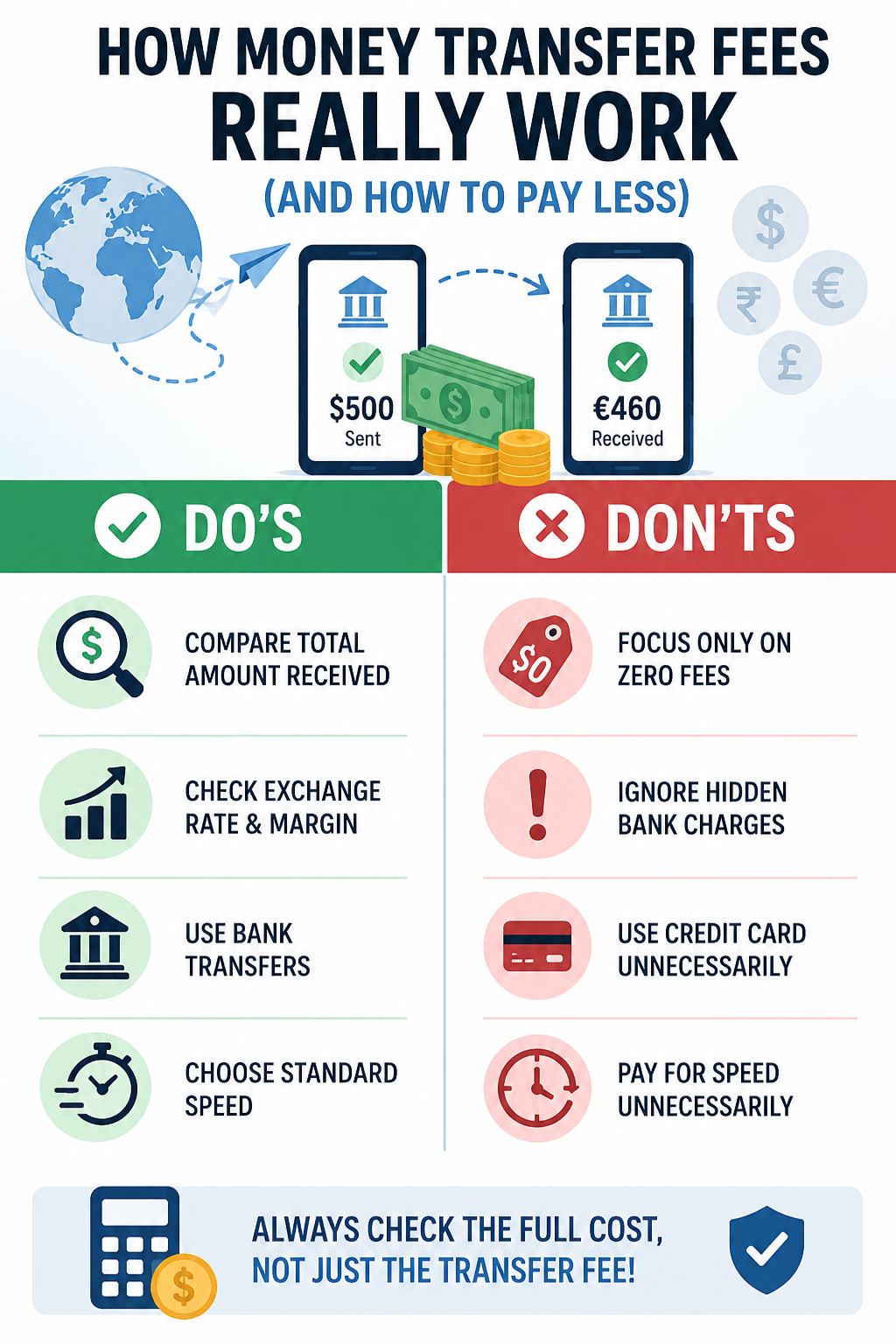
- Compare the recipient’s final amount, not the headline fee. This is the single most useful habit when dealing with money transfer fees.
- Use bank-funded transfers when appropriate. Some services price transfers funded directly from a bank account differently from card-funded transactions. Always check the final quote rather than assuming one method is cheaper.
- Avoid unnecessary urgency. If the transfer can arrive in two or three days instead of minutes, compare both options. Paying for speed makes little sense when there is no deadline.
- Compare before every large transfer. Prices change by corridor, amount and payment method. A provider that was cheapest last month may not be the cheapest today.
- Watch promotional pricing. A first-transfer discount can make a service appear dramatically cheaper. Check what the normal rate and exchange rate will be after the promotion ends.
- Consider consolidating transfers where practical. If you regularly send small amounts internationally, several separate transactions can expose you to repeated flat fees. Sending less frequently may reduce the impact of fixed charges, provided it fits your financial needs and doesn’t create unnecessary risk.
What About Domestic Transfers?
Domestic transfers work differently. In the US, for example, ACH transfers are generally used for electronic bank-to-bank payments, while wire transfers are commonly used when speed and finality are more important. The fee structure depends on the financial institution and the type of transfer.
For international payments, however, the exchange rate becomes an additional major consideration. This is why a domestic transfer costing a few dollars cannot be compared directly with an international remittance where currency conversion is involved.
The World Bank’s data also shows why digital and payment methods matter: total remittance costs can vary considerably depending on how the transaction is funded and how the recipient receives the money.
A Quick Checklist Before You Hit Send
Before confirming a transfer, check these seven numbers:
- Amount you pay
- Transfer fee
- Exchange rate
- Currency received
- Amount recipient receives
- Delivery time
- Any receiving or intermediary charges
If two providers show different fees, calculate the final amount received. If one offers a $0 fee but the recipient gets less money, the “free” transfer isn’t necessarily the better deal.
For larger transactions, also check cancellation rules, identity requirements and whether the quoted exchange rate is guaranteed for the period you need.
FAQs on Money Transfer Fees
1. Are Money Transfer Fees always charged separately?
No. Some providers charge an explicit fee, while others incorporate much of their revenue into the exchange-rate margin. Some promotions may remove the upfront fee altogether.
2. Is a lower transfer fee always better?
No. The exchange rate can have a larger effect than the visible fee, especially for larger international transfers. Compare the total amount the recipient receives.
3. How can I avoid hidden transfer costs?
Ask for the complete quote before confirming the transaction. Check the exchange rate, transfer fee, delivery method and final recipient amount rather than relying on the advertised fee.
The most important lesson is simple: a money transfer has a price even when the fee says $0. Once you start looking at the exchange rate and final amount received alongside the upfront charge, comparing providers becomes much easier and avoiding unnecessary costs becomes far more realistic.