
Fitness Trackers vs Smartwatches: Which Data Actually Matters?
Compare fitness trackers vs smartwatches to understand which health metrics matter most, how accurate wearable data is, and which device suits your routine.

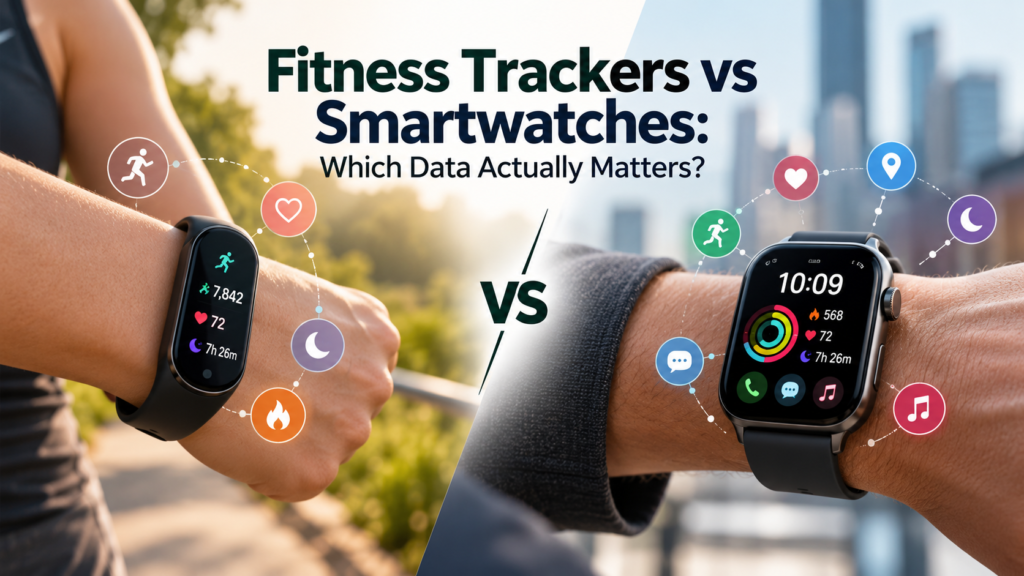
Wearable activity trackers can record your heart rate, count your steps, estimate calories burned, analyse sleep and even calculate how quickly your body may recover from exercise. But more numbers do not necessarily mean better health insights. The real question behind fitness trackers vs smartwatches is which measurements you can use to make meaningful changes to your routine.
Research published in Frontiers in Digital Health in 2026 reviewed 47 studies on wrist-worn activity trackers and found that accuracy varies by device, activity and measurement. Heart-rate and step-count tracking have improved, but estimating energy expenditure remains challenging. The review reports that recent devices can still show errors of approximately 10-40% in calorie estimates compared with laboratory reference methods.
That distinction matters when choosing a wearable. A fitness tracker may offer a simpler way to follow activity and sleep, while a smartwatch combines those functions with apps, calls, notifications and other everyday tools. Neither automatically provides more useful data. The right choice depends on what you want to measure and how you plan to act on the results.
1. Fitness Tracker vs Smartwatch: What Is the Difference?
A fitness tracker is designed primarily to monitor activity and selected health indicators. Many models are lightweight, have fewer distractions and offer battery life suited to continuous wear.
A smartwatch usually adds a larger display, smartphone notifications, calls, third-party apps, contactless payments and music controls. Some models also offer detailed workout analysis, GPS navigation and advanced health features.
The distinction is no longer absolute. Premium fitness trackers can provide detailed recovery insights, and sports-focused smartwatches can deliver sophisticated training metrics. Instead of choosing by product category alone, compare the specific features and data quality of each model.
2. Which Health Metrics Actually Matter?
Heart rate: Useful for understanding exercise intensity
Heart rate helps you see how your body responds to walking, running, cycling and other activities. Over time, it can reveal patterns in workout intensity and resting heart rate.
However, wrist-based optical sensors can struggle during sudden changes in intensity, weight training or activities with repeated wrist movement. Fit, sensor contact and the individual device also affect readings.
Use heart-rate trends to compare similar workouts rather than treating every reading as exact. If precise training measurements are important, look for independent testing and consider whether a compatible chest strap is supported.
Steps and active minutes: Practical measures of movement
Step counts are useful for people who want to move more during the day. Active minutes can help identify whether exercise is becoming a regular habit.
These metrics are most useful when compared over time. If your usual routine involves long periods at a desk, noticing a consistent increase in daily movement may be more meaningful than hitting an arbitrary target every day.
Remember that wrist movement can affect step counting, particularly during household tasks or exercises that do not involve walking.
Sleep duration and consistency: More useful than chasing a perfect score
Wearables estimate sleep using movement, heart rate and other sensor signals. They can help you notice bedtime patterns, changes in sleep duration and differences between weekdays and weekends.
Sleep-stage estimates, however, are not equivalent to a clinical sleep assessment. Treat the overall pattern as a guide rather than assuming every minute of light, deep, or REM sleep has been classified correctly.
Calories burned: A number to interpret cautiously
Calorie expenditure is one of the most tempting metrics to watch, especially when exercising to manage weight. Yet wrist-worn devices estimate energy use using variables such as movement, heart rate, body information and proprietary algorithms.
They do not directly measure all the energy your body uses. Avoid treating the displayed figure as an exact amount you have burned or eating back every reported exercise calorie.
GPS, pace and distance: Important for outdoor training
For runners, cyclists and hikers, GPS quality may matter more than the number of wellness features on a device. Built-in GPS can record routes without requiring a phone, while connected GPS relies on a paired smartphone.
Compare route accuracy, pace stability, battery use and support for your preferred activities. A smartwatch with reliable navigation may be more useful to an outdoor runner than a tracker with extra lifestyle scores.
3. Fitness Trackers vs Smartwatches: A Practical Comparison
| Feature | Fitness tracker | Smartwatch |
|---|---|---|
| Daily steps and activity | Core focus | Usually included |
| Heart-rate monitoring | Common | Common |
| Sleep tracking | Often a key feature | Available on many models |
| Workout analysis | Basic to advanced | Basic to advanced |
| GPS | May rely on phone | Built-in on many models |
| Calls and apps | Limited on most models | Usually more capable |
| Battery life | Often longer | Often shorter with frequent use |
| Best suited to | Consistent health and activity tracking | Fitness plus everyday connectivity |
These are general tendencies, not guarantees. A dedicated sports watch may outperform a basic fitness band for running, while a premium smartwatch may offer better training analysis than an entry-level tracker. Check the exact model rather than assuming its category determines performance.
4. Which Device Gives You Better Data?
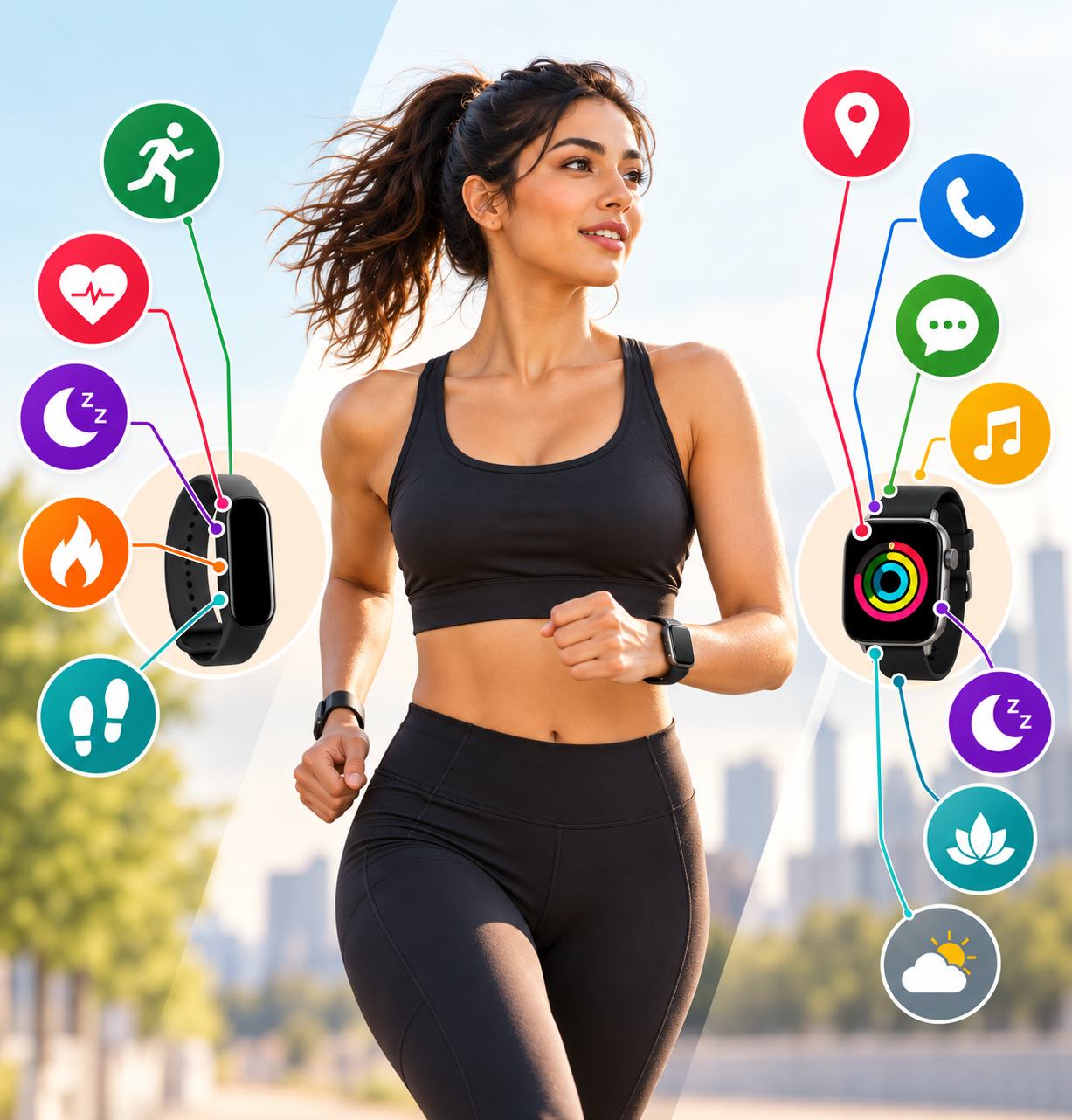
When comparing fitness trackers vs smartwatches, focus on how well the device performs the measurements you actually need.
If your priority is daily activity, sleep consistency, and resting heart-rate trends, a comfortable tracker with reliable sensors may be sufficient. You do not necessarily need a large display or dozens of apps.
If you train for races, GPS accuracy, pace analysis, workout programming and recovery trends become more important. A sports-focused smartwatch may be worth the additional cost.
For people who want to monitor health while managing a busy workday, notifications, calendar access and calls may justify choosing a smartwatch. Just remember that extra features do not automatically make its health measurements more accurate.
Before buying, check independent reviews, supported phone operating systems, subscription requirements, battery performance and whether your preferred metrics are available without paying for an additional service.
5. How to Turn Wearable Data Into Better Decisions
The most useful wearable is one that helps you change a habit, not one that gives you another screen to check.
- For everyday movement: Review weekly step averages and active minutes.
- For exercise: Compare heart rate and pace across similar sessions.
- For sleep: Look for consistent bedtime and sleep-duration patterns.
- For recovery: Combine wearable trends with how rested you actually feel.
- For long-term progress: Compare several weeks of data rather than reacting to one unusual day.
Keep the limitations in mind. Consumer wearables are useful for general trends, but their readings should not be used alone to diagnose a medical condition or replace professional assessment.
Final Verdict: Choose the Data You Will Actually Use
The debate around fitness trackers vs smartwatches is not about finding one universal winner. It is about matching the device to your priorities.
Choose a fitness tracker if you want a lightweight, focused way to monitor daily activity and health trends. Choose a smartwatch if you need those functions alongside connectivity, navigation and broader training tools.
Above all, prioritise reliable measurements, comfortable daily wear and clear insights over the sheer number of metrics advertised. The best wearable is the one that helps you understand your habits and make better decisions consistently.
Frequently Asked Questions
1. Are fitness trackers more accurate than smartwatches?
Not necessarily. Accuracy depends on the specific device, sensor, activity and metric. Compare independent testing for the measurements that matter to you.
2. Which is better for sleep tracking?
Either can work well for observing sleep duration and routine. Comfort, battery life and consistent overnight wear may matter more than whether the device is called a tracker or smartwatch.
3. Should I trust the calories-burned number?
Treat it as an estimate, not an exact measurement. Wearable calorie calculations can have substantial errors, so avoid making major dietary decisions based solely on that number.
Also Read: The Capsule Wardrobe Formula: 30 Pieces, 100 Outfits