
How Exchange Rates Work: Getting the Real Rate When You Transfer
Learn how exchange rates work, understand mid-market rates and hidden transfer fees, and discover how to get more money to your recipient.

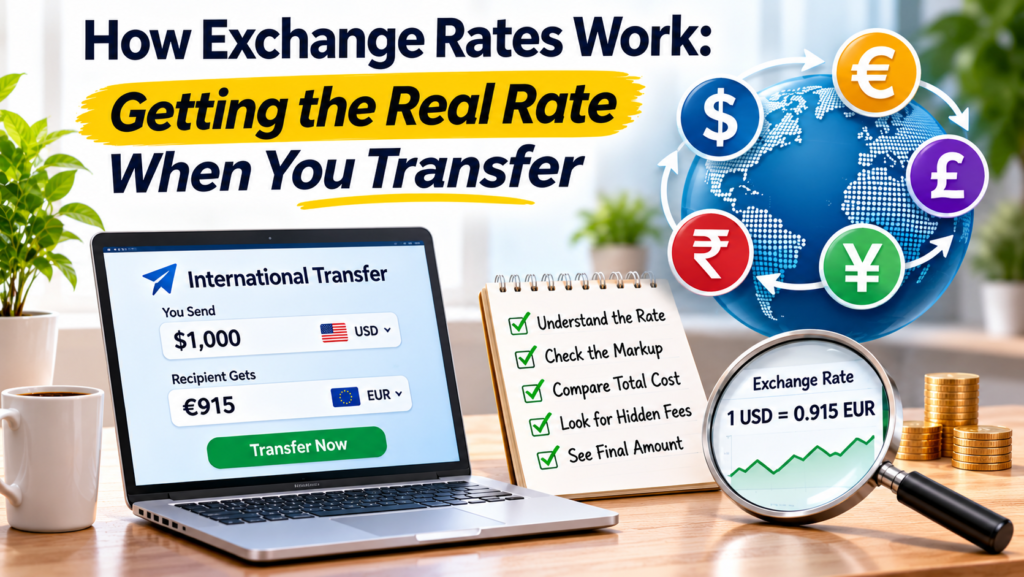
Sending money internationally can cost more than the transfer fee displayed on the payment screen. The difference often comes from the exchange rate itself. A bank or money transfer provider may advertise a low transfer fee while offering a conversion rate that is less favorable than the market reference rate. Understanding exchange rates helps you identify this hidden cost and make sure more of your money reaches its destination.
For example, imagine you are sending $1,000 from the United States to someone in Europe. If the reference rate is $1 = €0.92, the conversion would produce €920 before fees. But if your provider offers €0.89 per dollar, the recipient gets only €890. That is a €30 difference, even before considering the transfer charge. This is why comparing providers based only on their advertised fees can be misleading.
The good news is that you do not need to understand currency trading to make smarter transfer decisions. You simply need to know how rates are calculated, where providers add their margins and how to compare the actual amount your recipient will receive.
What Are Exchange Rates and How Do They Work?
An exchange rate tells you how much one currency is worth in relation to another. For example, if USD/EUR is 0.92, one US dollar can be exchanged for 0.92 euros.
Currency values change because of several factors:
- Interest rates: Higher interest rates can attract foreign investment and influence demand for a currency.
- Inflation: Countries with relatively high inflation may experience pressure on their currency’s purchasing power.
- Economic performance: Employment, trade, economic growth and business confidence influence currency demand.
- Political developments: Elections, policy changes and geopolitical uncertainty can affect investor confidence.
- Market demand: Businesses, investors, banks and governments continuously buy and sell currencies.
These movements happen throughout the global foreign exchange market. As a result, the rate you see today may differ from the rate available when you actually complete a transfer.
What Is the Mid-Market Rate?
The mid-market rate is the midpoint between the buying and selling prices quoted in the currency market. It is commonly used as a reference when comparing currency conversion offers.
However, it is important to understand that the mid-market rate is not necessarily the rate a consumer can obtain. Banks and transfer companies may add a margin, often called an exchange-rate markup or spread, to cover costs and generate revenue.
For example:
| Transfer detail | Provider A | Provider B |
|---|---|---|
| Amount sent | $1,000 | $1,000 |
| Reference rate | €0.92 | €0.92 |
| Offered rate | €0.90 | €0.915 |
| Transfer fee | $5 | $10 |
| Amount after conversion | €900 | €915 |
In this example, Provider B charges a higher upfront fee but offers a better conversion rate. The recipient receives €15 more before considering any additional receiving-bank charges.
This illustrates why the cheapest-looking transfer is not always the most affordable.
Where Do Money Transfer Providers Make Their Money?
When comparing exchange rates, pay attention to more than the advertised transaction fee. Providers may earn revenue through several charges.
- Exchange-rate markup: The provider offers a rate less favorable than its reference or wholesale rate. The difference represents an additional conversion cost.
- Transfer fees: A fixed or percentage-based charge for processing the transaction.
- Receiving fees: The recipient’s bank or an intermediary institution may deduct a charge before the money reaches the final account.
- Payment method charges: Paying by credit card or certain other methods may cost more than funding the transfer through a bank account.
- Currency conversion charges: Some banks and card providers apply additional fees when converting purchases or withdrawals made in foreign currencies.
The Consumer Financial Protection Bureau (CFPB) explains that international remittance costs can include provider fees, third-party charges, taxes and the exchange-rate spread. These costs can vary between providers and transfer routes.
How to Find the Real Exchange Rate Before Sending Money
The most reliable way to compare providers is to focus on the final amount received rather than the promotional rate.
Follow these steps:
1. Check an independent reference rate. Look up the current mid-market rate using a currency converter or financial information service. Treat it as a comparison benchmark, not a guaranteed transaction rate.
2. Enter the same transfer amount with different providers. Compare the same currencies, payment method and delivery option. Changing these details can change the offered rate and fees.
3. Check the complete fee breakdown. Look for transfer charges, taxes, payment-method fees, and any disclosed third-party costs.
4. Compare the recipient’s final amount. This is the most useful figure because it reflects the conversion and applicable disclosed charges.
5. Check the delivery time. An instant transfer may cost more than a bank deposit that takes one or two business days. Decide whether the speed is worth the additional expense.
What US Consumers Should Know About International Transfer Disclosures
In the United States, covered remittance transfer providers generally must disclose important transaction details before payment. Under the CFPB’s Remittance Rule, these can include the transfer amount, applicable fees and taxes, exchange rate, covered third-party fees and the amount expected to reach the recipient.
You should receive a transaction receipt with the relevant information after paying. Some additional third-party fees or taxes may still apply, so read the disclosures carefully.
These protections generally apply to qualifying transfers of more than $15 sent by covered providers to recipients in another country. The CFPB also explains that consumers may have cancellation and error-resolution rights for qualifying transfers.
You can review the rules at the CFPB’s official remittance transfer guidance.
Common Mistakes to Avoid When Sending Money Abroad
| Common mistake | Why it can cost you | Better approach |
|---|---|---|
| Choosing the lowest transfer fee | The provider may offer a poor conversion rate | Compare the final amount received |
| Ignoring the exchange-rate margin | Markups can reduce the converted amount | Compare against a reference rate |
| Sending without checking the currency | Recipient may face another conversion | Confirm the receiving currency |
| Always choosing instant delivery | Faster transfers may cost more | Compare standard and express options |
| Ignoring receiving-bank fees | Additional deductions may occur | Check recipient-bank charges |

Get More Value From Every International Transfer
International payments should not be judged by transfer fees alone. A small difference in the offered rate can become significant when you send larger amounts or make regular payments. Understanding exchange rates, identifying conversion markups and comparing the final amount received can help you avoid unnecessary costs. Before confirming your next transfer, take a moment to compare the full transaction rather than focusing on the headline rate. That simple habit can help more of your money reach the people or businesses you intend to pay.
FAQs About Currency Exchange and International Transfers
1. Why is the exchange rate different at banks and money transfer apps?
Each provider sets its own customer rate and may include a margin over a wholesale or reference rate. Its operating costs, pricing strategy and transfer route can influence the final offer.
2. Is the mid-market rate the real exchange rate?
It is a useful market reference, but not necessarily the rate available to individual customers. Providers may offer a different rate after applying their margins.
3. Is it better to send money when exchange rates are high?
It depends on which currency you are sending and receiving. A stronger sending currency generally buys more of the receiving currency, but rates can change unexpectedly. For regular transfers, consistency and total costs may matter more than trying to predict short-term movements.
Also Read: How to Read Your Credit Report (and Dispute Errors That Cost You)