
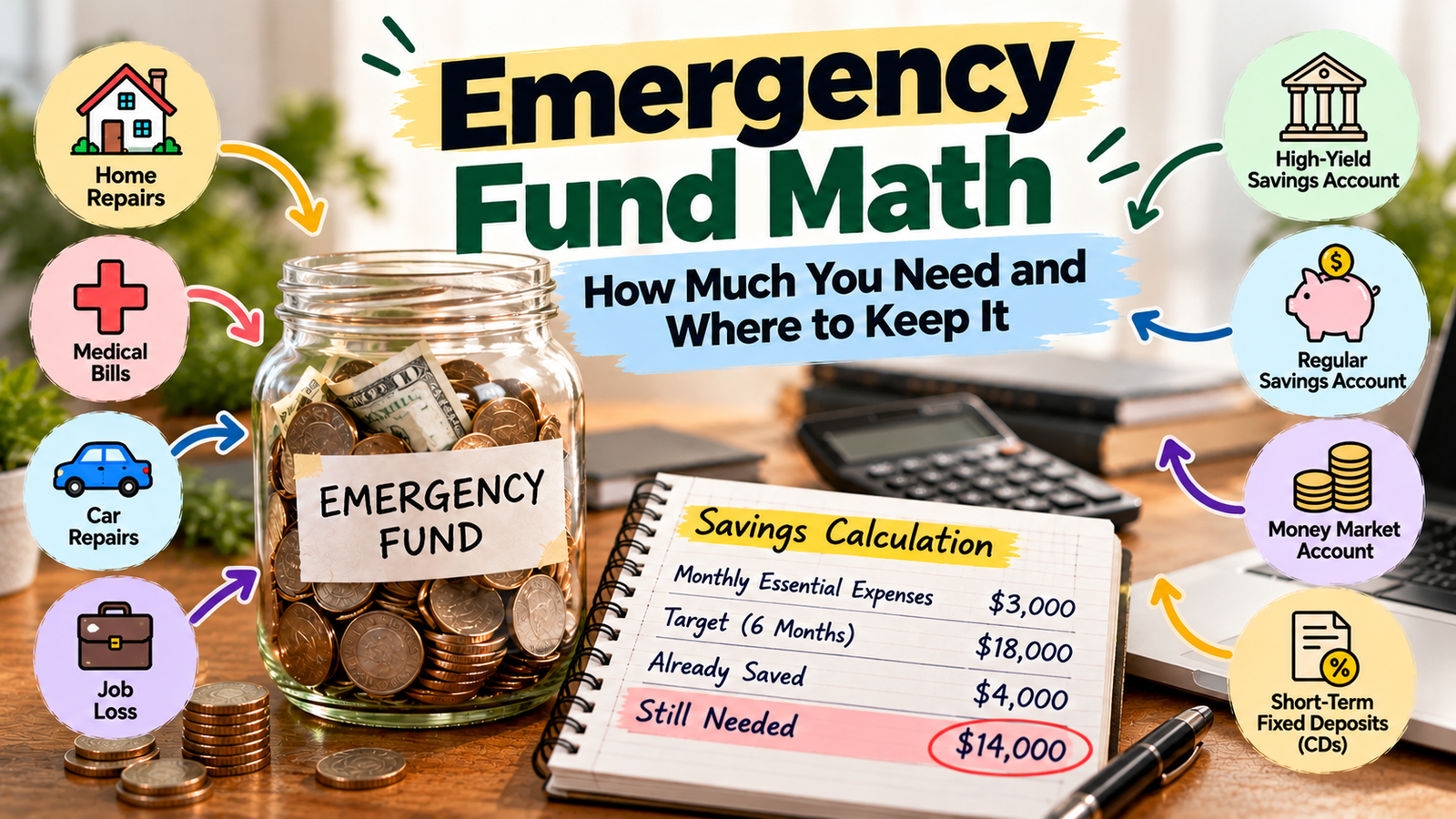
Emergency Fund Math: How Much You Need and Where to Keep It
Learn emergency fund math, calculate your ideal savings target, and discover where to keep your emergency fund accessible, secure, and earning interest.


An unexpected job loss, medical bill, urgent home repair, or car breakdown can disrupt months of financial planning. Yet many households still lack enough savings to manage a prolonged setback. According to the Federal Reserve’s Economic Well-Being of U.S. Households in 2025 report, published in May 2026, only 55% of adults said they had set aside enough money to cover three months of expenses. Another 30% said they could not cover three months of expenses through savings, borrowing, asset sales, or other means. These figures highlight why emergency fund math matters: you need a specific savings target based on your actual costs, not an arbitrary number pulled from a financial checklist.
The goal is to create a reserve that covers essential expenses when your regular income is interrupted. Getting the calculation right helps you avoid unnecessary debt, make better decisions under pressure, and protect investments meant for longer-term goals.
How Much Should Your Emergency Fund Cover?
A common guideline is to save three to six months of essential living expenses. Some households need more, particularly if income is unpredictable or several people depend on one earner.
Start by calculating what you would genuinely need to pay if you lost your income tomorrow. Include:
- Rent or mortgage payments
- Groceries and basic household supplies
- Electricity, water, internet, and essential phone bills
- Health insurance, medication, and necessary medical costs
- Transportation, fuel, and vehicle payments
- Minimum debt repayments
- Childcare, insurance, and other unavoidable commitments
Exclude expenses you could temporarily pause, such as restaurant meals, holidays, entertainment subscriptions, and discretionary shopping.
Emergency Fund Math: Calculate Your Target
Use this straightforward formula:
Emergency fund target = Essential monthly expenses × Number of months covered
Suppose your essential monthly expenses total $3,000. Your target would look like this:
| Coverage period | Monthly expenses | Emergency fund target |
|---|---|---|
| 1 month | $3,000 | $3,000 |
| 3 months | $3,000 | $9,000 |
| 6 months | $3,000 | $18,000 |
| 9 months | $3,000 | $27,000 |
A three-month reserve may suit someone with stable employment, another household income, and few dependants. Six months or more may be appropriate for freelancers, commission-based workers, single-income families, or people working in industries where finding a new job can take time.
Your target should reflect your circumstances rather than a universal rule. If you have expensive ongoing medical needs or support family members financially, include those obligations in the calculation.
How Quickly Can You Build Your Fund?
A large savings target can feel discouraging when you are starting from zero. Break it into milestones instead.
For example, if your six-month target is $18,000, your first goal could be $1,000, followed by one month of essential expenses, then three months, and eventually six.
Your monthly contribution determines how long it takes to reach each milestone. Saving $300 every month would produce $3,600 in a year before interest. At $500 per month, you would save $6,000 over the same period.
Set up an automatic transfer shortly after payday, even if the amount is modest. You can also direct part of a bonus, tax refund, or unexpected cash inflow into the fund. Review your contribution whenever your income or expenses change.
The practical value of an emergency fund is that it turns a vague intention to save into a measurable plan.
Where Should You Keep Your Emergency Fund?
The best account balances three priorities: safety, accessibility, and a reasonable return. An emergency reserve is not designed to maximise investment growth. It is there to be available when life becomes unpredictable.
1. High-yield savings account
A high-yield savings account is often a strong choice for the main reserve. It can earn interest while keeping money accessible for unexpected bills. Compare interest rates, minimum balances, withdrawal rules, account fees, and deposit insurance before opening one.
2. Regular savings or checking account
A separate savings account can help you distinguish emergency money from everyday spending. You might also keep a smaller amount in checking for immediate bills, with the rest held in savings.
Avoid keeping the entire fund in an account where daily spending makes it too easy to dip into the balance.
3. Money market deposit account
Depending on the bank and account terms, a money market deposit account may offer interest and convenient access to funds. Check minimum balance requirements, fees, transaction restrictions, and insurance coverage. Do not confuse a bank deposit account with a money market mutual fund, which is an investment product and does not carry FDIC deposit insurance.
4. Certificates of deposit
Certificates of deposit (CDs) can offer a fixed interest rate, but withdrawing money before maturity may trigger a penalty. Because emergencies rarely arrive on schedule, avoid locking your entire reserve into a product that restricts access. If you use CDs, keep enough readily available cash elsewhere and understand the withdrawal terms.
Stocks, cryptocurrency, and other volatile investments are generally poor choices for the core emergency fund. Their value can fall just when you need the money.
In the United States, eligible deposits at FDIC-insured banks are generally insured up to $250,000 per depositor, per insured bank, per ownership category. Credit union members should check applicable NCUA share insurance. Coverage rules differ by country, so confirm the protections available where you live.
When Should You Use the Fund?
Use your emergency reserve for necessary, unplanned expenses that cannot reasonably wait: an urgent repair, a medical bill, or essential costs during unemployment. A planned holiday, routine annual insurance premium, or predictable car service should normally come from a separate sinking fund.
If you withdraw money, rebuild it when your finances stabilise. Recalculate the target after major changes such as moving house, having a child, changing jobs, or taking on a mortgage.
The Bottom Line
A strong emergency fund starts with realistic numbers, not guesswork. Calculate essential monthly costs, choose a coverage period that reflects your risks, and keep the money somewhere secure and accessible. With consistent contributions and regular reviews, emergency fund math becomes a practical way to prepare for setbacks without sacrificing your long-term financial goals.
Emergency Fund Math: Frequently Asked Questions
1. Should I pay off debt before building an emergency fund?
Consider building a small starter reserve first so that an unexpected bill does not force you to borrow again. Then balance high-interest debt repayment with continued saving, based on your cash flow and obligations.
2. Should my emergency fund earn interest?
Yes, if you can earn interest without sacrificing safety or access. Compare account fees, rates, withdrawal terms, and deposit protection rather than choosing an account based on its advertised rate alone.
3. How often should I review my target?
Review it at least once a year and whenever your essential expenses, income, household size, or employment situation changes.
Also Read: Malaysia Airlines Economy Review: Seats, Food, Baggage and Service