
Walking 10000 Steps: What the Science Actually Says
If walking 10000 steps fits naturally into your lifestyle and you enjoy it, there is no scientific reason to stop. The problem comes when the number becomes an arbitrary pass-or-fail test.


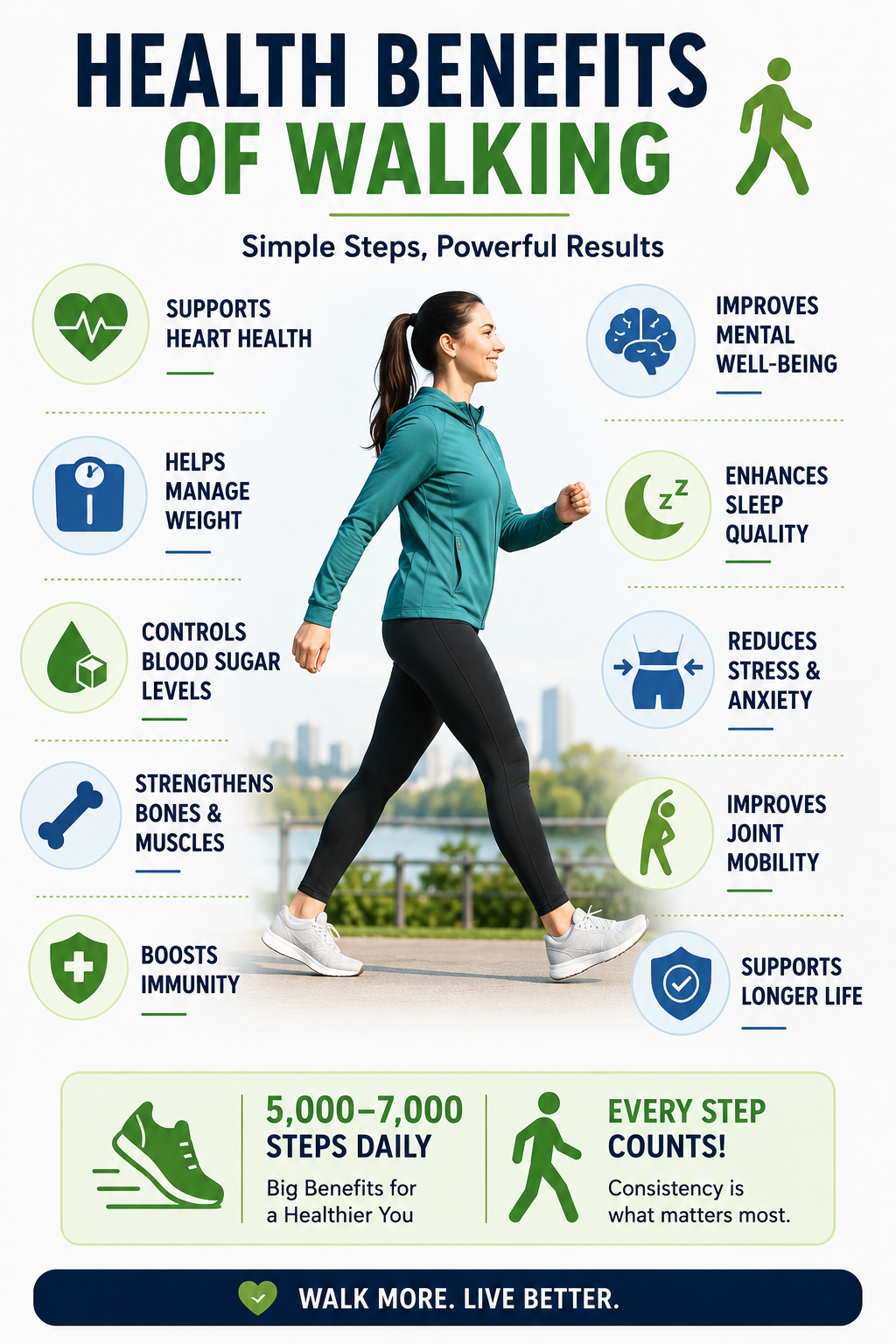
The idea of walking 10000 steps every day has become one of the most recognisable fitness targets, but the number itself is not a medical requirement. A 2025 systematic review and dose-response meta-analysis published in The Lancet Public Health examined 57 studies from 35 cohorts and found that health benefits became particularly meaningful around 5,000 to 7,000 daily steps. At 7,000 steps, compared with 2,000, researchers found associations with a 47% lower risk of death from any cause, 25% lower cardiovascular disease incidence, 38% lower dementia risk and 14% lower type 2 diabetes risk. The researchers also cautioned that these are associations from mostly observational studies, not proof that steps alone caused the reductions.

Where Did 10,000 Steps Come From?
The interesting part is that 10,000 was never established as a universal medical threshold. The number became popular after a Japanese pedometer marketing campaign in the 1960s and eventually became embedded in fitness culture.
That does not make 10,000 steps meaningless. Someone who comfortably reaches that level can continue doing so, and the 2025 Lancet analysis specifically noted that 10,000 remains a viable target for more active people. The important distinction is that you do not need to reach exactly 10,000 to obtain substantial health benefits.
What Happens Between 2,000 and 7,000 Steps?
This is where the newer research becomes particularly useful. The evidence does not show a magical point where walking suddenly becomes beneficial. Instead, health outcomes generally improve as daily movement increases, with several outcomes showing a curved relationship in which the gains become less pronounced at higher step counts.
In the Lancet analysis, the researchers found inflection points around 5,000 to 7,000 steps for all-cause mortality, cardiovascular disease incidence, dementia and falls. That means moving from a very low activity level toward 5,000 or 7,000 steps may offer considerably more health benefit than obsessing over the final few thousand steps.
| Daily Steps | What the Evidence Suggests |
|---|---|
| Around 2,000 | Very low activity baseline |
| 4,000-5,000 | Meaningful improvement begins |
| 5,000-7,000 | Strong health associations |
| Around 7,000 | Major benefits across outcomes |
| 10,000 | Useful target, not a requirement |
| Above 10,000 | Benefits can continue, but vary |
Walking Is More Than a Step Counter
One weakness of focusing exclusively on steps is that two people can reach the same number in very different ways. A person who spends the day moving around a workplace may accumulate thousands of low-intensity steps, while another person may complete a brisk 30-minute walk and accumulate fewer total steps.
Public-health recommendations therefore do not use a universal daily step target as their primary measure. The CDC recommends that adults get at least 150 minutes of moderate-intensity aerobic activity each week, such as brisk walking, plus muscle-strengthening activity on at least two days each week. It also emphasises that some physical activity is better than none.
That distinction matters. Reaching a step target should complement cardiovascular and strength training rather than replace them.
Does Walking Help Mental Health?
The evidence is not limited to heart health and longevity.
- The 2025 Lancet review found that 7,000 daily steps were associated with a 22% lower risk of depressive symptoms compared with 2,000 steps.
- The authors found a broadly linear relationship between step count and depressive symptoms rather than a single threshold at which the benefit suddenly appeared.
- A separate systematic review and meta-analysis published in JAMA Network Open in 2024 also examined daily steps and depression, reinforcing the broader relationship between greater daily movement and fewer depressive symptoms.
This does not mean walking is a treatment for depression by itself. It does, however, add to the evidence that regular movement has benefits extending beyond physical fitness.
What About Weight Loss?
- Walking uses energy, so increasing daily movement can contribute to a calorie deficit when combined with appropriate food intake.
- However, the number on a step counter should not be treated as a direct measure of weight loss.
- The CDC notes that physical activity increases the calories the body uses, but most weight loss generally comes from reducing calorie intake, while regular physical activity is important for maintaining weight loss.
This is why someone walking 10000 steps every day may not lose weight if their overall energy intake remains high. Conversely, a person walking 6,000 or 7,000 steps while maintaining an appropriate calorie balance can still make meaningful progress.
Practical Tips to Increase Your Steps
You do not need to add a long walk to an already packed schedule. Small changes can accumulate surprisingly quickly.
- Track your current baseline: Record your normal steps for a week before setting a target.
- Increase gradually: If you average 3,000 steps, moving toward 4,000 or 5,000 is more realistic than immediately demanding 10,000.
- Walk after meals: A short post-meal walk can add steps without requiring another dedicated workout.
- Break up sitting: Take brief walking breaks during long periods at a desk.
- Use everyday destinations: Walk to nearby shops, take stairs where practical or park farther away.
- Add one deliberate walk: A 15-30 minute brisk walk can raise both your step count and aerobic activity.
- Watch the trend: Your weekly average is more useful than becoming frustrated by one low-step day.
The CDC specifically recommends starting gradually and notes that physical activity can be divided into smaller periods rather than completed in one long session.
Should You Still Aim for 10,000?
If walking 10000 steps fits naturally into your lifestyle and you enjoy it, there is no scientific reason to stop. The problem comes when the number becomes an arbitrary pass-or-fail test.
For someone currently walking 2,000 steps, reaching 4,000 is progress. Moving toward 5,000 or 7,000 may provide substantial health benefits without requiring a dramatic lifestyle overhaul. For an already active person, 10,000 or more may be perfectly reasonable.
The better question is not whether you hit an exact number every day, but whether your overall activity is increasing and whether you are combining walking with enough moderate-intensity activity and strength work.
Frequently Asked Questions
1. Is 10,000 steps scientifically necessary?
No. The latest evidence suggests that substantial health benefits occur below 10,000 steps, particularly around 5,000-7,000 daily steps.
2. Are 7,000 steps better than 10,000?
Not necessarily. Seven thousand steps were associated with substantial benefits, but the research does not establish it as a new universal maximum or ideal target. More active people can continue walking beyond that level.
3. Can 5,000 steps improve health?
Yes. Research indicates that benefits begin well below 10,000 steps, although the exact effects vary by health outcome and individual characteristics.
The science has moved beyond the simple idea that walking 10000 steps is the minimum requirement for good health. Ten thousand remains a perfectly reasonable goal, but it is not a biological threshold. For many people, getting from a sedentary baseline toward 5,000-7,000 steps, adding some brisk walking and including strength training may be a more realistic and evidence-based approach.
Also Read: How to Learn a Language with iTalki: A Beginner’s Roadmap