
Chegg Study Review: Is It Worth It for College Students?
by parth@bidkinetic.com | Sep 1, 2026 | Education
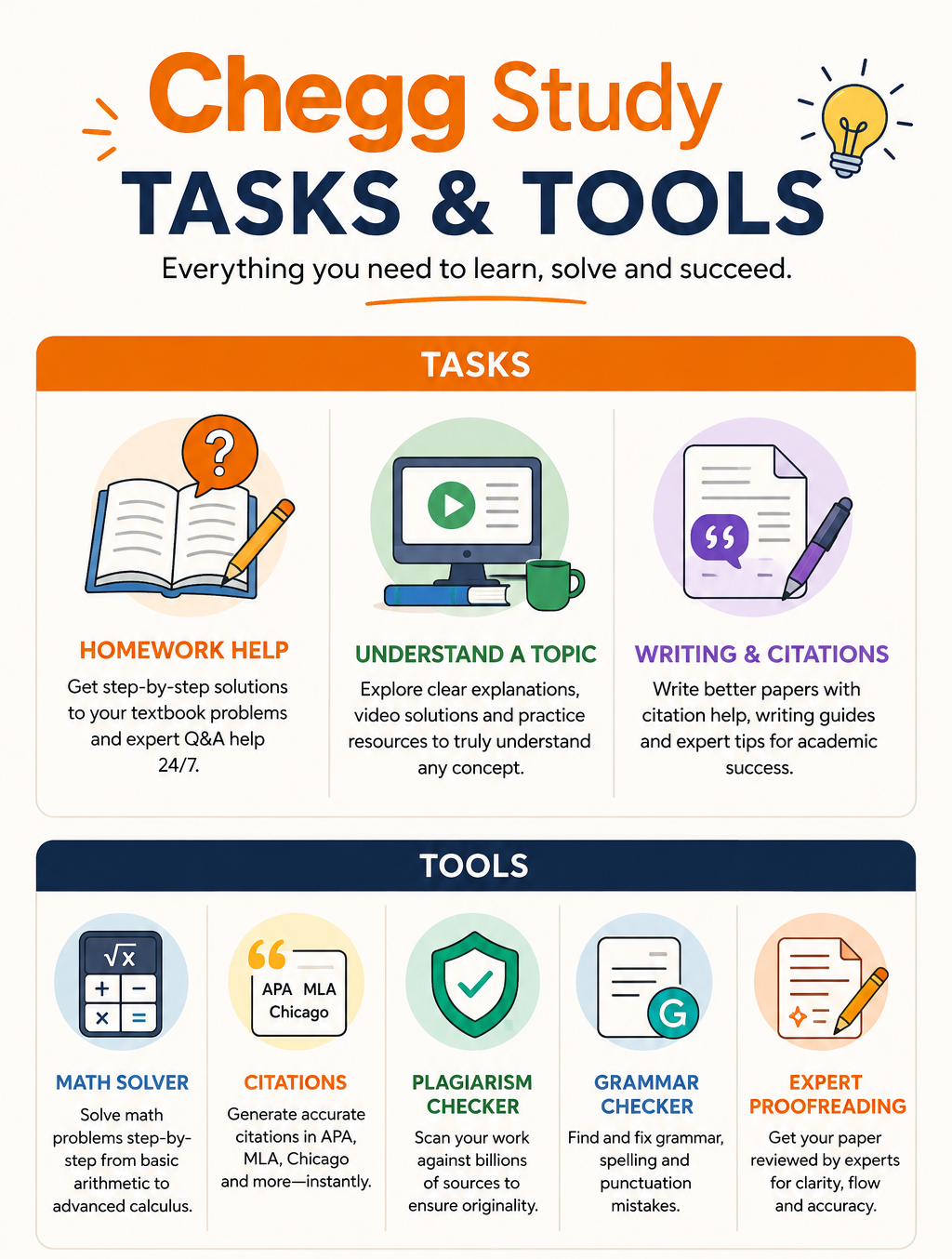
A useful Chegg Study review has to look beyond the familiar promise of “homework help.” Chegg currently positions Study as a broader learning platform offering searchable step-by-step solutions, 24/7 Expert Q&A, practice questions, flashcards and AI-powered study tools across dozens of subjects. Its current homework-help pages cover areas including mathematics, engineering, computer science, economics, physics and chemistry, while its Study pages emphasize explanations rather than simply displaying final answers.
That distinction matters for college students. Chegg can be genuinely useful when you’re stuck on a calculus problem at 11 p.m., trying to understand a textbook exercise before an exam, or checking whether your approach to an accounting or engineering problem makes sense. But its value changes dramatically depending on how often you use it, whether your textbook is supported, and whether you use solutions to learn or simply copy them.
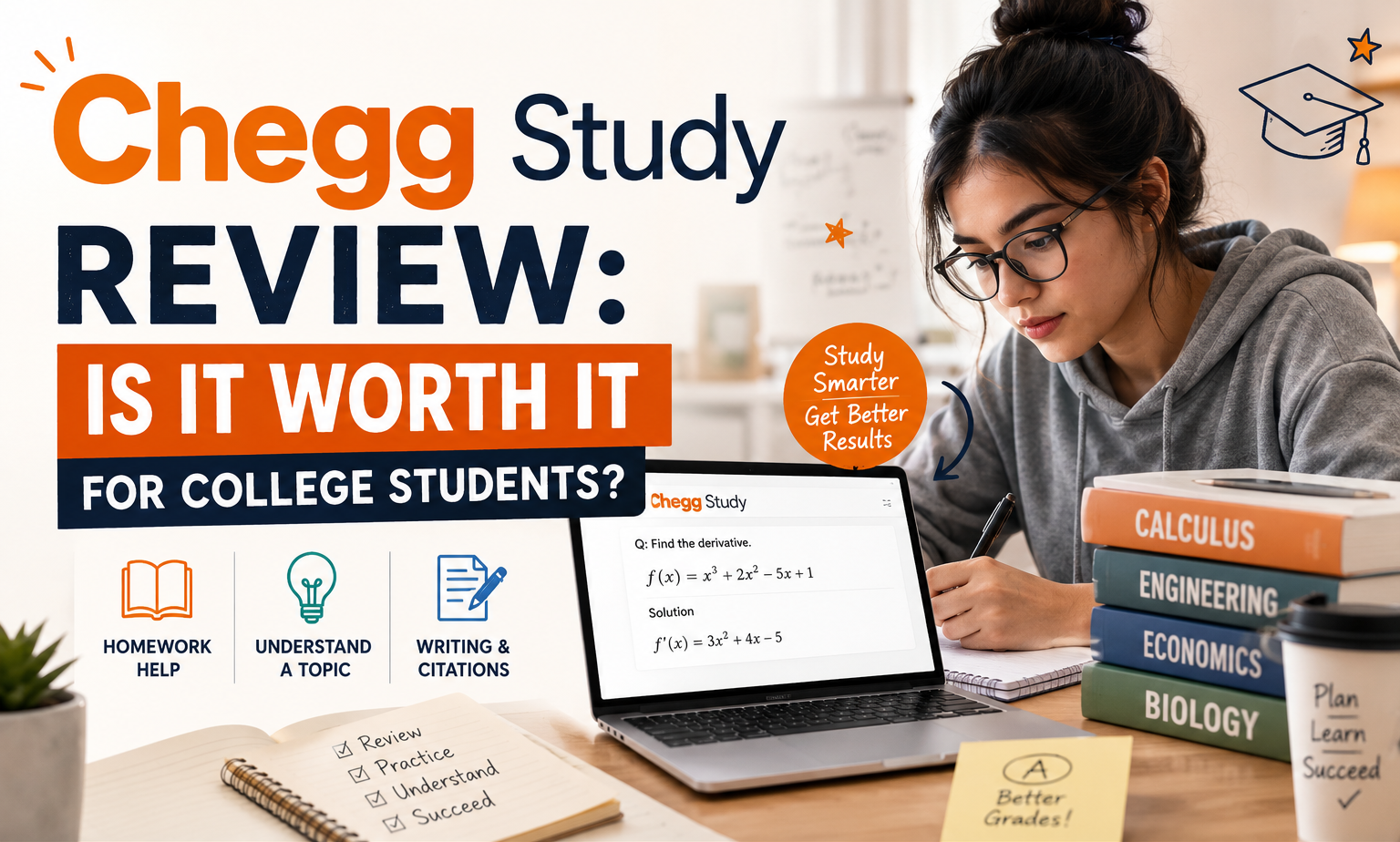
What You Actually Get With Chegg Study
The biggest attraction is the depth of its existing solution library. Chegg’s current Study offering advertises millions of textbook solutions alongside Expert Q&A, where students can submit questions for explanations. Its platform also includes practice-oriented tools such as flashcards and practice questions.
The textbook connection is particularly useful for students whose professors assign problems directly from a specific edition. Searching by textbook title, chapter and problem can be much faster than trying to find an equivalent problem elsewhere.
However, availability isn’t universal. A student should check whether their exact textbook edition and problem set are covered before paying for a subscription.
| Factor | What Chegg Offers | What Students Should Consider |
|---|---|---|
| Textbook solutions | Millions of solutions | Check your exact edition |
| Expert help | 24/7 Q&A | Useful for unfamiliar problems |
| Subjects | 50+ areas listed by Chegg | Depth varies by subject |
| Explanation style | Step-by-step solutions | Quality can vary |
| Practice | Questions, flashcards and study tools | Best used before exams |
| Mobile access | Web and app-based study | Convenient for quick checks |
| Academic integrity | Honor Code and answer blocking | Don’t use it for graded exams |
Where Chegg Saves the Most Time
The strongest use case isn’t necessarily getting an answer. It’s getting unstuck.
Imagine you’re working through a statistics problem and your calculation produces a different result from the textbook. Instead of spending another hour wondering whether the error occurred during the formula selection, substitution or arithmetic, a step-by-step solution can show where your method diverged.
The same applies to engineering and mathematics. A worked solution can reveal the sequence of operations that a lecture may have moved through too quickly.
Chegg’s current platform also uses AI-generated tips alongside some solutions, but those should be treated as supplementary guidance rather than unquestionable authority. Current Chegg pages show AI-generated tips being presented alongside full solutions and expert content.
That makes verification important, particularly in technical subjects where a small error in an intermediate step can completely change the result.
The Textbook Edition Problem Is Bigger Than It Looks
One of the easiest mistakes is assuming that a solution for the same textbook title will automatically match your assignment.
It may not.
A professor using the 11th edition can assign a problem that has a different number, altered wording or different data in the 10th edition. Even when the underlying concept is identical, submitting the wrong solution can send your studying in the wrong direction.
Before subscribing specifically for textbook answers, search Chegg using the exact ISBN, edition and problem number. If you can’t find several of your assigned problems, the subscription may not deliver the value you’re expecting.
There’s another recent change worth knowing: Chegg’s digital textbook service changed in July 2025. Chegg says its eTextbooks are now supplied by Valore, with flexible rental periods and tiered pricing.
So students shouldn’t assume that a Chegg Study subscription automatically means the same textbook-rental experience Chegg previously provided.
Chegg Is Most Useful Before the Deadline
The timing of your usage makes a surprising difference.
Using Chegg at the beginning of a study session can help you understand a difficult concept. Using it after you’ve attempted the problem yourself lets you compare your reasoning against the worked solution. Using it the night before an exam to copy 40 answers is much less useful because you’ve skipped the part where your brain actually builds the skill.
A practical method is:
Attempt → identify the mistake → check the explanation → redo without looking.
That final step is crucial. If you cannot reproduce the solution independently five minutes later, you probably haven’t learned the underlying concept.
The Academic Integrity Issue Cannot Be Ignored
This is where any serious Chegg Study review needs to be more cautious.
Chegg explicitly says its services are designed to support learning, not cheating. Its Honour Code prohibits using answers or solutions from the platform to cheat on exams or graded work. Chegg can investigate suspected violations, remove material and terminate accounts.
The company also operates Honor Shield, which allows verified educators to block access to answers matching their exam questions during an examination period.
For students, the practical rule is straightforward: if your professor’s syllabus or institution prohibits outside solution services for an assignment, don’t use Chegg for that work. Even if the platform technically allows you to access the material, your university’s academic-integrity rules take priority.
Is the Subscription Worth Paying For?
The answer depends heavily on usage.
A student taking quantitative courses and regularly getting stuck on textbook problems could extract substantial value from a subscription. Someone taking mostly essay-based classes and rarely needing worked solutions may get much less from it.
Before subscribing, calculate how often you’d realistically use it.
If you’re paying for one month and expect to use Chegg only twice, compare that cost against free alternatives such as office hours, tutoring provided by your college, library resources and professor-provided practice material. If you’re using it several times a week across multiple difficult courses, the economics become much more favourable.
Chegg has also changed its product mix over time, so students should check the current plan, included features and cancellation terms rather than relying on older reviews or screenshots.
Who Should Actually Use Chegg?
Chegg makes the most sense for students who:
- Regularly work from supported textbooks
- Need step-by-step explanations
- Take math, science, engineering or economics courses
- Study independently outside normal class hours
- Want an additional way to check their reasoning
It’s less compelling if you’re primarily looking for someone to complete assignments for you. Apart from the academic-integrity problem, that approach removes the exact practice you’re paying to improve.
Final Verdict on Chegg Study Review
The most accurate Chegg Study review verdict is that Chegg is a study accelerator, not a substitute for studying.
Its large solution library, Expert Q&A and on-demand explanations can be extremely useful when you’re stuck, particularly in technical college courses. The value is highest when your textbooks are well covered, and you use the platform to diagnose mistakes rather than copy answers.
For a student who uses it strategically several times a week, it can justify the cost. For someone looking for an answer machine, it is expensive and academically risky.
FAQs
1. Is Chegg Study good for college students?
Yes, particularly for students in quantitative and technical courses where step-by-step textbook solutions are useful. Its current platform covers subjects including mathematics, engineering, computer science, science and economics.
2. Can Chegg answers be wrong?
They can be. Students should compare solutions with lecture notes, textbooks and their professor’s methods, especially when an answer seems inconsistent.
3. Is using Chegg considered cheating?
Not automatically. Chegg says its services are intended to support learning, but using its answers for active exams or prohibited graded work violates its Honor Code.
Also Read: How to Start a Blog in 2026: The Complete Beginner’s Guide