
by parth@bidkinetic.com | Nov 25, 2026 | LifeStyle
Sending money internationally can cost more than the transfer fee displayed on the payment screen. The difference often comes from the exchange rate itself. A bank or money transfer provider may advertise a low transfer fee while offering a conversion rate that is less favorable than the market reference rate. Understanding exchange rates helps you identify this hidden cost and make sure more of your money reaches its destination.
For example, imagine you are sending $1,000 from the United States to someone in Europe. If the reference rate is $1 = €0.92, the conversion would produce €920 before fees. But if your provider offers €0.89 per dollar, the recipient gets only €890. That is a €30 difference, even before considering the transfer charge. This is why comparing providers based only on their advertised fees can be misleading.
The good news is that you do not need to understand currency trading to make smarter transfer decisions. You simply need to know how rates are calculated, where providers add their margins and how to compare the actual amount your recipient will receive.
What Are Exchange Rates and How Do They Work?
An exchange rate tells you how much one currency is worth in relation to another. For example, if USD/EUR is 0.92, one US dollar can be exchanged for 0.92 euros.
Currency values change because of several factors:
- Interest rates: Higher interest rates can attract foreign investment and influence demand for a currency.
- Inflation: Countries with relatively high inflation may experience pressure on their currency’s purchasing power.
- Economic performance: Employment, trade, economic growth and business confidence influence currency demand.
- Political developments: Elections, policy changes and geopolitical uncertainty can affect investor confidence.
- Market demand: Businesses, investors, banks and governments continuously buy and sell currencies.
These movements happen throughout the global foreign exchange market. As a result, the rate you see today may differ from the rate available when you actually complete a transfer.
What Is the Mid-Market Rate?
The mid-market rate is the midpoint between the buying and selling prices quoted in the currency market. It is commonly used as a reference when comparing currency conversion offers.
However, it is important to understand that the mid-market rate is not necessarily the rate a consumer can obtain. Banks and transfer companies may add a margin, often called an exchange-rate markup or spread, to cover costs and generate revenue.
For example:
| Transfer detail |
Provider A |
Provider B |
| Amount sent |
$1,000 |
$1,000 |
| Reference rate |
€0.92 |
€0.92 |
| Offered rate |
€0.90 |
€0.915 |
| Transfer fee |
$5 |
$10 |
| Amount after conversion |
€900 |
€915 |
In this example, Provider B charges a higher upfront fee but offers a better conversion rate. The recipient receives €15 more before considering any additional receiving-bank charges.
This illustrates why the cheapest-looking transfer is not always the most affordable.
Where Do Money Transfer Providers Make Their Money?
When comparing exchange rates, pay attention to more than the advertised transaction fee. Providers may earn revenue through several charges.
- Exchange-rate markup: The provider offers a rate less favorable than its reference or wholesale rate. The difference represents an additional conversion cost.
- Transfer fees: A fixed or percentage-based charge for processing the transaction.
- Receiving fees: The recipient’s bank or an intermediary institution may deduct a charge before the money reaches the final account.
- Payment method charges: Paying by credit card or certain other methods may cost more than funding the transfer through a bank account.
- Currency conversion charges: Some banks and card providers apply additional fees when converting purchases or withdrawals made in foreign currencies.
The Consumer Financial Protection Bureau (CFPB) explains that international remittance costs can include provider fees, third-party charges, taxes and the exchange-rate spread. These costs can vary between providers and transfer routes.
How to Find the Real Exchange Rate Before Sending Money
The most reliable way to compare providers is to focus on the final amount received rather than the promotional rate.
Follow these steps:
1. Check an independent reference rate. Look up the current mid-market rate using a currency converter or financial information service. Treat it as a comparison benchmark, not a guaranteed transaction rate.
2. Enter the same transfer amount with different providers. Compare the same currencies, payment method and delivery option. Changing these details can change the offered rate and fees.
3. Check the complete fee breakdown. Look for transfer charges, taxes, payment-method fees, and any disclosed third-party costs.
4. Compare the recipient’s final amount. This is the most useful figure because it reflects the conversion and applicable disclosed charges.
5. Check the delivery time. An instant transfer may cost more than a bank deposit that takes one or two business days. Decide whether the speed is worth the additional expense.
What US Consumers Should Know About International Transfer Disclosures
In the United States, covered remittance transfer providers generally must disclose important transaction details before payment. Under the CFPB’s Remittance Rule, these can include the transfer amount, applicable fees and taxes, exchange rate, covered third-party fees and the amount expected to reach the recipient.
You should receive a transaction receipt with the relevant information after paying. Some additional third-party fees or taxes may still apply, so read the disclosures carefully.
These protections generally apply to qualifying transfers of more than $15 sent by covered providers to recipients in another country. The CFPB also explains that consumers may have cancellation and error-resolution rights for qualifying transfers.
You can review the rules at the CFPB’s official remittance transfer guidance.
Common Mistakes to Avoid When Sending Money Abroad
| Common mistake |
Why it can cost you |
Better approach |
| Choosing the lowest transfer fee |
The provider may offer a poor conversion rate |
Compare the final amount received |
| Ignoring the exchange-rate margin |
Markups can reduce the converted amount |
Compare against a reference rate |
| Sending without checking the currency |
Recipient may face another conversion |
Confirm the receiving currency |
| Always choosing instant delivery |
Faster transfers may cost more |
Compare standard and express options |
| Ignoring receiving-bank fees |
Additional deductions may occur |
Check recipient-bank charges |

Get More Value From Every International Transfer
International payments should not be judged by transfer fees alone. A small difference in the offered rate can become significant when you send larger amounts or make regular payments. Understanding exchange rates, identifying conversion markups and comparing the final amount received can help you avoid unnecessary costs. Before confirming your next transfer, take a moment to compare the full transaction rather than focusing on the headline rate. That simple habit can help more of your money reach the people or businesses you intend to pay.
FAQs About Currency Exchange and International Transfers
1. Why is the exchange rate different at banks and money transfer apps?
Each provider sets its own customer rate and may include a margin over a wholesale or reference rate. Its operating costs, pricing strategy and transfer route can influence the final offer.
2. Is the mid-market rate the real exchange rate?
It is a useful market reference, but not necessarily the rate available to individual customers. Providers may offer a different rate after applying their margins.
3. Is it better to send money when exchange rates are high?
It depends on which currency you are sending and receiving. A stronger sending currency generally buys more of the receiving currency, but rates can change unexpectedly. For regular transfers, consistency and total costs may matter more than trying to predict short-term movements.
Also Read: How to Read Your Credit Report (and Dispute Errors That Cost You)

by parth@bidkinetic.com | Nov 25, 2026 | Business
Earning extra money is easier to start than ever, but building a side income that grows beyond a few hundred dollars a month is a different challenge. Selling handmade products, freelancing, creating digital downloads or offering online services can generate additional income, but the real opportunity lies in choosing a model that does not depend entirely on the hours you personally work. As more Americans explore independent work and digital businesses, side income ideas are shifting from occasional gigs towards repeatable services, subscription products and online businesses that can reach customers beyond a local market.
The opportunity is significant, but so is the competition. The US Bureau of Labor Statistics reported that 8.9 million people held multiple jobs in September 2025, representing around 5.4% of employed people. This reflects the importance of additional income for many households, although not all multiple-job holders are running businesses.
In 2027, the smartest approach is not necessarily finding another job after work. It is building an income stream around a skill, product or system that can serve more customers without increasing your workload at the same rate. Here are practical opportunities worth considering.
Freelancing That Becomes a Small Agency
Freelancing remains one of the easiest ways to start earning because you can sell skills you already have. Services such as website development, graphic design, copywriting, SEO, video editing and bookkeeping have clear business applications.
However, working independently puts a limit on your earnings: there are only so many hours you can sell. The scalable approach is to specialise in one service, develop repeatable processes and eventually bring in contractors or employees.
For example, a freelance SEO specialist could move from individual blog assignments to monthly SEO retainers for small businesses. Once delivery processes are documented, a small team can handle more clients.
How it scales: Recurring contracts, specialised packages, standardised delivery and a small team.
Digital Products and Online Templates
Digital products are attractive because you create the product once and can sell additional copies without manufacturing or shipping each order.
Potential products include:
- Budget planners and financial spreadsheets.
- Notion templates and productivity systems.
- Social media content calendars.
- Resume and business proposal templates.
- Online guides, workbooks and educational resources.
A practical example is a freelancer creating a collection of client onboarding templates. Instead of repeatedly building documents for every client, the freelancer can sell a ready-to-use version through an online marketplace or personal website.
How it scales: Search visibility, email marketing, product bundles and repeat purchases.
Niche Content Websites and Newsletters
A website or newsletter focused on a specific audience can generate income through advertising, affiliate partnerships, sponsorships and paid subscriptions.
Rather than publishing about everything, choose a subject with a clear audience and commercial interest. Examples include personal finance for young professionals, home improvement, sustainable living, travel planning or software tutorials.
The important distinction is that content should solve a genuine problem. A website that attracts readers searching for product comparisons or practical advice may have stronger commercial opportunities than one relying entirely on general-interest articles.
How it scales: Search traffic, email subscribers, affiliate content and sponsorship partnerships.
AI-Powered Services for Small Businesses
AI is creating opportunities for people who understand how to apply technology to everyday business problems. Many small businesses need help with marketing, customer communication, data organisation and repetitive administrative tasks.
You could offer services such as:
- Setting up automated customer enquiry responses.
- Creating AI-assisted content workflows.
- Building simple chatbots for websites.
- Automating appointment reminders and lead follow-ups.
- Creating reporting dashboards for business owners.
The opportunity is not simply selling access to an AI tool. It is solving a business problem. For example, a local service company may pay for a system that captures enquiries, organises customer details and sends follow-up messages.
The Federal Reserve Bank of San Francisco reported in 2026 that nearly 40% of small-business respondents had used or planned to use AI, including for marketing, customer service, analytics and productivity.
How it scales: Monthly maintenance packages, reusable automation templates and industry-specific solutions.
E-Commerce and Niche Online Stores
Selling products online can become a scalable business when you build a recognisable product range and a reliable customer acquisition strategy.
Instead of opening a general store with hundreds of unrelated products, focus on a defined market. Examples include personalised gifts, pet accessories, specialist hobby products, sustainable household goods or products for a particular profession.
You can start with a small catalogue, test demand and expand based on actual sales. Digital marketing, customer reviews, email campaigns and repeat-purchase offers become increasingly important as the business grows.
How it scales: A focused product catalogue, repeat customers, fulfilment partnerships and multiple sales channels.
Online Courses, Coaching and Paid Communities
If you have professional experience or specialist knowledge, you can turn it into educational products. This might include teaching Excel, coding, photography, language skills, career development or business operations.
You could begin with one-to-one coaching, identify the questions customers repeatedly ask and turn those lessons into a recorded course, downloadable workbook or group programme.
A paid community can provide recurring revenue through workshops, resources and member discussions. However, it needs ongoing value; simply charging for access to a private group rarely creates long-term retention.
How it scales: Recorded courses, group coaching, memberships and educational partnerships.

Which Side Income Ideas Have the Best Scaling Potential?
| Income model |
Initial investment |
Revenue potential |
Main scaling opportunity |
| Freelancing to agency |
Low–medium |
High |
Team and retainers |
| Digital products |
Low |
High |
Repeat sales |
| Content websites/newsletters |
Low–medium |
High, but gradual |
Audience and sponsorships |
| AI-powered services |
Low–medium |
High |
Automation and recurring contracts |
| Niche e-commerce |
Medium |
High |
Product range and fulfilment |
| Online courses/coaching |
Low–medium |
High |
Courses and memberships |
These are relative business-model assessments, not guaranteed earnings. Results depend on demand, execution, competition and operating costs.
What Makes a Side Income Actually Scalable?
Not every profitable side hustle becomes a scalable business. A delivery gig may generate immediate cash, but earning more generally requires working more hours. A digital product or subscription service can potentially generate additional sales without requiring the same increase in working time.
Look for these characteristics when evaluating side income ideas:
- Repeatable demand: Customers need the product or service regularly.
- Healthy margins: Revenue remains worthwhile after platform fees, software, advertising and delivery costs.
- System-based delivery: You can document tasks and eventually delegate them.
- Customer retention: People have a reason to return, renew or recommend your business.
- Reach beyond your location: You can serve customers online rather than depending entirely on local demand.
A Practical 90-Day Plan to Build Your Side Income
Instead of launching several projects simultaneously, use the first three months to test one business model.
| Timeline |
What to focus on |
Target outcome |
| Days 1-30 |
Select a niche, research competitors and identify customer problems |
A clear offer |
| Days 31-60 |
Build a basic product or service and approach potential customers |
First paying customers |
| Days 61-90 |
Collect feedback, improve delivery and introduce repeat-purchase options |
A repeatable sales process |
Start small and avoid spending heavily on branding, inventory or advertising before validating demand. Keep separate records of business income and expenses, understand your tax obligations and set aside money for taxes. In the US, side-business income may be taxable even when you receive payments through online platforms.
Build an Asset, Not Just Another Job
The most promising side income ideas for 2027 are not necessarily the trendiest ones. They are the businesses that solve specific problems, attract repeat customers and become easier to operate as systems improve.
Start with a skill or market you understand, secure your first paying customers and reinvest carefully. Whether you choose freelancing, AI automation, digital products or e-commerce, the real objective is to build something that can grow without requiring every additional dollar to come from another hour of your time.
FAQs About Side Income Ideas
1. Which side income has the highest potential in 2027?
There is no guaranteed winner. AI-powered business services, digital products, niche e-commerce and specialised freelancing have attractive scaling characteristics because they can reach customers beyond your immediate location.
2. Can I start a side business with $500?
Yes. Freelancing, digital templates, online tutoring and certain AI-assisted services can be started with relatively little capital. Focus on validating demand before investing in expensive tools or advertising.
3. How long does it take for a side hustle to become profitable?
It depends on the business model, customer demand and your ability to acquire customers. Service businesses may generate revenue sooner, while content websites and digital products often take longer to build consistent sales.

by parth@bidkinetic.com | Nov 25, 2026 | LifeStyle
Splitting a $200 purchase into four payments of $50 can make an expensive purchase feel much easier to manage. That convenience explains why buy now pay later (BNPL) has become a popular payment option across US online stores and retail checkout pages. But smaller installments do not necessarily mean a purchase is affordable. You still owe the full amount, and several overlapping payment plans can quietly consume a large part of your next paycheck.
The Federal Reserve’s 2025 Survey of Household Economics and Decisionmaking found that 16% of US adults used BNPL in the previous 12 months, up from 10% in 2021. More importantly, 26% of BNPL users reported making a payment late in 2025. Among those who paid late, 64% said they incurred an additional charge. These figures show why convenience needs to be balanced with careful planning.
So, is BNPL a useful financial tool or simply another way to accumulate debt? The honest answer is that it depends on what you are buying, how you plan to repay it and whether you could comfortably afford the purchase without splitting the payment.
How Does Buy Now, Pay Later Work?
Most popular pay-in-four plans divide a purchase into four installments, usually paid over approximately six weeks. You typically pay the first installment at checkout, followed by three payments every two weeks.
For example, a $400 purchase could look like this:
| Payment |
Amount |
When |
| First payment |
$100 |
At checkout |
| Second payment |
$100 |
Two weeks later |
| Third payment |
$100 |
Four weeks later |
| Final payment |
$100 |
Six weeks later |
| Total |
$400 |
|
Many pay-in-four plans advertise zero interest when payments are made on schedule. However, late fees, returned-payment charges or other conditions may apply depending on the provider.
Longer-term installment plans are different. Some charge interest, may require a credit check and can have repayment periods extending over several months. Always read the specific loan agreement rather than assuming every BNPL option is interest-free.
When Is BNPL Actually a Good Idea?
BNPL can be reasonable when it solves a short-term payment-timing problem without creating a long-term financial problem.
1. You already have the money
Suppose you have $400 available for a necessary purchase but prefer to keep more cash in your checking account until your next payday. A genuinely interest-free plan with no additional fees may offer flexibility. The important distinction is that you can already afford the full purchase.
2. The purchase is planned and necessary
Replacing a broken household appliance or purchasing an essential work item may justify spreading payments, provided the installments fit your budget. The product should serve a genuine need rather than create a reason to spend.
3. You understand the repayment schedule
You know exactly when each installment will be deducted, have enough money in the linked account and have considered upcoming bills. Automatic payments can help, but only if your account has sufficient funds.
4. The total cost is genuinely lower
Compare the BNPL price with the cash price and other financing options. If the plan has no interest or fees and does not encourage extra spending, it may be a practical payment choice.
When Should You Avoid Buy Now, Pay Later?
The biggest mistake is treating BNPL as extra spending power. It is borrowed money, even when the provider does not charge interest.
1. You are using it because you cannot afford the purchase
If you need four installments just to make an ordinary purchase fit your budget, ask whether the expense should be delayed. Financing groceries, everyday essentials, or routine bills can indicate that your monthly cash flow needs attention rather than another payment obligation.
2. You already have multiple payment plans
Four separate purchases may look manageable individually, but their repayment dates can overlap. A $50 payment here, $75 there, and another $100 next week can quickly become a significant commitment.
3. You are buying something impulsively
Retailers often display installment amounts more prominently than the full price. Seeing “$25 today” instead of “$100 total” can make unnecessary purchases feel affordable. If you would not buy the item at its full price, reconsider using BNPL.
4. You are already carrying expensive debt
If you have high-interest credit card balances or struggle to pay existing bills, adding another repayment schedule can make your finances harder to manage.
BNPL vs Credit Cards vs Paying in Full
Not every payment option has the same cost or consequences. Compare the alternatives before choosing.
| Factor |
Buy Now, Pay Later |
Credit Card |
Pay in Full |
| Initial payment |
Often partial |
Usually none beyond purchase |
Full amount |
| Interest |
Often zero for pay-in-four; varies for longer plans |
Applies if balance is carried |
None |
| Payment schedule |
Fixed installments |
Minimum or full statement balance |
No future installments |
| Late-payment consequences |
Fees and possible collections |
Fees, interest and possible credit impact |
None |
| Credit reporting |
Varies by provider and product |
Generally reported |
No borrowing record |
| Best use |
Planned short-term purchases |
Convenient purchases with disciplined repayment |
Purchases within available cash |
One important difference is credit reporting. Traditional credit cards generally report account activity to major credit bureaus. Many pay-in-four plans have historically not reported routine payments, although policies vary and unpaid debts sent to collections may appear on credit reports. Some longer-term BNPL loans may also involve credit checks and reporting. Do not assume timely installments will automatically improve your credit score.
A Simple Framework Before You Choose BNPL
Before accepting an installment offer, ask yourself these five questions:
- Can I afford the full price? If not, consider postponing the purchase.
- Is it necessary? Separate genuine needs from impulse purchases.
- What is the total cost? Check interest, late fees and other charges.
- Do I have overlapping payments? Add all existing installment obligations together.
- Will the payment affect essential bills? Rent, utilities, insurance, groceries and savings should not suffer.
Consider a $600 purchase split into four payments of $150. You already have $600 available; your next three paychecks can comfortably cover the scheduled deductions, and the plan has no interest or fees. This may be reasonable.
Now imagine you have only $100 left after paying essential expenses and already owe $200 in upcoming installments. Adding another $150 payment is not a smart decision, even if the checkout page makes it look manageable.

How to Use BNPL Without Losing Control
If you decide to use buy now pay later, establish a few boundaries:
- Limit yourself to one active plan whenever possible.
- Record every installment and due date in your calendar.
- Keep enough money in your linked account before automatic withdrawals.
- Read the late-payment and returned-payment policies.
- Avoid using one BNPL plan to cover another financial obligation.
- Review your total outstanding installments every payday.
You can also use a simple spreadsheet or budgeting app to track provider names, purchase amounts, remaining balances and upcoming payment dates. This is particularly helpful when shopping across multiple websites.
FAQs About Buy Now Pay Later
1. Does BNPL affect your credit score?
It depends on the provider and product. Some pay-in-four plans do not report regular payments, while longer-term financing may involve credit checks and credit reporting. Accounts sent to collections may also affect your credit history.
2. Is buy now pay later better than a credit card?
Not automatically. Interest-free BNPL may be cheaper than carrying a credit card balance, but credit cards can offer stronger consumer protections and rewards. Compare fees, repayment terms and your ability to pay.
3. What happens if you miss a BNPL payment?
Depending on the provider, you may face late fees, account restrictions, collection activity or potential credit-reporting consequences. Check your agreement for the exact policy.

by parth@bidkinetic.com | Nov 25, 2026 | LifeStyle
Your bank account may be costing you more than you realise. A monthly maintenance charge here, an out-of-network ATM withdrawal there, or an overdraft fee after a small payment can quietly reduce your available balance. These hidden bank fees are not always obvious when you open an account, and some only appear when you use particular services or fail to meet account conditions. According to the Financial Health Network’s 2025 FinHealth Spend Report, US consumers paid an estimated $20.3 billion in deposit account fees during 2024, including maintenance, ATM and overdraft or non-sufficient funds (NSF) fees. Overdraft and NSF fees alone accounted for approximately $12.1 billion.
The frustrating part is that many of these charges are avoidable. Understanding your bank’s fee schedule, checking transaction descriptions and changing a few everyday banking habits can help you keep more of your money. Here’s where these charges hide and what you can do about them.
Monthly Maintenance and Minimum Balance Fees
Some checking and savings accounts charge a monthly service fee simply for keeping the account open. Others waive the charge only if you maintain a minimum daily balance, receive qualifying direct deposits or meet certain transaction requirements.
For example, an account might charge $12 every month if you do not maintain a $1,500 minimum balance. That adds up to $144 annually.
How to stop it:
- Check the minimum balance requirements in your account agreement.
- Set up qualifying direct deposits if that is the easiest waiver condition.
- Ask your bank whether it offers a no-monthly-fee checking account.
- Compare free checking options from other banks and credit unions.
- Do not keep extra money idle just to avoid a fee if another account offers better terms.
Out-of-Network ATM Fees
Withdrawing cash from an ATM outside your bank’s network can trigger two separate charges: one from the ATM operator and another from your own bank.
Bankrate’s 2024 checking account survey found that the average combined cost of an out-of-network ATM withdrawal was $4.77. Frequent withdrawals can make this an expensive habit.
How to stop it:
- Use your bank’s ATM locator before withdrawing cash.
- Choose banks that reimburse out-of-network ATM fees.
- Consider cash-back options at participating grocery stores.
- Withdraw a reasonable amount at once rather than making several small withdrawals.
Overdraft and Non-Sufficient Funds (NSF) Fees
Overdraft fees occur when a bank pays a transaction even though your account does not have enough available money. NSF fees may apply when a payment or check is returned unpaid because funds are insufficient.
These charges can be particularly frustrating because one low balance can affect multiple transactions. Bankrate reported an average overdraft fee of $27.08 in its 2024 survey.
How to stop it:
- Enable low-balance alerts through your banking app.
- Maintain a small account buffer for unexpected payments.
- Review pending transactions and automatic bill payments.
- Consider linking a savings account for overdraft transfers, after checking the transfer fee.
- Review whether you have opted into debit card overdraft coverage.
Under federal rules, banks generally need your affirmative consent before charging overdraft fees on ATM withdrawals and one-time debit card transactions. You can ask your bank to remove this coverage if you no longer want it. However, checks and recurring electronic payments can still create overdrafts.
Paper Statement and Account Service Fees
Some banks charge for printed monthly statements, cashier’s checks, stop-payment requests, wire transfers or expedited replacement cards. These charges may not appear every month, making them easy to overlook.
How to stop it:
- Switch to electronic statements if they are free.
- Check the cost of cashier’s checks and wire transfers before requesting them.
- Ask about free standard card replacement.
- Review service charges before confirming a transaction.
Foreign Transaction and Currency Conversion Fees
Travelling internationally or shopping from overseas websites can trigger foreign transaction fees. These are commonly charged as a percentage of the purchase amount, depending on your card’s terms. Currency conversion services may also use an exchange rate that includes an additional markup.
For example, a 3% foreign transaction fee on $1,000 of purchases adds $30 to your bill.
How to stop it:
- Use a debit or credit card with no foreign transaction fees.
- Check your card’s international usage terms before travelling.
- When paying abroad, choose the local currency rather than accepting dynamic currency conversion into US dollars, and compare the displayed exchange rate.
- Avoid unnecessary cash withdrawals from international ATMs.
Common Bank Fees at a Glance
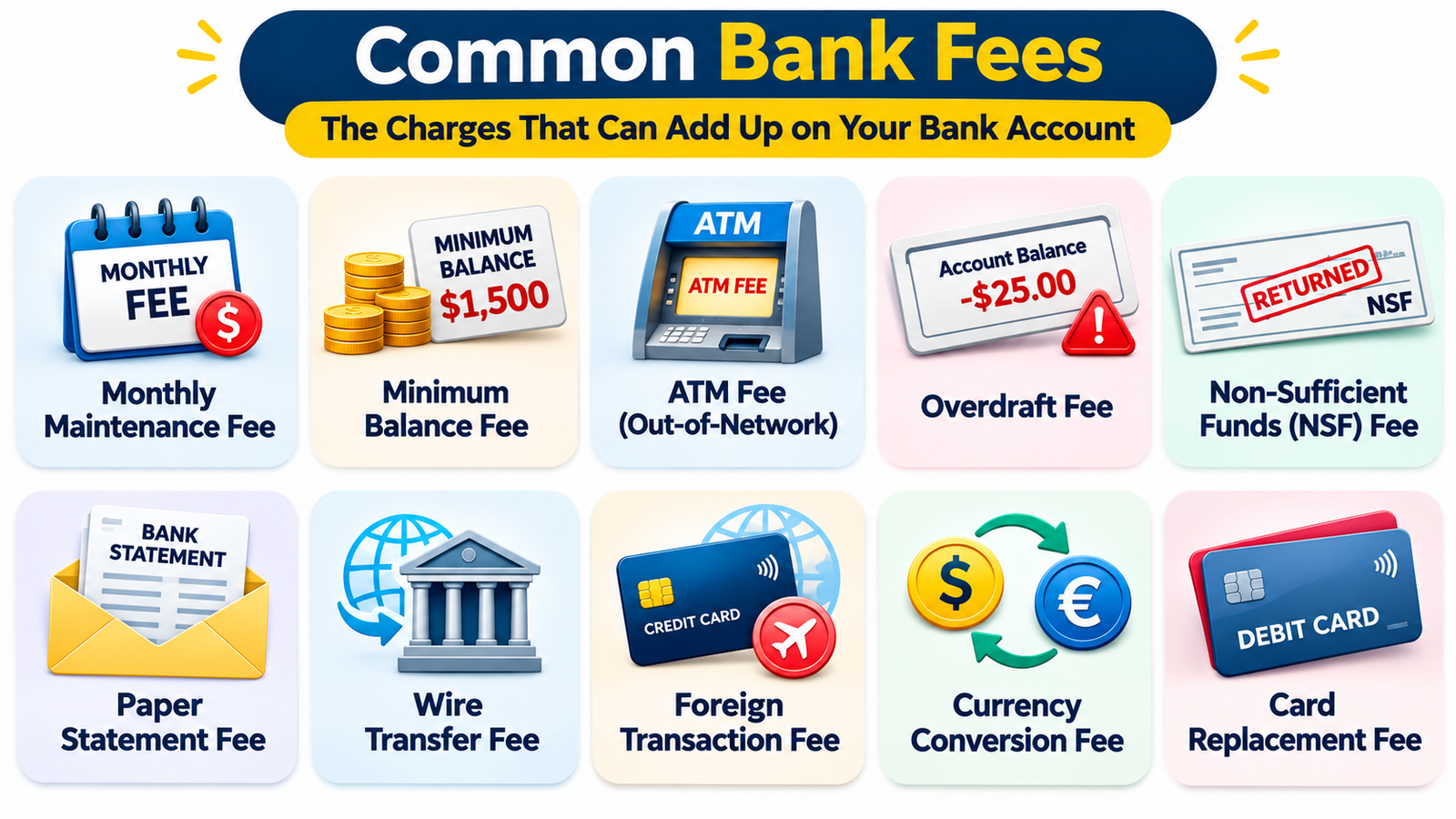
| Fee type |
When it occurs |
How to avoid it |
| Monthly maintenance |
Account conditions are not met |
Choose a fee-free account |
| Minimum balance |
Balance falls below the required amount |
Check waiver conditions |
| ATM fee |
Using an out-of-network ATM |
Use in-network ATMs |
| Overdraft |
Bank pays a transaction with insufficient funds |
Enable alerts and manage balances |
| NSF |
Payment is returned unpaid |
Monitor scheduled payments |
| Paper statement |
Printed statements are requested |
Switch to e-statements |
| Wire transfer |
Sending money through a wire service |
Compare transfer options |
| Foreign transaction |
Eligible international purchases |
Use a no-foreign-fee card |
How to Find Hidden Bank Fees in Your Statements
The best way to identify hidden bank fees is to review your transactions rather than checking only your ending balance.
Start by downloading the last three months of bank statements. Search for descriptions such as monthly service fee, ATM surcharge, overdraft, NSF, wire transfer and account service charge. Then compare the charges with your bank’s official fee schedule. If you do not understand a charge, contact customer service and ask what triggered it, whether it can be waived and how to prevent it from happening again.
You can also use transaction alerts and budgeting apps to monitor recurring charges. A monthly review helps identify fees before they become a regular expense.
Keep More of Your Money
Bank fees may look small individually, but repeated charges can add up over a year. The solution is not necessarily to change banks immediately. Start by understanding your account conditions, identifying recurring charges and asking which fees can be waived. By monitoring your statements and avoiding unnecessary services, you can reduce hidden bank fees and make your everyday banking less expensive.
FAQs About Bank Fees
1. Can banks charge fees without notifying customers?
Banks generally have disclosure obligations for deposit account fees, but charges can still surprise customers when they overlook account conditions or service terms. Review your account agreement and fee schedule.
2. Can I ask my bank to refund an overdraft fee?
Yes. You can contact your bank, explain the circumstances and request a courtesy refund. Approval depends on the bank’s policies and your account history.
3. Are free checking accounts really free?
Some accounts have no monthly maintenance fee, but may still charge for overdrafts, out-of-network ATM use, wires or other services. Always review the complete fee schedule.

by parth@bidkinetic.com | Nov 24, 2026 | Business
A good budget does more than track bills. It helps you decide how much to spend today, how much to save for tomorrow and how to avoid relying on credit cards when unexpected expenses appear. Yet choosing a budgeting system can be confusing, especially when every method promises better control over money. Three popular budgeting methods stand out: the 50/30/20 rule, zero-based budgeting and pay-yourself-first. Each takes a different approach to managing income, spending and savings.
Consider someone bringing home $5,000 per month after taxes. With the 50/30/20 rule, that money is divided into $2,500 for needs, $1,500 for wants and $1,000 for savings and financial goals. A zero-based budget would assign the entire $5,000 to specific expenses and goals, while pay-yourself-first would move a chosen savings amount into a separate account before everyday spending begins. The Consumer Financial Protection Bureau (CFPB) describes the 50/30/20 rule as one possible spending guideline, while emphasizing that households should adapt it to their circumstances.
The right choice depends on your income, financial priorities and how closely you want to monitor spending. Here’s how the three approaches compare.
The 50/30/20 Budget: Simple and Flexible
The 50/30/20 method divides your monthly take-home income into three categories:
- 50% – Needs: Rent or mortgage, groceries, utilities, insurance, transportation and minimum debt payments.
- 30% – Wants: Dining out, entertainment, shopping, subscriptions and vacations.
- 20% – Savings and financial goals: Emergency savings, retirement contributions and additional debt payments.
For someone earning $5,000 after taxes, the allocation would look like this:
| Category |
Percentage |
Monthly amount |
| Needs |
50% |
$2,500 |
| Wants |
30% |
$1,500 |
| Savings and goals |
20% |
$1,000 |
| Total |
100% |
$5,000 |
Why it works: It is easy to understand and does not require tracking every purchase. It gives you a broad spending structure while leaving room for lifestyle choices.
Where it struggles: Housing, healthcare and childcare costs can make the 50% needs limit unrealistic. If essential expenses already consume 60% of your income, forcing the original percentages may create unnecessary pressure.
This approach is a useful starting point for people who want structure without managing dozens of spending categories.
Zero-Based Budgeting: Give Every Dollar a Purpose
Zero-based budgeting takes a more detailed approach. Instead of dividing income into broad percentages, you assign every dollar to a specific category before the month begins.
The basic calculation is:
Income − Planned expenses − Savings − Debt payments = $0
That does not mean spending all your money. Savings, retirement contributions, extra loan payments and emergency-fund deposits are also assigned jobs.
For example, a $5,000 monthly income might be allocated to housing, groceries, transportation, utilities, insurance, entertainment, savings and debt repayment. Once every dollar has a planned destination, nothing is left unassigned.
Why it works: You can identify exactly where your money goes, set realistic limits and find spending that can be reduced. It is particularly useful when paying down high-interest debt or managing several financial goals.
Where it struggles: It requires regular tracking and planning. Irregular expenses, such as car repairs, annual insurance premiums and holiday spending, need to be included in advance. People with fluctuating income may also need to budget using a conservative income estimate.
Zero-based budgeting suits people who prefer detailed control and are comfortable reviewing their spending regularly.
Pay-Yourself-First: Make Saving Automatic
Pay-yourself-first reverses the usual spending routine. Instead of paying bills, spending on lifestyle and saving whatever remains, you move money into savings as soon as your paycheck arrives.
For example, if your monthly take-home income is $5,000 and you decide to save 15%, you transfer $750 into savings first. The remaining $4,250 is available for bills and other expenses.
Your savings allocation could support:
- Emergency fund contributions.
- Retirement savings.
- A future home down payment.
- Education or travel goals.
- Additional debt repayment, if included in your plan.
Why it works: Automatic transfers reduce the temptation to spend money that you intended to save. You build consistency without having to make the same decision every payday.
Where it struggles: Saving first does not automatically control everyday spending. If you set the savings amount too high, you may struggle to cover essential bills or rely on credit cards. Calculate your fixed expenses first and choose a realistic amount.
This approach is especially useful for people who earn a predictable paycheck but find it difficult to save consistently.
Comparing the Three Budgeting Methods
| Feature |
50/30/20 |
Zero-Based |
Pay-Yourself-First |
| Main focus |
Balanced allocation |
Every dollar assigned |
Savings before spending |
| Tracking effort |
Low to moderate |
High |
Low |
| Flexibility |
High |
High, with planning |
Depends on savings target |
| Best suited for |
Beginners |
Detail-oriented budgeters |
People building savings habits |
| Main advantage |
Easy structure |
Strong spending control |
Consistent saving |
| Main challenge |
Fixed percentages may not fit |
Requires regular updates |
Spending can remain unstructured |

Which Budgeting Method Should You Choose?
The best budgeting methods are the ones you can maintain beyond the first few weeks. Your choice should reflect your current financial situation rather than what looks best on paper.
- Choose 50/30/20 if you are starting from scratch and want a straightforward way to divide your income.
- Choose zero-based budgeting if you want to understand every expense, control overspending, or make faster progress towards a specific financial goal.
- Choose pay-yourself-first if your biggest challenge is building savings, and you prefer automatic transfers over detailed expense tracking.
You do not necessarily have to follow only one system. For example, you could use 50/30/20 to establish spending limits and automate your 20% savings transfer using the pay-yourself-first approach. Alternatively, a zero-based budget can include automatic savings as one of its planned monthly allocations.
How to Make Your Budget Work Month After Month
Whichever system you choose, a few habits can make it more effective:
- Start with take-home income: Build your plan around the money that actually reaches your bank account after taxes and payroll deductions.
- Include irregular expenses: Budget for car maintenance, medical costs, annual subscriptions, gifts and insurance rather than treating them as unexpected every time.
- Automate important payments: Schedule savings transfers and recurring bills around your payday to reduce missed payments.
- Review your spending: Compare planned and actual expenses at the end of each month. Adjust categories when your income, household expenses or priorities change.
- Build an emergency fund: Set aside money for unexpected costs so that one repair or medical bill does not automatically become credit card debt.
A budget should evolve as your financial situation changes. A system that works when you live alone may need adjustments when you move, start a family or take on a mortgage.
Final Thoughts
Managing money is not about following strict rules or eliminating everything you enjoy. It is about making sure your income supports both your current lifestyle and future priorities. The three budgeting methods offer different ways to achieve that balance: 50/30/20 provides simplicity, zero-based budgeting offers detailed control, and pay-yourself-first makes saving a priority. Try the approach that fits your habits, review it regularly and adjust it when life changes. A realistic budget you follow consistently is more valuable than a perfect plan you abandon after one month.
FAQs About Budgeting Methods
1. Which budgeting method is best for beginners?
The 50/30/20 method is often a practical starting point because it uses three simple categories. You can move to a more detailed system once you understand your spending habits.
2. Does zero-based budgeting mean spending all your income?
No. Every dollar receives a planned purpose, including savings, retirement contributions and debt payments. The goal is to leave no income unallocated.
3. How much should I save using pay-yourself-first?
There is no universal percentage. Start with an amount that fits your income and essential expenses, then increase it gradually as your financial situation allows.
Also Read: Hydration Myths: How Much Water You Really Need
