

Coursera Plus Review: When the Subscription Pays for Itself
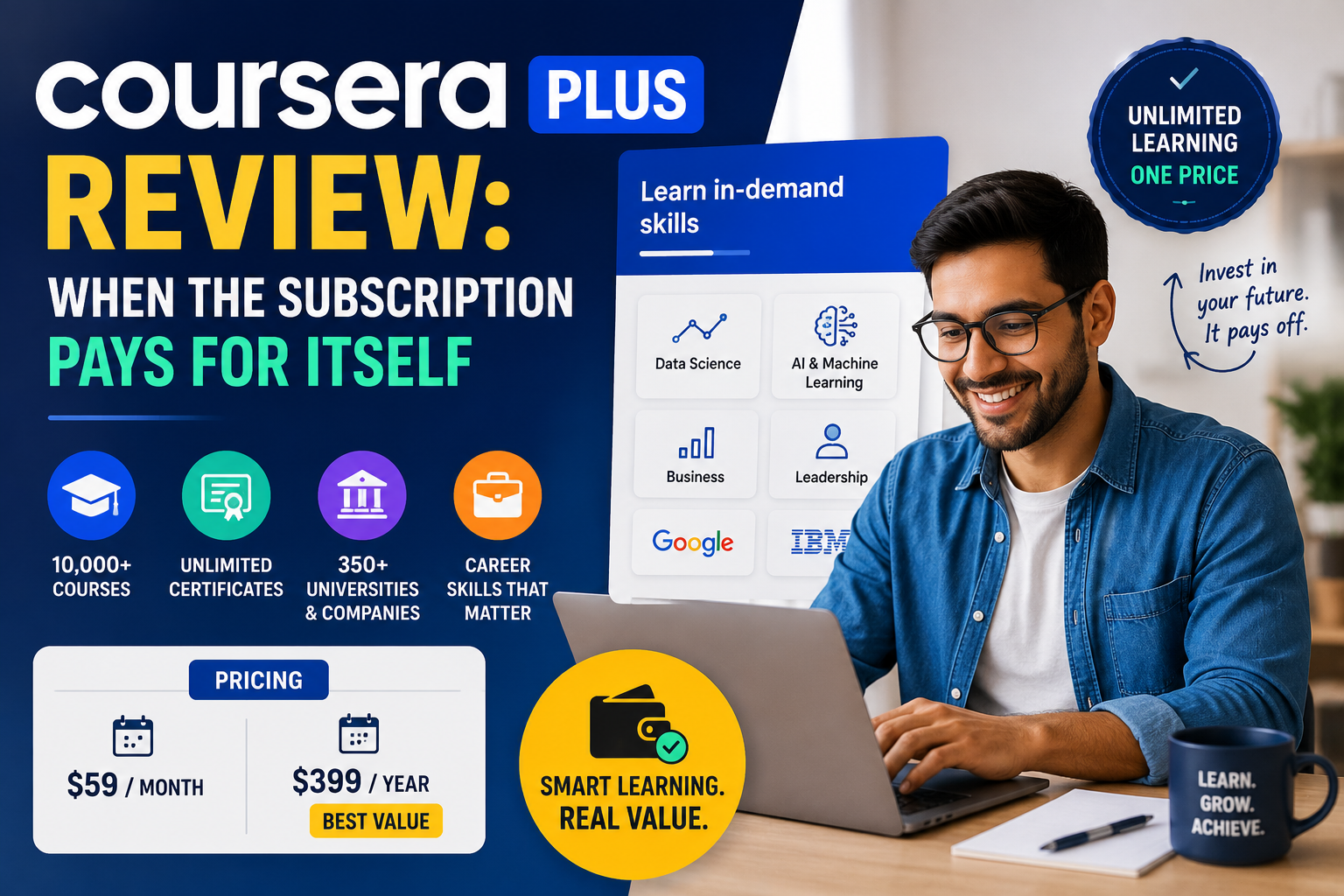
Coursera Plus can be a smart investment for learners who plan to take multiple courses, earn certificates, or build several skills throughout the year. As of 2026, Coursera Plus gives subscribers access to more than 10,000 courses, Projects, Specializations and Professional Certificates, with content from more than 350 universities and companies. The standard price is currently $59 per month or $399 per year, although Coursera periodically runs discounts. That means the annual plan works out to about $33.25 per month at the regular $399 price, while the monthly plan makes more sense if you only have a short learning sprint in mind.
The interesting part is the break-even point. If you take one course and disappear for the rest of the year, Plus may be unnecessary. If you’re planning a Google Professional Certificate, a data course, an AI specialization and a few shorter courses in the same year, the economics change considerably.
The Math Behind Coursera Plus
The easiest way to judge the subscription is to stop thinking about the number of courses available and calculate what you will actually finish.
At $399 annually, you need to extract roughly $400 worth of learning from the platform to justify the subscription. Coursera says Plus includes unlimited certificates, so completing several eligible courses does not create a separate certificate charge.
| Learning Pattern | Likely Value of Plus |
| 1 short course | Usually poor |
| 2 substantial courses | Could be worthwhile |
| 1 Professional Certificate | Potentially worthwhile |
| 2-3 Professional Certificates | Strong value |
| Multiple Specializations | Excellent value |
| Frequent skill exploration | Very strong value |
| Casual browsing | Poor value |
The biggest mistake is buying the annual plan because “10,000+ courses” sounds like an incredible bargain. The catalog only matters if those courses match your goals.
When the Monthly Plan Makes More Sense
The $59 monthly plan is particularly interesting for people with a defined short-term objective. Suppose you want to finish a Professional Certificate in four months. Paying monthly would cost about $236, assuming the current standard price stays unchanged.
That can be considerably more sensible than paying $399 upfront.
- The monthly option also gives you flexibility if you’re testing whether online learning fits your schedule.
- Coursera currently offers a 7-day free trial for the monthly plan, while annual subscribers have a 14-day refund window.
There is one catch: check the exact content you want before subscribing.
- Coursera says the majority of its catalog is included, but some courses, Specializations and Professional Certificate programs are excluded, and degrees and MasterTrack programs aren’t covered by Plus.
Where the Subscription Becomes Surprisingly Valuable
Source: Coursera
The strongest case for Plus isn’t necessarily completing expensive professional programs. It’s the ability to experiment without repeatedly paying for another course.
Imagine you’re moving into data analytics. You could start with SQL, discover that you enjoy visualization, move into Python, take a Tableau course and then decide whether a broader data certificate makes sense.
With individual subscriptions, constantly switching subjects can become expensive. Plus removes much of that friction.
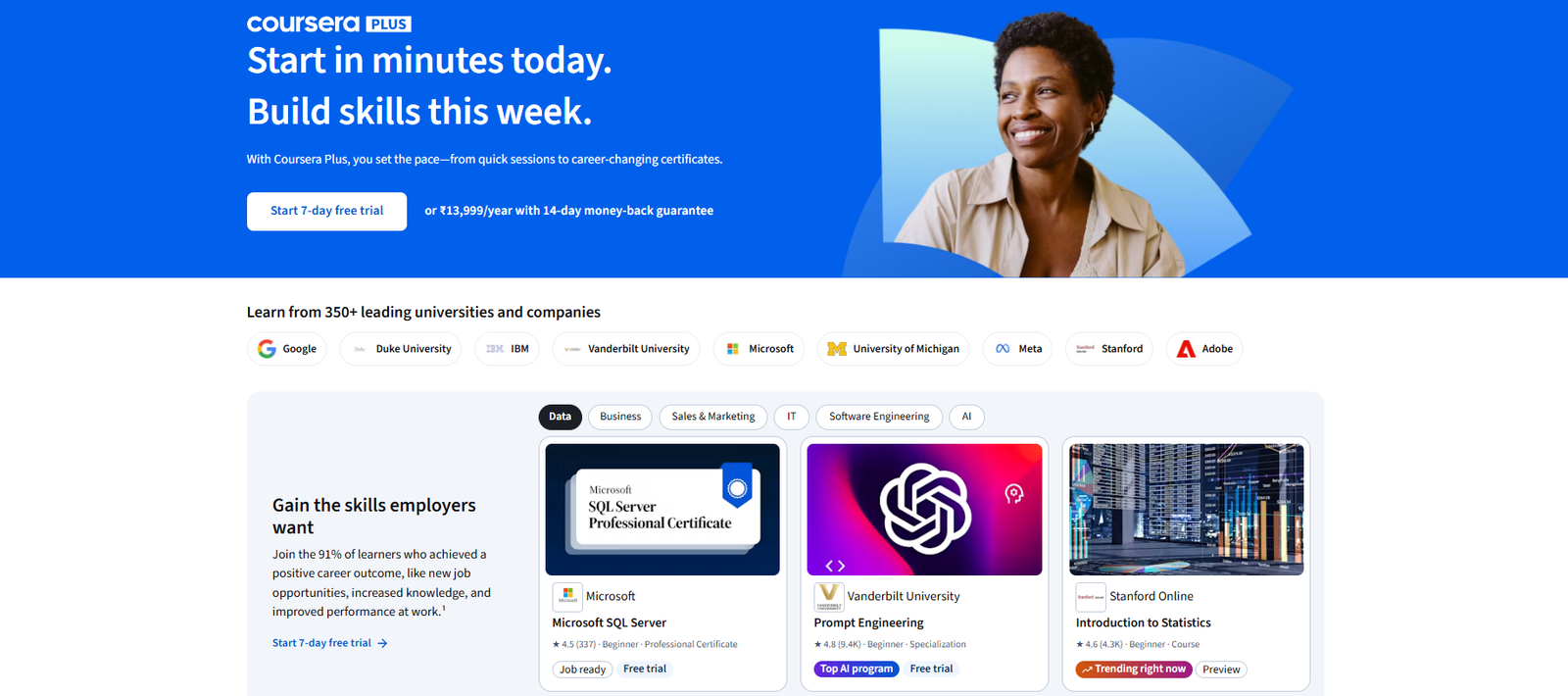
Coursera currently offers courses and credentials from organizations including Google, IBM and Microsoft, alongside university partners. That makes Plus particularly useful for career changers who haven’t yet settled on one specialization.
The Hidden Cost: Unfinished Courses
There’s another side to Coursera Plus that promotional pricing doesn’t show. Unlimited access can create a strange problem: too much choice.
A learner may enroll in machine learning on Monday, cybersecurity on Wednesday and UX design the following weekend. Three months later, they have started seven courses and finished none.
The subscription then becomes expensive even though the learner technically has access to thousands of resources. A better strategy is to maintain one primary course and one secondary course. Don’t open another program until one of those is finished.
Professional Certificates Change the Calculation
If your goal is career development, Professional Certificates are where Plus can make the most sense.
Coursera currently advertises more than 200 Professional Certificate programs through its Plus offering, including programs from major industry partners. These are designed around job-related skills rather than simply academic theory.
For example, someone targeting an entry-level data role could combine a data analytics certificate with shorter SQL, Python or visualization courses. Someone moving toward project management could pair a Professional Certificate with courses covering Agile, stakeholder management and business communication.
The certificate itself isn’t a job guarantee. Its usefulness depends on whether you can demonstrate the skills through projects, work experience or a portfolio.
Don’t Assume Everything on Coursera Is Included
This is probably the most important purchasing check.
- Coursera explicitly says that not every offering carries Plus access.
- Before subscribing, search for the exact program and look for the Coursera Plus badge.
- This matters especially if you’ve already identified a particular university course or advanced program you want.
- A $399 subscription isn’t a bargain if the one course you actually need isn’t covered.
Also check whether you already have another Specialization subscription.
- Coursera says existing subscriptions do not automatically cancel when you start Plus, so you could accidentally pay for both.
Who Gets the Most From Coursera Plus?
Source: Coursera
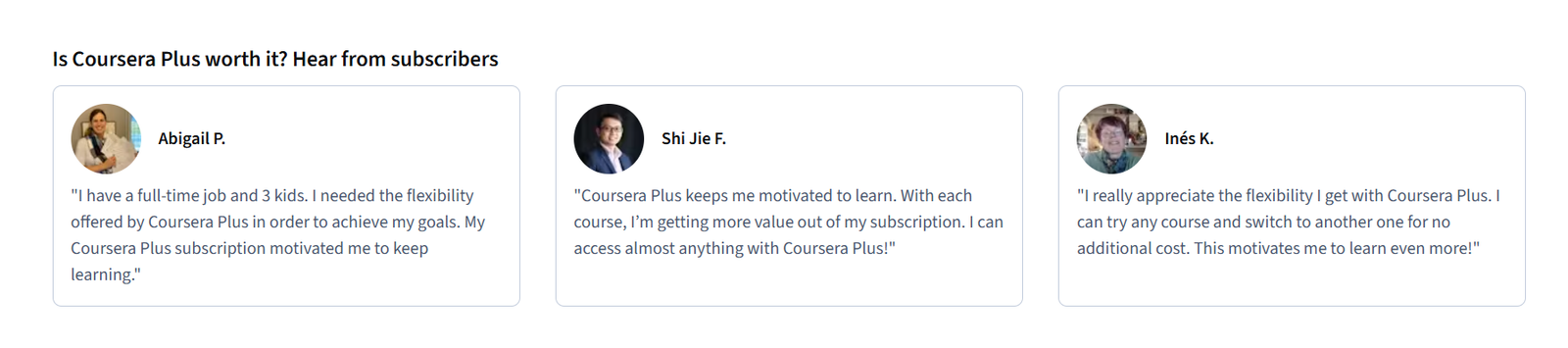
The ideal subscriber isn’t necessarily someone who studies every day. It’s someone who has multiple learning objectives within the same year.
Career changers, working professionals building complementary skills, students exploring career options and people preparing for a role transition can all benefit.
For example, spending six months completing one Professional Certificate and then using the remaining subscription period for targeted courses can make the annual plan substantially more attractive than purchasing each learning program separately.
By contrast, if you need one specific course for one specific purpose, buying that course individually may be the smarter decision.
So, Does Coursera Plus Pay for Itself?
The most useful conclusion is simple: Plus pays for itself through learning volume, not access volume.
Having access to 10,000+ courses means little if you finish one. But completing several substantial programs, earning multiple certificates and using shorter courses to fill specific skill gaps can make the $399 annual price look quite reasonable.
Before subscribing, make a list of the programs you realistically intend to complete in the next 6-12 months. Check that they’re included, estimate how long each will take and calculate the equivalent cost if purchased separately.
If that number comfortably exceeds the subscription price, Plus is probably a good buy. If your list contains only one course, keep your money and buy that course instead.
FAQs
- Can I earn unlimited certificates with Coursera Plus?
Yes. Coursera states that Plus subscribers can earn a certificate for every eligible course, Project, Specialization or Professional Certificate they complete, without a separate certificate limit.
- Is monthly or annual Coursera Plus better?
Choose monthly if you have a short, defined learning goal. The annual plan is more attractive when you expect to study consistently across several subjects throughout the year.
- Can I cancel Coursera Plus?
Yes. The monthly plan can be cancelled, while annual subscriptions are subject to Coursera’s applicable refund terms. Coursera currently provides a 14-day refund period for annual Plus subscriptions.
Also Read: Are Google Career Certificates on Coursera Worth It? A Complete Review