
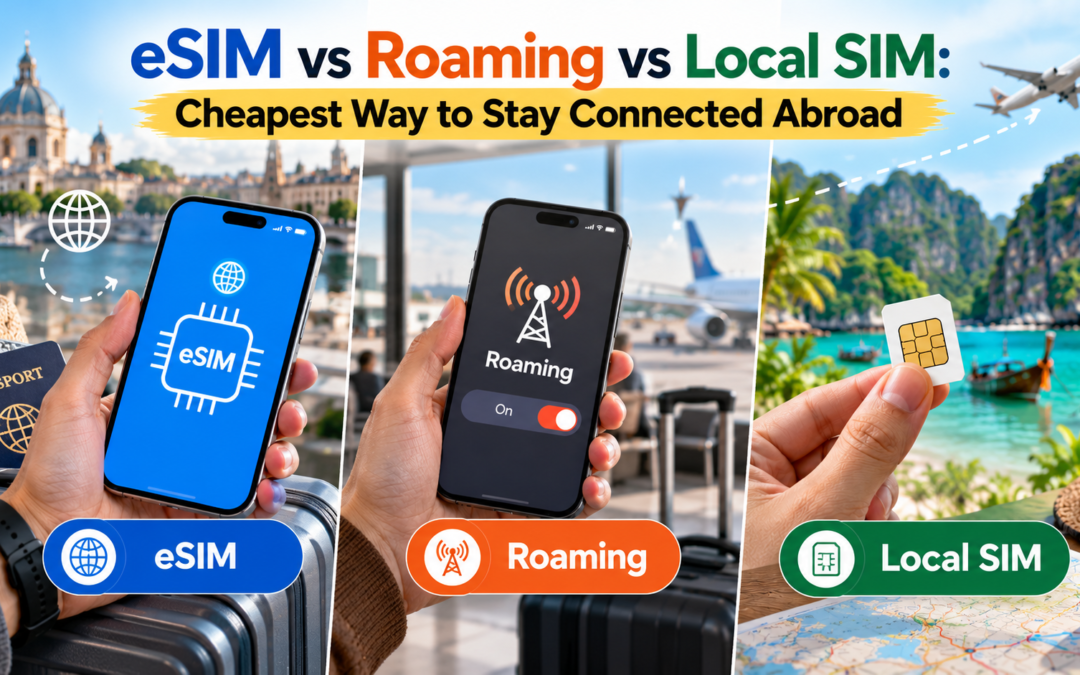
eSIM vs Roaming vs Local SIM: Cheapest Way to Stay Connected Abroad
For international travellers, mobile connectivity is no longer just about finding the strongest signal. The real question is how much that connection will cost once the phone crosses a border. In 2026, eSIM adoption is accelerating: GSMA Intelligence estimates that eSIMs represented about 5% of global smartphone connections at the end of 2025, with the share expected to reach 10% by the end of 2026. So, this eSIM vs roaming vs local SIM comparison is less about finding one universal winner and more about matching the connection method to the destination, trip length, data usage and the need to keep the home number active.
A traveller can now install a data plan before boarding a flight instead of buying a physical SIM after landing. But that does not automatically make eSIM the cheapest option. Local SIM cards can still offer excellent value in many countries, while roaming can actually be the smartest choice for a short trip when a carrier’s international pass is reasonably priced.
What Are the Three Options?
eSIM: A digital SIM profile installed directly on a compatible phone. Travel eSIM providers sell country, regional or global data packages that can usually be activated through an app or QR code. Some providers now offer plans covering hundreds of destinations, with packages ranging from small data allowances to unlimited options.
Roaming: The existing SIM connects to a foreign network through an agreement between the home carrier and the overseas operator. Nothing physical needs to change, and the home number remains available. The problem is pricing: outside regions with regulated or generous roaming agreements, standard roaming can become expensive quickly.
Local SIM: A physical SIM purchased from a mobile operator or retailer in the destination country. It generally gives access to local network pricing and may include a local phone number. The trade-off is the time and paperwork involved in buying and registering it.
Which One Is Actually Cheapest?
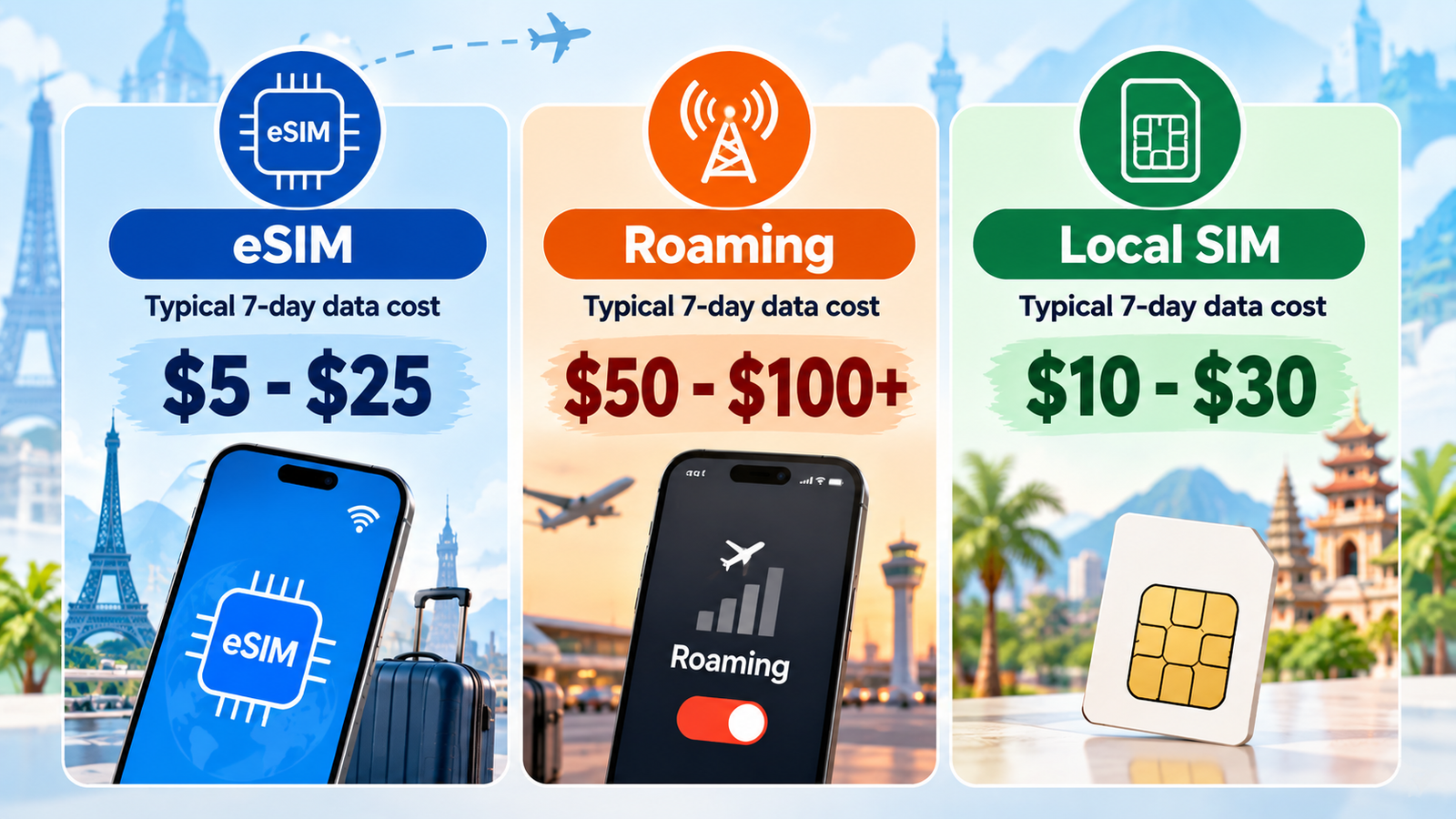
There is no single worldwide price because local telecom pricing varies enormously. As a useful 2026 benchmark, travel connectivity comparisons put a typical week of data at roughly $5-$25 for an eSIM, $50-$100+ for standard roaming, and $10-$30 for a local physical SIM. These are indicative ranges rather than fixed global prices.
| Factor | eSIM | Roaming | Local SIM |
|---|---|---|---|
| Typical 7-day data cost | $5-$25 | $50-$100+ without a good pass | $10-$30 |
| Setup | Before or after arrival | Usually automatic | Buy and install locally |
| Physical SIM required | No | No | Yes |
| Keep home number | Usually yes with dual SIM | Yes | Usually no |
| Local phone number | Usually no | Yes, home number | Usually yes |
| ID requirement | Usually no | No additional ID | Often required |
| Multi-country travel | Excellent with regional plans | Depends on carrier | Requires multiple SIMs |
| Best for | Convenience + predictable data cost | Short trips and simplicity | Longer stays + heavy data |
The important detail is that roaming should not automatically be dismissed as expensive. Many carriers sell daily passes or international bundles that make roaming much more predictable. In the EU/EEA, for example, eligible travellers can generally use their domestic allowance while roaming under the EU’s “Roam Like at Home” rules, subject to fair-use limits. The regime currently covers all 27 EU countries plus Iceland, Liechtenstein and Norway, and was extended to Ukraine and Moldova from January 1, 2026.
For an EU traveller visiting another EU country for a few days, switching to a separate eSIM may therefore add cost and complexity without providing much benefit.
eSIM: The Best Balance for Most Travellers
The biggest advantage of an eSIM is preparation. The plan can be purchased and installed before departure, meaning mobile data can work shortly after landing.
- It is particularly useful when travelling between multiple countries. Instead of buying a new physical SIM in each destination, a regional eSIM can cover several countries under one package.
Another advantage is dual-SIM functionality.
- On compatible unlocked phones, the home SIM can remain active for calls or SMS while the eSIM handles mobile data.
- This is useful for receiving bank OTPs, keeping WhatsApp associated with the home number and staying reachable without paying for full roaming data.
The main limitation is compatibility.
- The phone must support eSIM, and some devices are carrier-locked or have regional restrictions.
- Some travel eSIMs are also data-only, so they do not provide a conventional local phone number for calls and SMS.
That makes eSIM vs roaming vs local SIM particularly interesting for travellers who primarily need maps, messaging, ride-hailing, email, and social media rather than traditional voice calls.
Local SIM: Cheapest for Longer Stays
A local SIM becomes more attractive when the trip lasts several weeks or involves heavy data use.
Local operators often price their prepaid packages for residents rather than international travellers, which can mean substantial data allowances for comparatively little money. A local SIM can also provide a domestic phone number, which matters when restaurants, delivery services, taxis or businesses require local calling.
The downside is the arrival experience. The SIM has to be purchased, registered where required, installed and configured. Some countries require passport or identity verification. There is also the practical problem of removing the existing SIM and keeping it somewhere safe.
For a two-week or one-month stay, however, that inconvenience may be worthwhile.
When Roaming Makes More Sense
Roaming wins on convenience. There is no need to research local operators, compare eSIM packages or visit a store.
It is especially sensible when:
- The trip is only a few days.
- The carrier offers an affordable international day pass.
- The traveller needs the home number for regular calls.
- The destination has poor eSIM availability.
- A work phone has restrictions on installing third-party eSIMs.
The danger is using standard pay-as-you-go roaming without checking the rates beforehand. A phone that automatically downloads photos, synchronises cloud files or streams video can consume data surprisingly quickly.
Before departure, check the carrier’s roaming price, daily limits, destination coverage, hotspot restrictions and whether receiving calls or SMS costs extra.
The Cheapest Choice Depends on the Trip
- For a three- to seven-day holiday, an eSIM is often the strongest combination of low cost and convenience.
- For a month-long stay, a local SIM can win on raw value, particularly for heavy data users.
- For a very short business trip, roaming can be cheapest in practical terms if the existing carrier offers a reasonably priced pass. There is no setup time and no need to change the phone configuration.
- For multi-country travel, a regional eSIM usually becomes more attractive because one plan can cover several destinations.
This is why eSIM vs roaming vs local SIM should always be evaluated against the actual itinerary rather than a generic “cheapest SIM” list.
What to Check Before Buying
Price per gigabyte is only one part of the calculation. Check the network used by the provider, coverage in rural areas, maximum 4G/5G speeds, hotspot support, activation period, validity window and whether unused data expires.
Also check whether the phone is unlocked. A cheap local SIM or eSIM is useless if the handset cannot accept another carrier profile.
For eSIMs, confirm whether the plan starts when installed or only when it connects to the destination network. For local SIMs, check registration requirements. For roaming, check whether the advertised price is a daily charge, a fixed data bundle or simply the carrier’s standard out-of-bundle rate.
FAQs
1. Is an eSIM cheaper than roaming?
Usually, especially outside regions where roaming is regulated or where the carrier offers a competitive international pass. But prices vary by country and carrier.
2. Is a local SIM cheaper than an eSIM?
Often, particularly for longer stays and large data requirements. However, an eSIM can be cheaper when convenience and short-trip pricing are considered.
3. Can the home SIM and travel eSIM work together?
Yes, on compatible dual-SIM phones. The eSIM can handle mobile data while the home SIM remains active for calls and SMS.
Also Read: Traveloka Review: Is It Worth Using for Booking Flights and Hotels?