
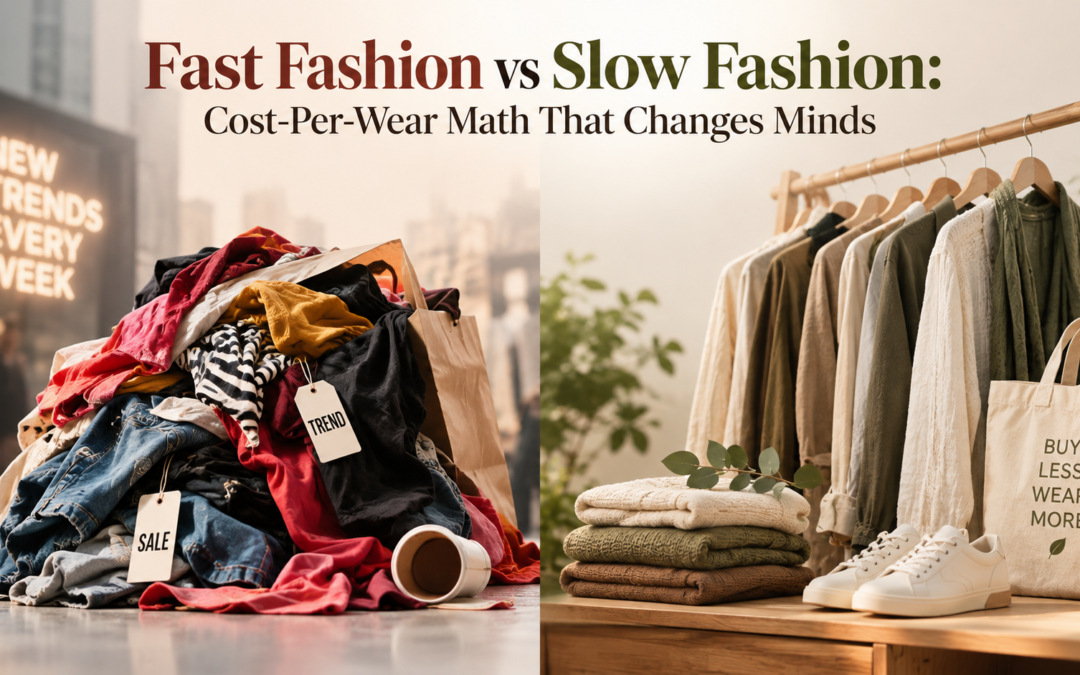
Fast Fashion vs Slow Fashion: Cost-Per-Wear Math That Changes Minds
The fast fashion vs slow fashion debate is often presented as cheap versus expensive, but the real comparison is more complicated. Between 2000 and 2015, global clothing production roughly doubled while the average number of times garments were worn fell by 36%. The Ellen MacArthur Foundation also reports that some clothing is discarded after only seven to ten wears.
Meanwhile, the environmental scale is substantial. UNEP estimates that the textile sector generates around 92 million tonnes of textile waste each year, while less than 1% of clothing material is recycled into new clothing.
So, does paying more actually save money? Not automatically. But looking at cost per wear, durability and how often a garment is actually used gives a much clearer answer.
What Does Cost Per Wear Actually Mean?
The formula is simple:
Cost per wear = Purchase price ÷ Number of times worn
Consider two hypothetical T-shirts:
- Fast-fashion T-shirt: $25
- Slow-fashion T-shirt: $100
If the $25 shirt lasts for 10 wears, its cost per wear is $2.50.
If the $100 shirt lasts for 50 wears, its cost per wear is $2.
The more expensive garment has the increased upfront price but the lower cost every time it is used.
That doesn’t mean every expensive garment is better. A $150 shirt that gets worn eight times is still expensive at $18.75 per wear.
Fast Fashion: Cheap at Checkout, Not Always Cheap Over Time
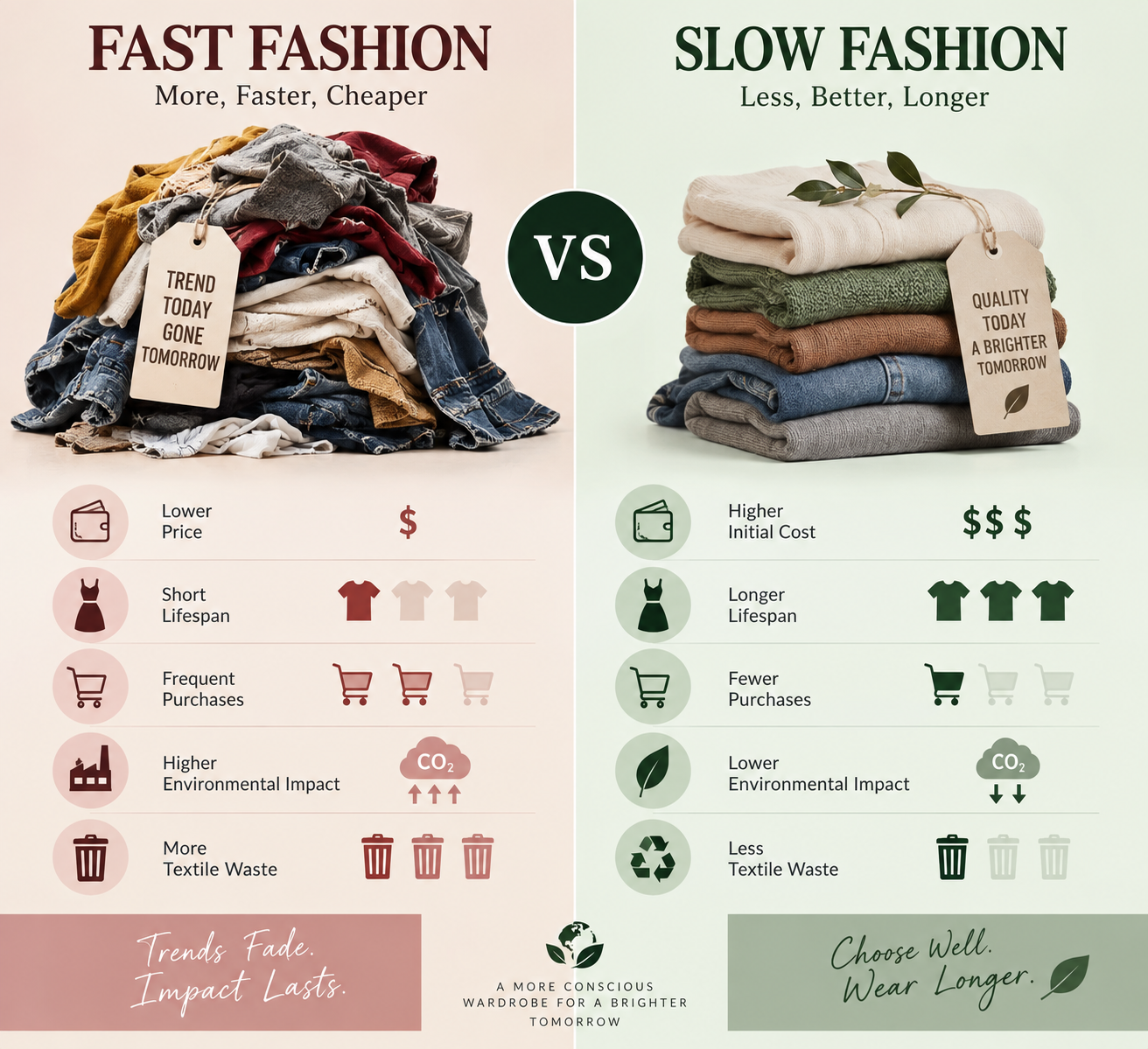
Fast fashion is built around frequent collections, low prices and rapidly changing trends. The attraction is obvious: shoppers can experiment with different styles without committing much money to individual pieces.
The problem starts when low prices encourage low utilisation.
The Ellen MacArthur Foundation estimates that customers globally lose around $460 billion in value each year by throwing away clothes that could still be worn.
Here’s a simple example:
| Fast Fashion | Slow Fashion | |
| Purchase price | $30 | $120 |
| Expected wears | 10 | 60 |
| Cost per wear | $3.00 | $2.00 |
| Replacement needed | More often | Less often |
| Typical appeal | Trend variety | Longevity and versatility |
| Upfront cost | Lower | Higher |
The numbers above are illustrative rather than industry averages, but they show why purchase price alone can be misleading.
Slow Fashion: Paying More for Longer Use
Slow fashion generally focuses on fewer purchases, longer use, repairability, timeless designs and more considered production.
The important word is use.
- Buying an expensive coat and wearing it twice isn’t automatically sustainable.
- Buying a well-made coat and wearing it every winter for several years is a very different proposition.
Durability also has two sides.
- Physical durability means the garment resists damage, while emotional durability means the wearer continues to like and use it rather than replacing it because the style quickly feels old-fashioned.
- The Ellen MacArthur Foundation identifies both as important to keeping clothing in use.
The Break-Even Point Is the Interesting Part
Here’s where cost-per-wear becomes useful.
Suppose a $30 fast-fashion dress lasts 10 wears.
A $120 slow-fashion dress costs four times as much.
It therefore needs to be worn at least 40 times to reach the same $3 cost per wear.
At 50 wears:
$120 ÷ 50 = $2.40 per wear
At 75 wears:
$120 ÷ 75 = $1.60 per wear
This is the point often missed in the fast fashion vs slow fashion conversation. A higher purchase price doesn’t automatically mean higher long-term clothing costs. What matters is how long the garment remains useful.
But Cost Per Wear Isn’t the Whole Story
There are other costs that don’t appear on a receipt.
A garment may need frequent replacement because of stretched fabric, broken seams, fading or changing trends. There is also the environmental cost of producing, transporting, and eventually disposing of clothing.
UNEP estimates that textiles account for roughly 2-8% of global greenhouse gas emissions and use the equivalent of around 86 million Olympic-sized swimming pools of water annually.
At the same time, it would be too simplistic to label every inexpensive garment environmentally harmful and every expensive garment sustainable. Material choice, manufacturing processes, washing habits, durability and end-of-life options all matter.
The Best Wardrobe May Be a Mix
The fast fashion vs slow fashion comparison doesn’t have to end with choosing one category exclusively.
A more practical approach is to spend more carefully on pieces that receive heavy use.
Think about:
- Jeans worn several times a week
- Winter coats
- Work trousers
- Everyday shoes
- Plain T-shirts
- Bags used regularly
For occasional partywear or rapidly changing trends, buying inexpensive clothing may make more financial sense if the item is genuinely used and eventually passed on, resold or responsibly recycled.
The mistake is buying something simply because it’s cheap.
Ask One Question Before Buying
Before purchasing another $20 top, consider:
“Will this still be worth owning after 20 wears?”
If the answer is no, the low price may not actually represent good value.
For a $20 garment worn twice, the cost per wear is $10.
For a $70 garment worn 70 times, it’s $1.
That doesn’t make the $70 item universally better. It simply demonstrates why wardrobe decisions become clearer when price is connected to actual use.
Fast Fashion vs Slow Fashion: What Should Shoppers Compare?
When evaluating clothing, look beyond the initial price.
| Factor | What to Ask |
| Price | What is the purchase cost? |
| Durability | How likely is it to survive regular use? |
| Versatility | Can it work with several outfits? |
| Cost per wear | How many times will it realistically be worn? |
| Care | Does it require expensive or difficult maintenance? |
| Repairability | Can small damage be repaired? |
| Resale | Could someone else use it later? |
| End of life | Can the material be reused or recycled? |
The Real Lesson Behind the Price Tag
The fast fashion vs slow fashion debate becomes much more useful when it moves away from labels and toward behaviour.
A cheap garment worn repeatedly can deliver excellent value. An expensive garment left untouched in a wardrobe does not. But when a higher-quality piece genuinely replaces several short-lived purchases, its economics can change dramatically.
The simplest takeaway is this: don’t ask only “How much does it cost?” Ask “How many times will I actually wear it?”
That one question can make a $100 garment look surprisingly affordable and a $15 impulse purchase surprisingly expensive.
FAQs
1. Is slow fashion always cheaper?
No. Slow-fashion products can have significantly higher upfront prices. They become financially attractive when their longer useful life produces a lower cost per wear.
2. Is fast fashion always poor quality?
No. Quality varies considerably between brands, garments and materials. Price alone cannot determine durability.
3. How many wears make clothing worthwhile?
There is no universal number. The useful calculation is to divide the purchase price by the realistic number of times you expect to wear the item.
Also Read: EGOHOME Mattress Review: A CertiPUR Memory Foam Bed on a Budget