
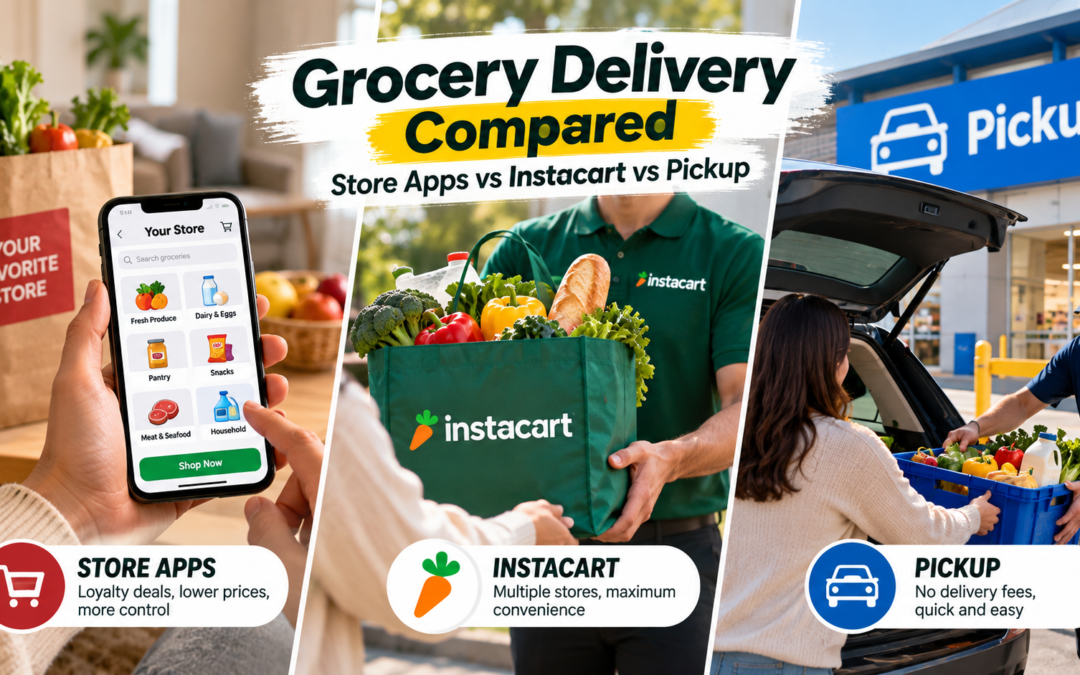
Grocery Delivery Compared: Store Apps vs Instacart vs Pickup
Grocery shopping has moved well beyond the traditional weekly trip to the supermarket. In the U.S., food prices were 2.7% higher in August 2026 than a year earlier, while grocery-store food prices specifically rose 2.2% over the same period. At the same time, retailers and delivery platforms have made it possible to order groceries for delivery, schedule curbside pickup, or shop directly through a supermarket’s own app.
That creates a more useful question than simply asking which service is cheapest: what does each method actually cost after delivery fees, service charges, item pricing, tips, membership costs and the value of your time? In grocery delivery, the platform you choose can materially change the final bill. A recent comparison of 15 Costco products, for example, found the same items priced about 24% higher through Instacart than in-store before fees; the final Instacart total was about 32% above the in-store purchase once fees, taxes and a 5% tip were included.
Store Apps: More Control Over the Retailer Relationship
Shopping through a supermarket’s own app is often the most straightforward option when the retailer has a strong digital operation.
Walmart, Kroger and other major chains increasingly allow customers to search inventory, apply store promotions, choose pickup or delivery windows and manage substitutions directly inside their own apps.
The biggest advantage is retailer integration. Store-specific loyalty pricing, digital coupons and rewards are generally easier to manage when ordering directly from the retailer.
Kroger, for example, offers both its own delivery service and third-party delivery through companies such as Instacart and Shipt. Its delivery fees vary depending on the service, day and time slot.
Walmart currently lists free pickup for orders over $35, while standard store delivery is $9.95 and express delivery adds another $10. Walmart+ members receive free standard delivery on qualifying $35+ orders.
That makes the store app particularly attractive for shoppers who already have a preferred supermarket and regularly use its loyalty programme.
Instacart: Convenience Across Multiple Stores
Instacart’s biggest advantage is breadth. Instead of building separate accounts and apps for different supermarkets, shoppers can access multiple retailers from one platform. That is particularly useful when a shopping list spans different stores. A shopper can compare availability, brands and prices without physically visiting several supermarkets.
But convenience comes with a more complicated pricing structure.
- Instacart says delivery fees vary according to retailer, delivery window and order size.
- Service fees also vary according to factors including location and the number and type of products in the cart.
- Tips are separate, with 100% of the tip going to the shopper.
Instacart+ can eliminate delivery fees on eligible orders, but it does not eliminate service fees, and membership does not guarantee faster delivery or preferred time slots.
There is another issue worth checking: item-level pricing.
- Retailers determine how products are priced on Instacart, and pricing can differ from the shelf price.
- The Costco comparison mentioned earlier illustrates how meaningful that difference can become on a large basket.
Pickup: The Middle Ground That Often Makes Financial Sense
Curbside pickup removes the biggest cost associated with delivery without requiring a traditional shopping trip.
The process is simple: build the cart online, select a pickup slot, pay digitally and collect the order when it’s ready. For shoppers who live close to their supermarket, pickup can offer an unusually strong balance between convenience and price.
Instacart says pickup orders have no service fee, although some retailers may charge a pickup fee. Its current guidance says non-members typically pay a $1.99 pickup fee, while Instacart+ members can have that fee waived.
Retailer-specific pickup can be even cheaper.
- Kroger currently states that qualified pickup orders over $35 are free.
- Walmart similarly offers free pickup for orders over $35.
The trade-off is obvious: somebody still has to drive to the store.
Store App vs Instacart vs Pickup
| Factor | Store App Delivery | Instacart | Store Pickup |
|---|---|---|---|
| Convenience | Very high | Very high | High |
| Store selection | Usually one retailer | Multiple retailers | One retailer |
| Delivery fee | Varies | Varies | Usually low/free above minimum |
| Service fees | Depends on retailer | Common | Often none |
| Loyalty discounts | Strong | Varies by retailer | Strong |
| Price comparison | Limited | Excellent across stores | Limited |
| Tipping | Depends | Common for delivery | Not required |
| Best for | Regular supermarket shoppers | Multi-store convenience | Saving on fees |
The Hidden Cost: Item Pricing
The most important mistake in grocery delivery comparisons is focusing only on the visible delivery charge.
A $9.95 delivery fee may look expensive, but a $150 basket with near-identical item prices could still be reasonable if the alternative requires driving 20 minutes each way. Conversely, “free delivery” doesn’t necessarily mean the order is cheaper if individual products are priced higher online.
The best comparison is therefore the final checkout total, not the delivery fee shown at the beginning.
Substitutions Can Change the Equation
Online grocery shopping also introduces a variable that doesn’t exist in exactly the same way during traditional shopping: substitutions.
Kroger notes that estimated totals can change because of substitutions, coupons, taxes and weighted products.
For produce, meat and other items sold by weight, the final amount can therefore differ from the initial estimate. Shoppers should review substitution preferences carefully. Automatically accepting a more expensive alternative can quietly increase the final bill.
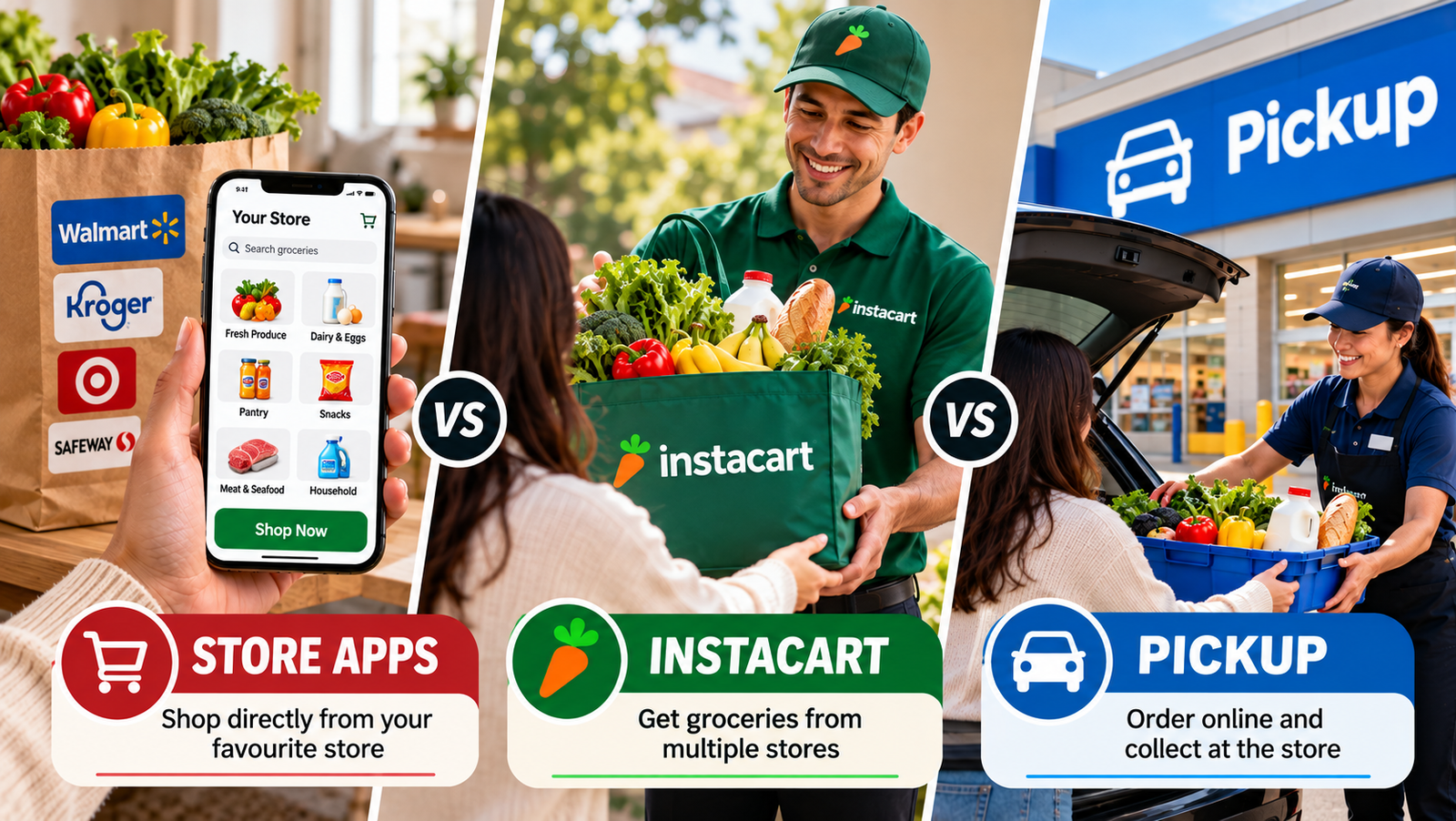
When Store Apps Make More Sense
A retailer’s own app tends to work best when:
- The household shops primarily at one supermarket.
- Store loyalty discounts are important.
- Digital coupons make up a meaningful portion of savings.
- Free or inexpensive pickup is available.
- The retailer has reliable inventory data.
- The order is large enough to meet the free-delivery or pickup threshold.
For frequent shoppers, these advantages can outweigh Instacart’s broader selection.
When Instacart Makes More Sense
Instacart becomes more useful when convenience matters more than squeezing out the lowest possible price.
It can be particularly practical when:
- Multiple stores are needed.
- The shopper doesn’t have a vehicle.
- Same-day delivery is important.
- A household needs groceries urgently.
- The shopper wants to compare several retailers from one interface.
The platform’s value is therefore less about being universally cheap and more about reducing the friction involved in grocery shopping.
The Case for Pickup
Pickup is often the most interesting option for budget-conscious households.
It keeps the biggest benefits of online ordering- saved shopping time, digital lists, and fewer impulse purchases- while avoiding much of the delivery cost.
If a supermarket offers free pickup above a reasonable minimum, a shopper can place the order from home, arrive at the scheduled time and leave with the groceries without spending time walking through every aisle.
For many households, that’s the practical sweet spot.
What Should You Choose?
The best grocery delivery method depends on what is actually being optimized.
- Store apps make sense for shoppers loyal to one supermarket and its rewards ecosystem.
- Instacart is useful when retailer choice and convenience are more important than achieving the lowest possible basket price.
- Pickup makes the strongest financial case when the supermarket offers free or inexpensive collection, and the store is reasonably close.
The smartest approach is to compare the final cart total, not just the advertised delivery charge. Check item prices, coupons, membership requirements, service fees, pickup fees, substitutions and minimum-order rules before paying.
For a large weekly grocery order, those small differences can easily add up to more than the delivery fee itself.
FAQs
1. Is Instacart more expensive than ordering directly from a grocery store?
It can be, but there is no universal markup across every retailer. Item pricing, service fees, delivery fees and promotions vary by store and location. Instacart recommends checking the complete price shown at checkout.
2. Is grocery pickup cheaper than delivery?
Often, yes, because pickup eliminates delivery charges and usually does not require a delivery tip. Some retailers offer free pickup above a minimum order.
3. Does Instacart+ eliminate all fees?
No. Eligible delivery fees can be waived, but service fees and other applicable charges can still apply.
Also Read: Coupert Review: Does the Coupon Extension Actually Save Money?