

How to Find Genuinely Cheap Hotels: Trivago, Metasearch, and Timing Tricks
by parth@bidkinetic.com | Aug 13, 2026 | Travel
Hotel prices can change dramatically for the same room, same dates and same property, which makes finding a genuinely cheap stay less about luck and more about comparing the right things. Your how to find cheap hotels search starts with understanding how hotel pricing actually works: rates vary by demand, booking channel, cancellation terms, location and even the night of the week you stay. In 2026, Hotels.com data found that booking closer to the trip can sometimes pay off, with its latest Hotel Price Index identifying the final two weeks before travel as a strong window for savings and reporting that last-minute bookers saved an average of 26% versus people booking four or more months ahead.

Start With a Metasearch Engine, Not One Booking Site
The biggest mistake is checking one hotel website and assuming its price is the market price.
A metasearch engine such as trivago compares accommodation offers from hundreds of booking sites, including online travel agencies, hotel chains and independent properties. Trivago says its platform covers more than 2.5 million accommodations across approximately 190 countries.
That gives you a much better starting point because the same hotel may appear at different prices depending on which booking site is selling the room.
But don’t simply click the cheapest number you see.
Trivago itself warns that rates and availability change constantly, and the final price can occasionally differ after you are redirected to the booking site. Always check the checkout page before paying.
Compare the Same Room, Not Just the Same Hotel
This is one of the most useful money-saving tricks.
Suppose you see a hotel for $82 on one site and $91 on another. The $82 option is not necessarily cheaper once you compare: Room type, number of guests, breakfast, taxes, resort or destination fees, cancellation policy, payment timing, included parking, Wi-Fi and other essentials.
A $91 refundable room can be a better deal than an $82 non-refundable room if your plans are uncertain.
Practical trick: Open the two cheapest offers side by side and compare the final payable amount, not the headline nightly rate.
Use Trivago’s Filters Properly
Trivago allows you to filter by price, rating, location, property type and amenities such as breakfast, parking, Wi-Fi and free cancellation. Its map is particularly useful because a slightly cheaper hotel can become more expensive once you factor in daily transportation.
Try this approach:
- First search: Your preferred neighbourhood
- Second search: Expand the map by 1-3 miles
- Third search: Compare the total cost of the hotel plus transportation
A $75 hotel requiring $25 of daily transportation is not cheaper than a $90 hotel within walking distance of your destination.
Don’t Assume Tuesday Is Always Cheapest
One of the most repeated hotel-booking myths is that there is one universally cheapest day to book.
There isn’t.
Hotel pricing depends heavily on destination, season and demand. Historical Expedia data has found Fridays to be relatively inexpensive booking days in some datasets, while Hotels.com’s 2026 data focuses more on when you stay, reporting Sunday as the cheapest check-in day for U.S. stays and Saturday as the most expensive.
The useful lesson is not “always book on Friday.” It is to compare different check-in dates when your schedule allows.
Shift Your Stay by One Night
This can produce a surprisingly large difference.
- If you’re planning a three-night stay from Friday to Monday, check Thursday to Sunday and Saturday to Tuesday as well.
- Business hotels can be expensive during weekday demand, while leisure destinations often become more expensive around weekends.
- Hotels.com’s 2026 analysis found that U.S. travellers could save around 15% by starting a stay on Sunday instead of Friday.
Practical trick: When searching, change the check-in date by one day in both directions. It takes less than a minute and can reveal a meaningful price difference.
Don’t Book Four Months Early Just Because You Can
Early booking makes sense when rooms are limited, but it is not automatically the cheapest strategy for ordinary hotel stays.
Hotels.com’s 2026 data identified an 8-14-day window as a strong booking period in one analysis and also found substantial last-minute savings in its broader dataset.
This does not mean you should wait until the last minute for a major festival, conference or holiday weekend. In high-demand situations, waiting can leave you with expensive rooms or no suitable rooms at all.
A better strategy is to monitor prices while keeping your options open.
Book Refundable, Then Keep Watching
This is one of the most practical tricks for flexible travellers.
Suppose you find a refundable hotel for $120 today. Book it if the cancellation terms are genuinely free and the room meets your needs. Then continue checking the same property.
If the price drops to $95, you can cancel the original reservation and book the cheaper rate, provided the first reservation can be cancelled without a fee.
Important: Check the cancellation deadline every time. A “free cancellation” rate may stop being refundable several days before arrival.
Try the Hotel Directly After Finding the Deal
Once you identify a hotel through a metasearch site, visit the property’s official website and compare the same room.
Hotels sometimes offer member rates, direct-booking promotions, breakfast packages or flexible cancellation terms that are not identical to third-party offers. Some hotel chains also have best-rate guarantees that can be useful when you find a qualifying lower price elsewhere.
You can also call the property for longer stays. If you’re staying for a week or booking several rooms, asking whether they have a direct rate is worthwhile.
Consider Last-Minute Deals Carefully
Last-minute booking can work particularly well when hotels have unsold rooms, but it is not a strategy for every trip.
Hotels.com’s 2026 data found meaningful savings among last-minute bookings, while HotelTonight is specifically designed around short-notice hotel inventory. NerdWallet’s recent testing also found that many same-day HotelTonight bookings were cheaper than comparable Booking.com prices, although non-refundable terms and limited inventory are important trade-offs.
Use this tactic when your destination has plenty of accommodation, and you can tolerate limited choice. Avoid it when travelling for weddings, major sporting events, festivals or conferences.
The Real How to Find Cheap Hotels Checklist
| What to Check | Why It Matters |
|---|---|
| Final price | Headline rates can exclude important costs |
| Cancellation | Protects you if plans change |
| Room type | Cheapest rate may be for a different room |
| Location | Transport can erase hotel savings |
| Breakfast | Included food can change the real value |
| Check-in date | A one-day shift can reduce rates |
| Booking window | Prices can fall closer to arrival |
| Direct hotel rate | May include better terms or perks |
Practical Tricks That Actually Work
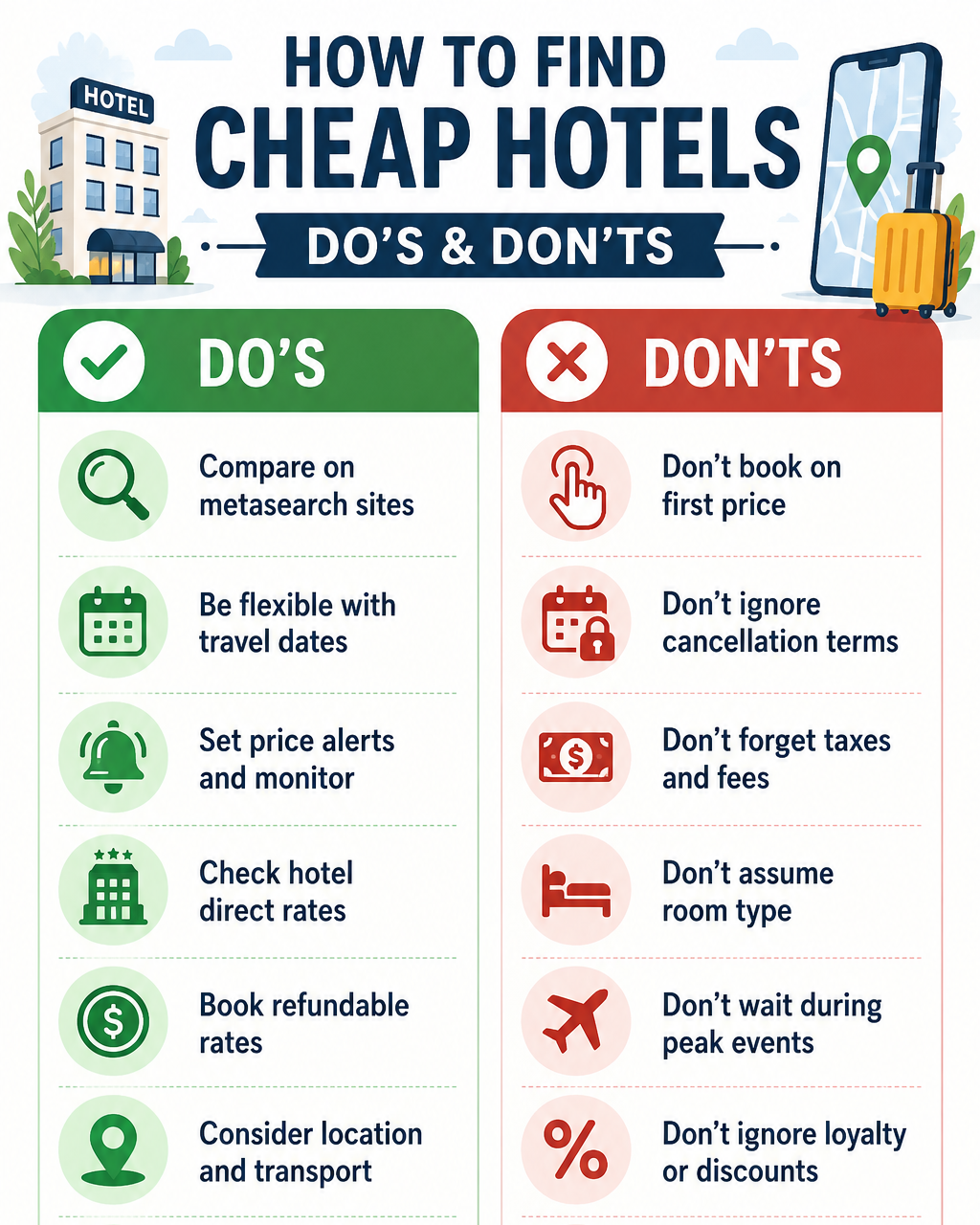
If you’re serious about how to find cheap hotels, build a repeatable process rather than searching randomly.
- Start on Trivago or another metasearch platform, identify three comparable properties and record their prices.
- Check the hotel’s own website next.
- Then change your dates by one day, expand the location slightly and compare refundable versus non-refundable rates.
- If the trip is still weeks away, set a price alert where available.
- Trivago currently offers price alerts through its app for members, notifying users when prices change.
- Also check whether you qualify for legitimate discounts such as AAA, AARP, military, corporate or loyalty rates.
- Never use a discount code or eligibility rate you do not qualify for.
- Most importantly, calculate the total trip cost, not simply the room rate.
FAQs on How to Find Cheap Hotels
1. Is Trivago cheaper than booking directly?
Not always. Trivago compares offers from multiple booking sites, so it is useful for finding price differences, but you should also check the hotel’s own website before booking.
2. What is the best time to book a hotel?
There is no universal rule. Current 2026 Hotels.com data identifies roughly the final two weeks before travel as a strong window in its analysis, but destination and demand can change the result considerably.
3. Is it cheaper to book hotels at the last minute?
Sometimes yes. Hotels may discount unsold inventory, but last-minute booking can backfire during busy periods. Flexibility is the key advantage.
Ultimately, how to find cheap hotels is less about discovering a secret website and more about comparing intelligently. Use metasearch to establish the market price, verify the final cost, experiment with your dates, check the hotel directly and keep watching when your reservation is refundable. Those small decisions can make a much bigger difference than chasing every supposed hotel-booking “hack.”
Also Read: How to Automate Instagram DMs with ManyChat: A Step-by-Step Guide