
Humble Bundle Explained: How It Works and When It’s a Steal
by parth@bidkinetic.com | Aug 27, 2026 | Games
Humble Bundle is one of the more unusual ways for US gamers to buy PC games, ebooks, software and other digital products: instead of purchasing every title separately, you can sometimes get a themed collection for a fraction of the combined list price. The platform launched in 2010 with a focus on selling games while supporting charitable causes, and it has since expanded into a broader digital storefront, subscription service and publishing business. Humble says its community has raised more than $282 million for charity.
The important catch is that a bundle’s headline value isn’t automatically a reason to buy it. A $20 bundle containing $250 worth of games sounds incredible, but it isn’t a bargain if you already own six of the titles or have no interest in the remaining games. The real skill is identifying bundles where the games you actually want justify the price.
What Is Humble Bundle?
At its simplest, Humble groups several digital products around a theme and sells them together, often using different payment tiers. A bundle might focus on indie games, major PC releases, strategy titles, software, comics or ebooks.
The platform’s history is closely tied to charitable giving. Humble’s original model helped distinguish it from conventional game stores by allowing purchases to support developers, Humble and charitable organizations. The exact allocation can vary by product and checkout options, so buyers should look at the contribution information shown before completing a purchase.
The platform has also evolved beyond its original bundle model. It now includes individual games through the Humble Store and Humble Choice, a recurring subscription offering. Humble has described Choice as part of its broader service for gamers, while its bundles remain separate purchases rather than simply being another name for the subscription.
How a Typical Bundle Works
A bundle usually has a fixed price and a selection of products. Depending on the promotion, you may unlock more items by choosing a higher tier.
For a US PC gamer, the process generally looks like this:
- Find a bundle that interests you.
- Check every included title.
- Review the price tiers.
- Confirm the platform and redemption method.
- Purchase the tier you want.
- Redeem the included keys or download DRM-free content.
Many game bundles include keys that can be redeemed on platforms such as Steam, while some products may be DRM-free downloads or use another platform. The redemption platform is important because buying a bundle doesn’t necessarily mean every game becomes part of the same launcher library.
| What to Check | Why It Matters |
|---|---|
| Total bundle price | Determines your actual spending |
| Games you want | Measures the bundle’s real value |
| Games you own | Prevents paying for duplicates |
| Redemption platform | Confirms where you’ll play |
| DRM requirements | Affects how the game is accessed |
| Tier structure | Determines which titles you unlock |
| Regional restrictions | Can affect key redemption |
| Charity information | Shows where part of the purchase goes |
When Is a Humble Bundle Actually a Steal?
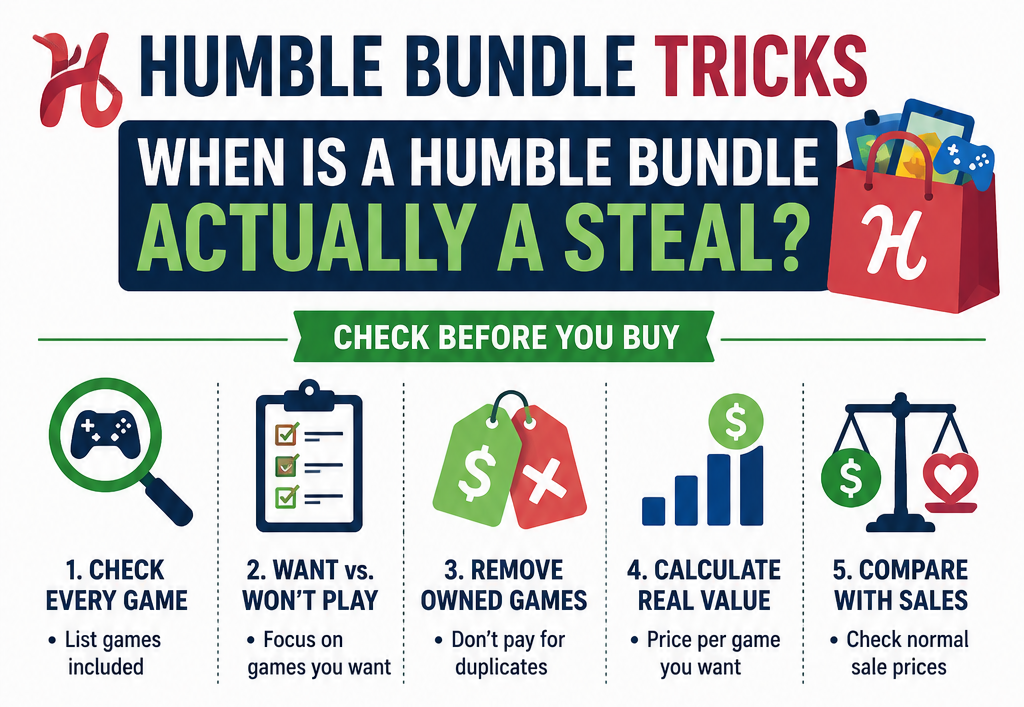
The biggest mistake is calculating value from the total retail price printed on the bundle page.
Instead, make a personal value calculation.
Suppose a $25 bundle contains eight games. You already own four, wouldn’t play two and genuinely want the remaining two. The bundle might advertise hundreds of dollars in combined value, but your personal value is based primarily on those two games.
There’s another useful test: compare the bundle against the lowest realistic price of the games you want.
If the two games you want frequently fall to $10 each during Steam sales, paying $25 for the bundle isn’t necessarily extraordinary. But if one of those games rarely receives discounts and the bundle includes it for an effective price of only a few dollars, the deal becomes much more compelling.
This is where Humble Bundle can be particularly attractive for PC gamers who are willing to explore outside their usual genres.
Don’t Ignore the Redemption Details
A cheap game isn’t necessarily useful if you cannot redeem it the way you expect.
Before buying, check whether each title is a Steam key, another platform key or a DRM-free download. A Steam key generally means you redeem the game through Steam rather than downloading it as a standalone Humble file. DRM-free products work differently.
Regional availability can matter as well. If you’re buying from the US, confirm that the key is available for your region before paying, particularly when a bundle contains games from different publishers.
Also check whether a bundle includes base games, DLC, expansions or coupons. A coupon for 50% off another game isn’t the same as receiving that game.
Humble Choice vs. Individual Bundles
Humble Choice makes sense for a different kind of buyer.
If you regularly play several PC games and like receiving a curated selection each month, a subscription can provide more predictable value. Humble’s earlier subscription service evolved into Choice, which offers a monthly collection of games and additional membership benefits.
But occasional buyers may be better off purchasing individual bundles. If you only see two or three games you want every few months, paying for a recurring membership can turn an otherwise inexpensive hobby purchase into an ongoing expense.
The question isn’t whether Choice is “better” than bundles. It’s whether you will consistently use enough of the monthly offering to justify the subscription.
What Makes a Bundle Worth Buying?
A good deal usually has three characteristics.
- You actually want the games. Don’t let an enormous claimed value convince you to buy software that will sit untouched in your library.
- The effective price beats normal sale pricing. Check what your desired titles typically cost during major US PC sales.
- The bundle fits your existing library. Duplicate games reduce the practical value considerably.
There’s also an overlooked benefit: bundles can be an inexpensive way to discover smaller games. A title you would never spend $20 on individually can become worth trying when it costs only a few dollars as part of a larger collection.
When You Should Skip It
Skip a bundle when you’re buying primarily because the discount looks enormous.
You should also think twice if most of the included games are duplicates, if the games require a platform you don’t use, or if the bundle contains several titles you have no intention of playing.
Another warning sign is buying multiple bundles faster than you can play them. A $15 bundle isn’t a saving if it contributes another 20 games to an already enormous backlog.
FAQs
1. Is Humble Bundle legitimate?
Yes. Humble is an established digital storefront that launched in 2010 and sells games, ebooks and software through its own platform. It has also partnered with publishers and developers to distribute digital products.
2. Do Humble Bundle games work on Steam?
Many bundles include Steam keys, but not every product necessarily does. Always check the redemption method listed for each title before purchasing.
3. Is Humble Choice worth paying for?
It depends on how many of the included games you will actually play. Frequent PC gamers who regularly want several monthly titles may get substantial value, while occasional buyers may find individual bundles more economical.
Ultimately, the best Humble Bundle deals aren’t about how much the bundle claims to be worth; they’re about how much value you can actually use. Check the games, compare real sale prices, watch for duplicates, and make sure the redemption terms work for you. When the numbers and your gaming interests line up, a bundle can be one of the easiest ways to expand your library without overspending.