
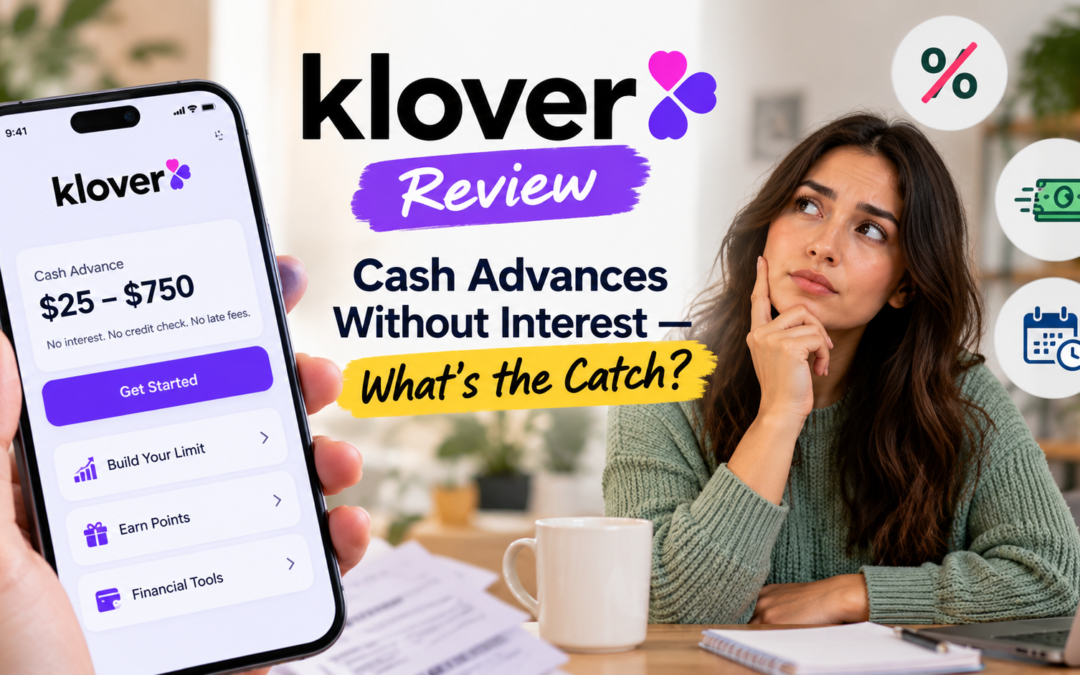
Klover Review: Cash Advances Without Interest, What’s the Catch?
A paycheck can be a few days away while an unexpected bill needs to be paid today. That gap is exactly where Klover operates. The app currently advertises cash advances from $25 to $750, with the average advance around $170. Klover says there are no interest charges, no credit checks and no late fees. It also says Klover+ is optional, while faster delivery can involve an additional fee. That sounds considerably cheaper than a traditional payday loan, but the “0%” headline does not tell the whole story. This Klover review looks at those details rather than treating “no interest” as the end of the story.
The real questions are how much cash a new user can actually access, how quickly it arrives, what an instant transfer costs, how Klover earns money, and whether the repayment timing creates another cash-flow problem.
How Klover Actually Works
Klover is different from a conventional personal-loan app. The company says it does not offer loans and instead provides access to money based on verified income and banking information. Users connect an eligible bank account, provide the requested information, and Klover determines whether an advance is available.
The advertised range is 25-750, but the maximum should not be interpreted as a starting limit. The app itself says the average advance is about $170, and individual eligibility can vary.
The app also has a points system. Users can earn points through activities such as surveys and watching advertisements, with points potentially helping unlock larger advances or other in-app features.
That is one of the first catches: the headline maximum and the amount a new user can actually access may be very different.
The No-Interest Claim Is Real But Look at the Fees
Klover’s current disclosure states that its advance service carries a 0% APR and that a $100 advance results in $100 being repaid when no optional delivery fee is selected. Its example says choosing an optional immediate-delivery fee of $8.49 would make the repayment $108.49.
That makes the fee structure much easier to understand:
| Feature | Klover |
| Advertised advance | 25-750 |
| Average advance | About $170 |
| Interest | 0% according to Klover |
| Credit check | No |
| Late fees | No |
| Klover+ | Optional |
| Faster delivery | Fee may apply |
| Points | Can affect access/features |
| Repayment | Based on the advance and applicable charges |
So, the catch isn’t conventional interest. The cost comes from how quickly you want the money and which optional features you use.
This distinction matters because a small fixed fee can become expensive relative to a small advance. Paying $8.49 to receive $50 immediately is very different from paying $8.49 on a $750 advance.
Klover+ Adds Another Layer

Source: Klover
Klover also offers Klover+, a subscription-based component.
- Current app-store information and Klover’s responses to users indicate that Klover+ is optional and has been listed at $4.99.
- That means users should not assume a subscription is automatically required simply to access the basic service.
- At the same time, anyone considering Klover should carefully review the checkout screen and account settings to understand which features are being paid for.
The broader issue is familiar across cash-advance apps: a small recurring subscription may not look significant, but it matters if advances are being used frequently.
What About the Points System?
The points system is probably the most unusual part of Klover.
Instead of simply looking at the app as a straightforward cash-advance service, users may encounter surveys, advertisements and other activities designed to earn points. Klover says points can be used for larger advances or other in-app features, but its legal disclosure also states that points themselves cannot be redeemed for cash.
For someone who needs $100 today, spending substantial time accumulating points can make the experience feel very different from the simple “get cash before payday” message.
That is an important part of this Klover review: the advertised $750 maximum does not mean every user can simply request $750 whenever needed.
The Data Trade-Off
There is another catch that is easier to overlook: data.
Klover says its model relies on approved financial data and that users can unlock features by opting into its Truth in Data agreement. The app requires banking information to determine eligibility and facilitate advances. Klover says this information is securely stored and encrypted.
That does not automatically make the service unsafe, but it is a meaningful trade-off. Anyone uncomfortable with connecting financial accounts should read the privacy policy and data permissions before signing up.
What Users Say
The current app-store picture is generally strong.
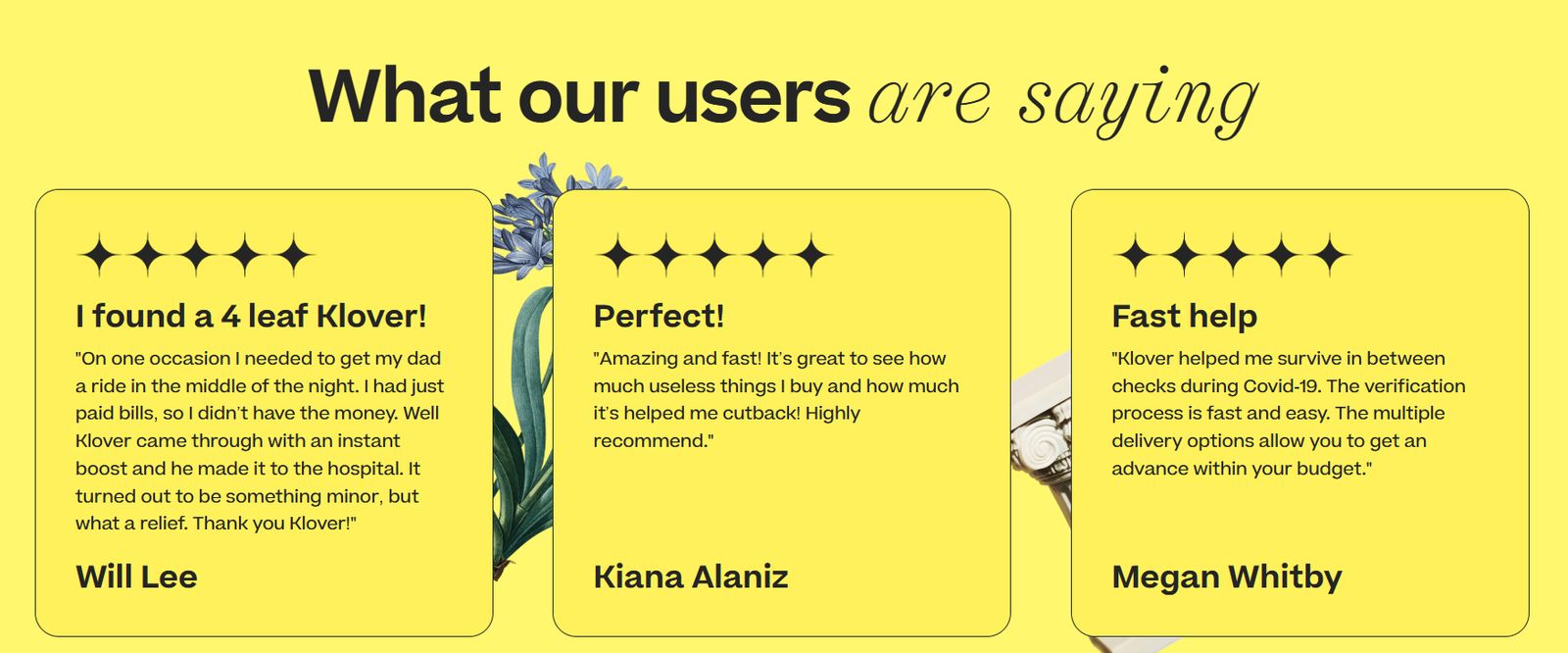
- The U.S. App Store lists Klover at 4.8/5 from about 379,000 ratings, while Google Play shows 4.6/5 from roughly 164,000 reviews at the time of review. (September 2026)
However, individual reviews reveal a more complicated experience.
- Some users report that Klover helped when they were between paychecks, while others complain about changing advance limits, delayed transfers, repayment problems or difficulty getting customer-service issues resolved.
- Recent BBB complaints and app-store reviews include reports concerning delayed deposits and account-access problems.
- These are individual complaints, not evidence that every user will experience the same issue.
The wider paycheck-advance market also deserves context.
- The CFPB has found that expedited-transfer fees are a major source of cost in this industry and has examined whether certain fees associated with paycheck advances should be treated as finance charges.
Is Klover Useful for an Emergency?
Source: Klover
The strongest use case is relatively narrow: a person has predictable income, is temporarily short on cash, and needs a modest amount before payday.
The biggest risk is turning that temporary solution into a regular part of the monthly budget. Getting $150 early can solve today’s problem while leaving $150 less available after payday. Repeating that cycle can make the underlying cash-flow problem harder to fix.
This Klover review therefore comes down less to the 0% headline and more to the total cost, transfer speed and repayment timing for each individual advance.
Pros
- No interest according to Klover
- No credit check
- No late fees
- Advances can reach $750 for eligible users
- Optional faster delivery
- Budgeting and financial tools
- Large volume of user ratings
Cons
- Maximum advance is not guaranteed
- Average advance is much lower than $750
- Instant delivery can cost extra
- Points may require time and effort
- Optional subscription needs attention
- Bank-data access is required
- Some users report account and customer-service issues
Final Verdict
Klover is more transparent than the phrase “cash advance with no interest” might initially suggest. The basic advance can genuinely carry no interest, but free does not always mean cost-free. Express delivery, optional subscription features, the points system and the value of accessing money early all need to be considered.
For occasional short-term cash-flow gaps, Klover can be useful. For someone repeatedly needing advances to reach the next paycheck, the bigger issue is not the interest rate but the possibility of creating a recurring cycle of early withdrawals and reduced payday cash.
FAQs
- Does Klover check credit?
Klover says its advance service does not require a credit check. - Is Klover+ required?
Klover states that Klover+ is optional. - Can Klover help build credit?
A cash advance should not automatically be treated as a credit-building product. Klover’s current app description focuses on cash access and financial tools rather than reporting the advance as conventional credit.
Also Read: Termly Review: Is It Worth Using for Website Privacy Compliance?