
Sending Money to India, Philippines, and Mexico: Best Rails Compared
Sending money internationally is no longer just about choosing a transfer provider. The payment method used to deliver funds to the recipient can influence the final cost, delivery time, and convenience. In 2024, India received an estimated $129 billion in remittances, followed by Mexico at approximately $68 billion and the Philippines at $40 billion, placing all three among the world’s largest remittance destinations. These flows support household expenses, education, healthcare and everyday spending. For senders comparing the best rails for these countries, the key is understanding how local payment infrastructure works.
India’s Unified Payments Interface (UPI), the Philippines’ InstaPay and PESONet networks, and Mexico’s SPEI system serve different needs. The best choice depends on whether the recipient needs immediate access to funds, a bank deposit, or cash in hand.
India: UPI and Bank Deposits Lead for Digital Convenience
India’s payment ecosystem is built around extensive digital payment adoption. UPI enables real-time payments between participating bank accounts using identifiers such as a UPI ID or supported mobile applications. India’s retail digital payment ecosystem processed 22,167 crore transactions in FY 2024–25, with UPI accounting for 81% of retail digital payment volume, according to government figures.
For international remittances, however, there is an important distinction: a sender abroad generally uses a remittance provider or supported cross-border service, which then delivers funds through an eligible local payout method. Not every international transfer can be sent directly to a UPI ID.
- UPI payout: Useful when the transfer provider supports delivery to the recipient’s UPI ID.
- Bank deposit: Suitable for rent, education fees, household bills and larger planned expenses.
- Cash pickup: Helpful when the recipient does not have convenient access to a bank account or needs physical cash.
India is often the strongest fit for digitally connected recipients, especially when the receiving service supports direct bank or UPI delivery. Always verify the eligible method and transfer limit before sending.
Philippines: InstaPay, PESONet and Mobile Wallets
The Philippines offers several ways to move money between domestic financial institutions. InstaPay supports low-value electronic fund transfers that are generally processed in near real time, while PESONet is designed for batch transfers that are processed according to clearing schedules.
For recipients who use mobile wallets, wallet deposits can be convenient for daily spending, bills and smaller household expenses. Bank deposits may be preferable for recipients who maintain a regular account or need funds for savings and larger payments.
- InstaPay-linked delivery: Useful for eligible transfers where quick account-to-account availability is important.
- PESONet-linked delivery: Worth considering when the receiving service uses scheduled bank clearing and immediate delivery is not essential.
- Mobile wallet: Convenient for recipients who regularly pay digitally.
- Cash pickup: A practical alternative for recipients who prefer in-person collection.
These domestic rails are not interchangeable, and an international provider may use a different settlement process before funds reach the local network. Check the provider’s quoted delivery time rather than assuming that every transfer using a digital destination will arrive instantly.
Mexico: SPEI and Bank Deposits for Electronic Transfers
Mexico’s Sistema de Pagos Electrónicos Interbancarios (SPEI) is an electronic interbank payment system operated by Banco de México. It supports electronic transfers between participating financial institutions and is an important part of the country’s domestic payment infrastructure.
For international senders, a transfer provider may route funds through its own settlement arrangements before crediting the recipient’s Mexican bank account. The recipient may need to provide accurate account details, such as the information requested by the selected bank and transfer service.
- Bank deposit: Often a convenient choice for recipients who already use a Mexican bank account.
- SPEI-supported delivery: Relevant when the provider’s payout process connects to participating institutions through Mexico’s domestic payment infrastructure.
- Cash pickup: Useful for recipients who prefer physical cash or do not want funds deposited into an account.
- Mobile wallet: An option only where the selected provider and destination wallet support it.
For Mexico, verify the receiving bank’s details carefully and confirm whether the transfer service supports the intended payout route. A domestic instant-payment system does not automatically mean every cross-border transaction settles instantly.
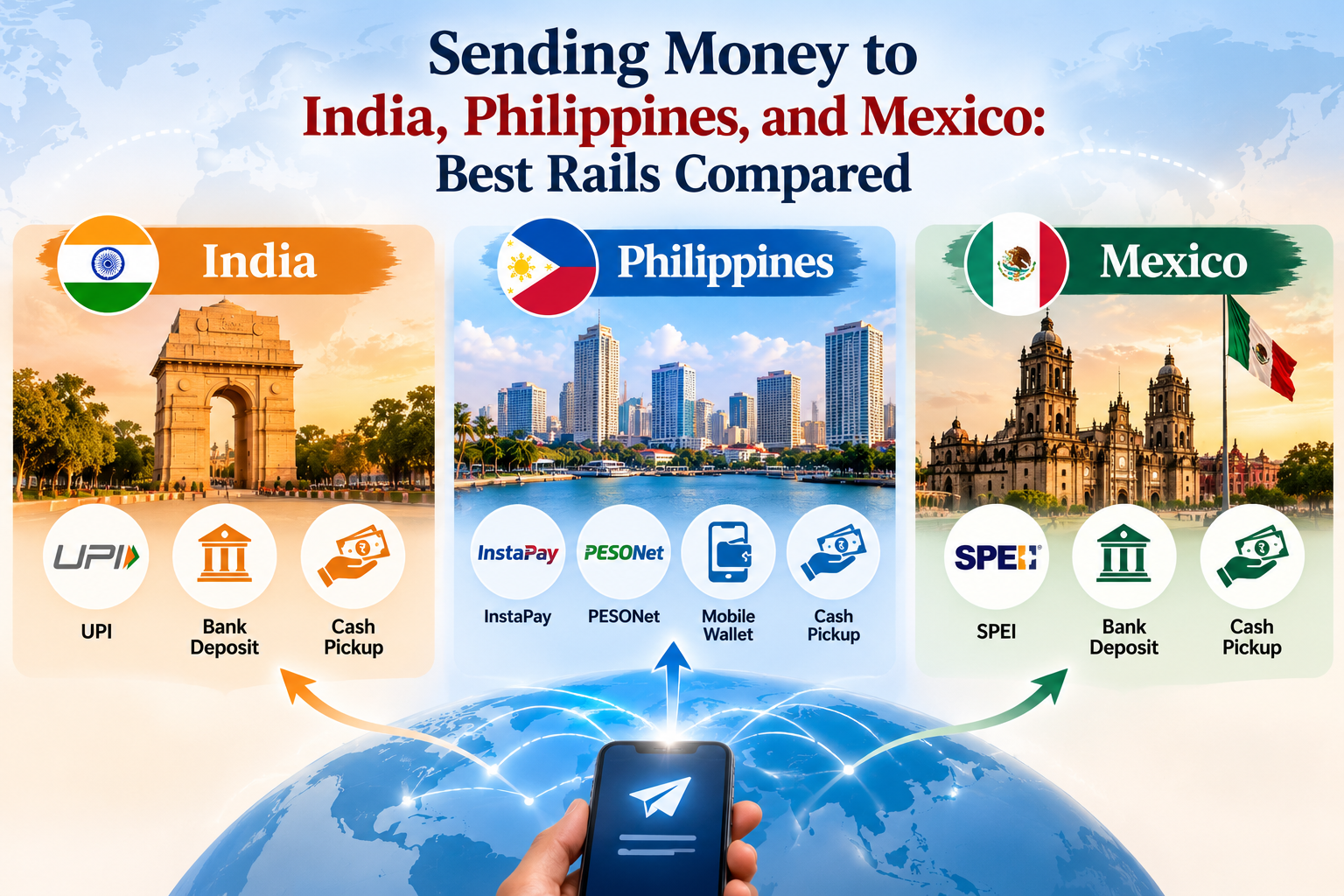
Best Rails Compared: India vs. Philippines vs. Mexico
| Destination | Important domestic rail or option | Best suited for | Main consideration |
|---|---|---|---|
| India | UPI and bank deposits | Digital payments and everyday banking | International UPI delivery depends on provider support |
| Philippines | InstaPay and PESONet | Electronic transfers and bank deposits | Timing depends on the network and payout method |
| Mexico | SPEI and bank deposits | Electronic bank-to-bank payments | Correct recipient bank details are essential |
| All three | Cash pickup | Recipients who need physical cash | Agent availability, ID and collection requirements vary |
How to Choose the Right Route
When comparing the best rails, don’t look at speed alone. Compare the total amount the recipient will receive after transfer fees and currency conversion. The World Bank’s Remittance Prices Worldwide database tracks costs across hundreds of country corridors, reflecting how much pricing can vary by route and provider.
Before confirming a transfer, check these four points:
- Total cost: Compare the fee and exchange rate together.
- Delivery time: Distinguish an estimated arrival from a guaranteed timeline.
- Recipient access: Confirm that the recipient can use the bank account, wallet or cash pickup location.
- Transfer details: Check names, account identifiers and limits before authorising payment.
For recurring family support, a reliable bank deposit or supported wallet may be easier to manage. For urgent expenses, choose a route with a clearly stated delivery estimate and a receiving method the recipient can access immediately.
Final Thoughts
The best rails for sending money to India, the Philippines and Mexico depend on the recipient’s financial habits, not simply the country’s payment infrastructure. UPI and bank deposits are important options in India, InstaPay and PESONet serve different transfer needs in the Philippines, and SPEI supports Mexico’s electronic interbank payments. Understanding these differences helps senders choose a route that balances cost, speed and accessibility, while ensuring the recipient receives funds through a method they can actually use.
FAQs
1. Which country has the fastest payment rails?
All three countries have modern domestic payment infrastructure. Actual cross-border delivery speed depends on the sender’s provider, the receiving route, operating hours and verification checks.
2. Is UPI available for international transfers to India?
Some services support transfers to eligible UPI IDs, but availability depends on the provider, sending country and transaction type. Confirm support before initiating a transfer.
3. What is the best way to send money to Mexico?
For a recipient with a bank account, a supported bank deposit can be convenient. Compare the provider’s fees, exchange rate, delivery estimate and recipient requirements before choosing.
Also Read: Crypto.com Review 2026: Card, App, and Fees Explained