

SEO for New Websites: A 90-Day Plan That Doesn’t Require Backlink Buying
Launching a new website is exciting, but getting its first organic visitors can be frustrating. You may have published useful pages, selected the right keywords and submitted your sitemap, yet Google traffic remains close to zero. This is normal: search engines need time to discover, crawl, understand and evaluate a new website. Google does not guarantee that every submitted URL will be indexed, and there is no fixed period in which a new domain starts ranking. The good news is that SEO for new websites does not require buying backlinks or paying for artificial authority.
A focused strategy built around technical foundations, useful content, search intent and genuine industry relationships can create sustainable visibility. Instead of publishing dozens of random articles or purchasing links, use the first 90 days to build a website that deserves to be discovered.
Days 1-30: Build the SEO Foundation
The first month should focus on making your website accessible, understandable and technically sound.
1. Set up Google Search Console and Analytics
Verify your website in Google Search Console. Submit your XML sitemap and inspect important URLs to identify indexing issues. Connect Google Analytics 4 to understand traffic, engagement and conversions.
Do not confuse sitemap submission with guaranteed indexing. Use the Page Indexing report to identify excluded pages and investigate the reasons.
2. Fix technical SEO before publishing extensively
Check these essentials:
- Install an SSL certificate and use HTTPS.
- Ensure mobile-friendly page layouts.
- Improve loading speed and Core Web Vitals.
- Create a logical URL structure.
- Fix broken links and redirect errors.
- Set canonical URLs correctly.
- Keep important pages accessible through internal links.
A beautiful website is not necessarily search-friendly. Search engines need to access its content without unnecessary technical barriers.
3. Research keywords around customer problems
Avoid targeting only broad keywords such as “digital marketing” or “web development.” These are highly competitive and often too vague.
Instead, identify searches that reveal specific needs. For example, a web development agency could target:
- Website development cost for small businesses
- WordPress website maintenance services
- Ecommerce website features for startups
- How to improve website loading speed
Build a keyword map so each important page targets a distinct search intent.
Days 31-60: Publish Content That Deserves Attention
The second month is about building topical relevance and giving search engines useful pages to understand.
4. Create a focused content cluster
Choose two or three core subjects closely connected to your business. Publish one detailed pillar page for each subject and support it with related articles.
For example, a website hosting company could create a pillar page about WordPress hosting, supported by articles on caching, backups, website migration and hosting security. This creates useful connections between pages instead of a collection of unrelated blog posts.
5. Optimise every important page
Each page should have a clear purpose, descriptive title, useful headings and a concise meta description. Include the primary keyword naturally, but write for the reader rather than repeating phrases.
Use descriptive image alt text, meaningful internal links and readable URLs. Add relevant structured data where appropriate, ensuring it accurately represents the visible content.
Google recommends useful, original, people-first content rather than pages created mainly to manipulate rankings.
6. Build internal links deliberately
Internal links help visitors discover related information and help search engines understand relationships between pages.
Link supporting articles to their main topic page. Use descriptive anchor text instead of repeatedly writing “click here.” Also review older pages whenever you publish new content to identify relevant linking opportunities.
7. Publish consistently, not excessively
For a small business, two well-researched articles each week may be more valuable than publishing ten shallow posts. Include practical examples, original screenshots, expert commentary or useful data wherever possible.
The objective of SEO for new websites is not to fill a blog archive. It is to become genuinely useful for a clearly defined audience.
Days 61-90: Earn Visibility Without Buying Backlinks
The final month focuses on building recognition, improving existing pages and earning legitimate mentions.
8. Create link-worthy resources
Publish something another website would naturally want to reference. This could be an industry checklist, original research, a calculator, a downloadable template or a detailed comparison.
For example, a web design agency could publish a website launch checklist that small businesses and industry publications find useful.
9. Build genuine industry relationships
Connect with suppliers, professional associations, local business communities, industry publications and complementary service providers.
Contribute expert insights, participate in relevant discussions and offer useful guest commentary. A link should come naturally from a genuine editorial reason, not a paid ranking arrangement.
Google classifies buying links for ranking purposes, automated link creation and excessive link exchanges as link spam.
10. Improve pages using actual search data
Check Search Console for impressions, clicks, queries and average positions. A page receiving impressions but few clicks may need a clearer title or description. A page appearing for irrelevant queries may need better content focus.
Update weak sections, add missing answers and strengthen internal links. Do not rewrite a page simply because it has not ranked within a few weeks.
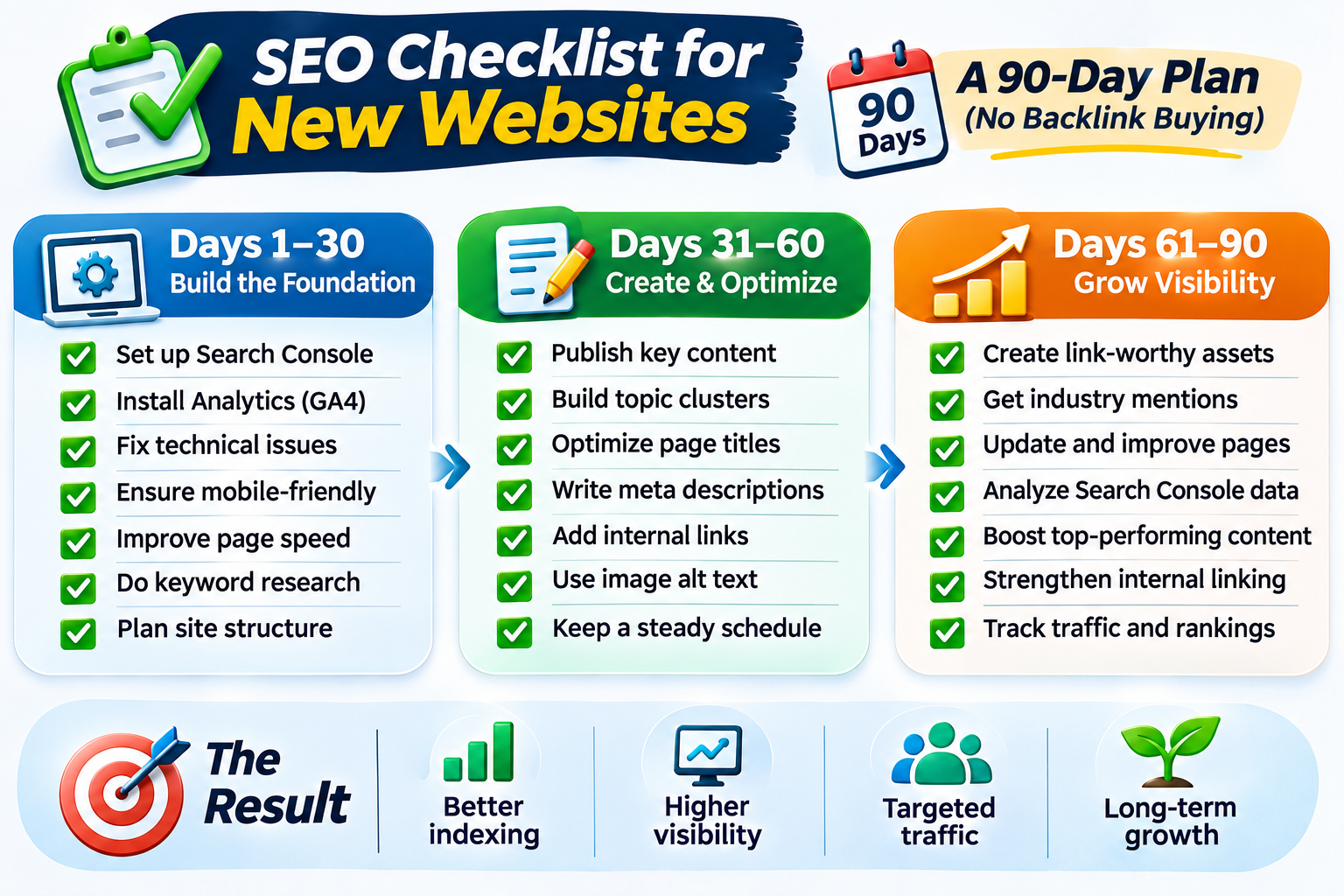
Your 90-Day SEO Roadmap
| Timeline | Main activity | Expected outcome |
|---|---|---|
| Days 1-15 | Search Console, analytics, sitemap | Search visibility setup |
| Days 16-30 | Technical SEO and keyword research | Strong website foundation |
| Days 31-45 | Pillar pages and content clusters | Relevant content coverage |
| Days 46-60 | On-page SEO and internal links | Better page organisation |
| Days 61-75 | Resources and industry outreach | Genuine visibility opportunities |
| Days 76-90 | Performance review and content updates | Clear improvement priorities |
SEO for New Websites: Final Thoughts
A new website does not need an expensive backlink package to start building organic visibility. It needs a clear subject focus, accessible pages, useful content and consistent improvement.
Treat SEO for new websites as a 90-day foundation-building exercise rather than a quick ranking campaign. Measure what people search for, understand which pages attract impressions and keep improving the information you publish. Sustainable search visibility comes from giving visitors a reason to choose your website, not from purchasing shortcuts.
SEO for New Websites: FAQs
1. How long does SEO take for a new website?
There is no guaranteed timeline. Search engines may discover pages quickly, but meaningful rankings and consistent organic traffic can take several months or longer, depending on competition, content quality and website authority.
2. Can a new website rank without backlinks?
Yes. Backlinks are not a prerequisite for every search result. A website can earn visibility through relevant content, good technical foundations and strong search intent alignment. However, genuine references can help build credibility and discovery.
3. How many blog posts should a new website publish?
There is no ideal number. Start with a manageable publishing schedule and prioritise comprehensive, useful articles that support your main services or products.