
Streaming Password Crackdowns: What’s Allowed and What’s Not Now
Sharing a streaming password with a sibling, friend or someone living in another city used to be an easy way to split entertainment costs. That arrangement is becoming harder to maintain. According to Pew Research Center’s 2025 survey, 26% of U.S. streaming users said they used a password belonging to someone outside their household. Among users aged 18–29, that figure reached 47%. Meanwhile, Deloitte’s 2026 Digital Media Trends research found that 90% of U.S. households have at least one paid streaming subscription, with subscribing households spending an average of $76 per month across services. These figures help explain why streaming password crackdowns have become a major part of the streaming business.
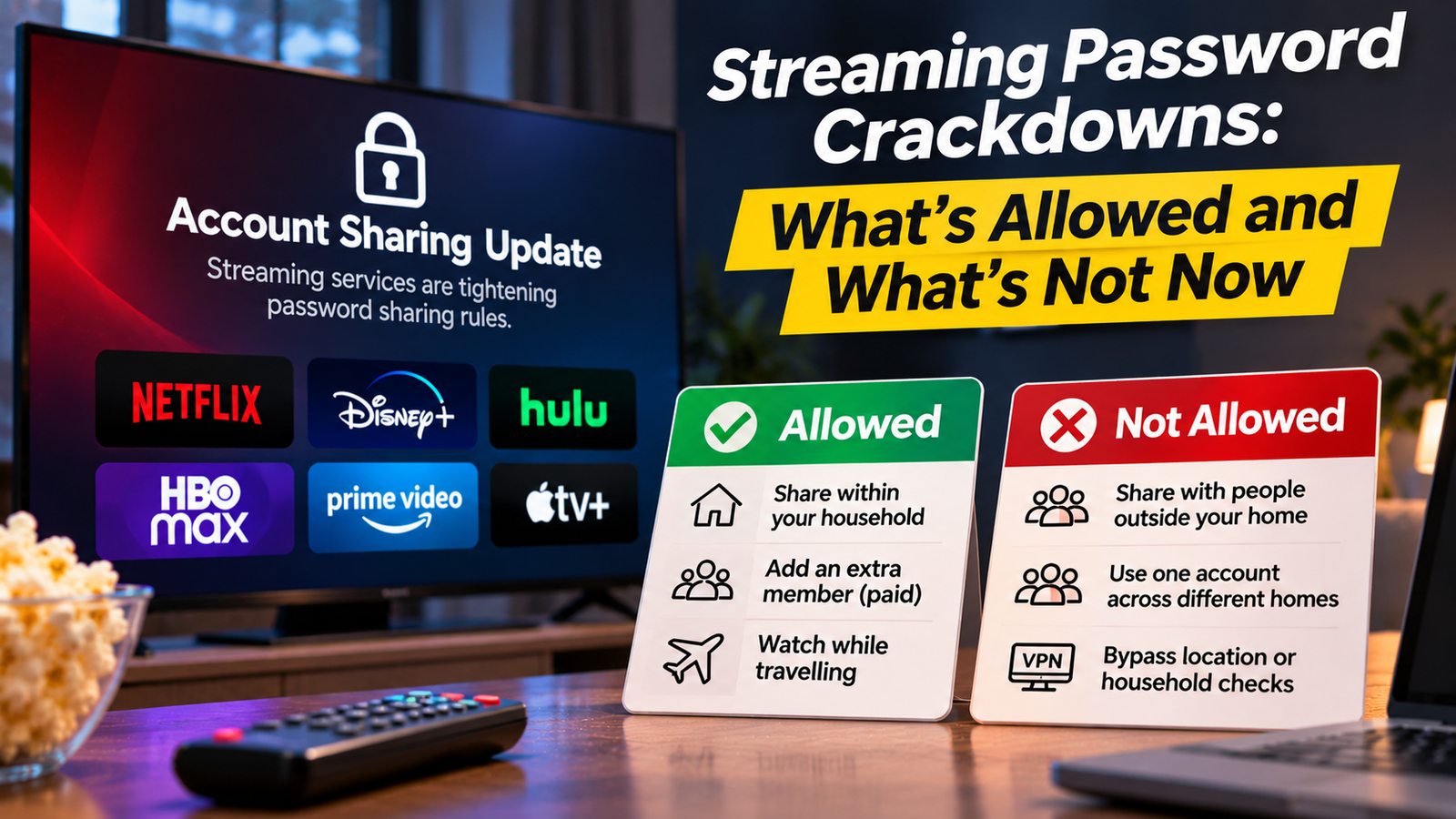
Netflix, Disney+, Hulu and HBO Max increasingly define access around a primary household, while other services have different sharing arrangements. Understanding the rules matters because having someone’s login details does not necessarily mean you are permitted to use their subscription.
What Does a Streaming Household Actually Mean?
A streaming household generally refers to people and devices associated with the account holder’s primary residence. Platforms may use internet connections, device information, account activity and location signals to identify that household.
This does not mean you cannot watch while travelling. Most household-based services provide ways to verify temporary access away from home. The problem usually arises when someone regularly uses an account from a separate residence.
The distinction is important: multiple profiles are not the same as multiple households. A family member having a separate profile does not automatically give them permission to watch from another home.
Which Streaming Services Allow Password Sharing?
The rules differ considerably between platforms. Here is how major U.S. services approach account sharing.
| Streaming service | Sharing outside your household | What you can do |
|---|---|---|
| Netflix | Restricted | Add an eligible paid Extra Member |
| Disney+ | Restricted | Use the Extra Member option where eligible |
| Hulu | Restricted | Check eligible Extra Member or bundle arrangements |
| HBO Max | Restricted | Use an Extra Member add-on where available |
| Amazon Prime Video | Limited household sharing | Use Amazon Family for eligible household members |
| Apple TV | Family Sharing supported | Share eligible subscriptions through an Apple family group |
| Peacock | Restricted by terms | Household members can use the account |
| Paramount+ | Restricted by terms | Follow household and simultaneous-stream rules |
A key point: a service’s terms and its enforcement practices are not necessarily identical. Do not assume that because a login works from another location today, the arrangement is permitted or guaranteed to continue.
Netflix: Extra Members Replace Free Account Sharing
Netflix explicitly states that an account cannot be shared outside the Netflix Household. People living elsewhere need their own subscription or an eligible Extra Member invitation.
The Extra Member option is available on eligible Standard and Premium plans in many countries. The account owner purchases an additional slot and invites the person, who gets their own login and profile. However, extra members are not supported on every billing arrangement or plan, including ad-supported plans.
Netflix also provides profile transfer options, allowing eligible users to move their viewing history, recommendations and saved list to a new account. This is useful if someone previously shared a family subscription and now needs an independent membership.
Disney+, Hulu and HBO Max: Household Rules With Paid Options
Disney+ defines a Household around devices associated with the primary personal residence. People outside that household can subscribe independently or use an eligible Extra Member add-on. The add-on provides a separate login and profile, although availability depends on the subscription and bundle.
Hulu’s subscriber agreement similarly prohibits sharing outside the household unless the subscription tier permits it. The company can analyse account usage and restrict access when it identifies a violation.
HBO Max also limits account access to people living with the account holder. Its Extra Member option is available for eligible subscriptions, while travellers can use its temporary travel verification process. The service may limit how often users can update household locations or identify themselves as travelling.
What About Amazon Prime Video and Apple TV?
These services have different arrangements, but neither should be treated as permission to distribute passwords freely.
Amazon allows eligible Prime members to share selected benefits through Amazon Family. Its U.S. household arrangement can include two adults with separate Amazon accounts, along with eligible teen and child accounts. Members must live at the same primary residential address, and the arrangement involves payment-method sharing for household verification.
Apple TV supports eligible subscription sharing through Apple Family Sharing, which can include up to six family members. This is safer than giving someone your Apple Account password, which could expose personal information beyond streaming access.
Streaming Password Crackdowns: What Happens If You Break the Sharing Rules?
The consequences depend on the service and the circumstances. You may receive a household verification message, be asked to confirm that you are travelling, lose access from an unrecognised device or be prompted to purchase an additional membership.
Some platforms reserve the right to restrict, suspend or terminate access when their terms are violated. For example, Peacock’s terms explicitly prohibit sharing outside the household unless permitted by the subscription tier.
Repeatedly changing household locations or sharing verification codes can also create account-access problems. Avoid using VPNs or location tricks to bypass restrictions; they are not a reliable substitute for an approved sharing arrangement.
How to Share Streaming Accounts Without Breaking the Rules
The simplest approach is to use the sharing features provided by each service. Before inviting someone, check whether your plan supports an Extra Member, family group or household arrangement.
If a friend or relative lives separately, compare the cost of an additional membership with the price of their own subscription. It may also be worth switching to an ad-supported plan or rotating subscriptions rather than paying for multiple premium memberships.
The shift behind streaming password crackdowns does not mean every form of sharing has disappeared. It means the definition of an eligible household and the permitted ways to add people have become more specific. Checking the current terms before sharing is the best way to avoid unexpected interruptions.
Streaming Password Crackdowns: Frequently Asked Questions
1. Can I share Netflix with someone who lives in another house?
Not through ordinary household sharing. You need an eligible Extra Member slot, or the other person must create their own account.
2. Can I use my parents’ streaming account if I live elsewhere?
Being related to the account holder does not automatically make you part of their household. Check whether the platform offers an Extra Member or family-sharing option.
3. Can I watch streaming services while travelling?
Yes, many services provide temporary travel access or device verification. Follow the platform’s official instructions rather than repeatedly changing your household location.
Also Read: Cloud Gaming in 2027: Is It Finally Good Enough to Replace a Console?