
Traveling? Cheapest Ways to Keep Your Number and Get Data
Discover the cheapest ways to keep your number and get data while traveling. Compare travel eSIMs, local SIM cards, roaming packs and Wi-Fi options.

International travel brings a small but important mobile dilemma: you want to keep receiving calls, messages and bank verification codes on your regular number, but you do not want to pay expensive roaming charges just to access maps, bookings and social media. With international travel from India reaching approximately 30.89 million departures in 2024, affordable connectivity has become a practical concern for millions of travellers. The good news is that you do not necessarily need to replace your existing SIM or purchase an expensive roaming package. The cheapest ways to keep your number and get data usually involve keeping your home SIM for calls and essential messages while using a separate local SIM or travel eSIM for internet access.
The right option depends on your destination, trip duration, phone compatibility and how often you need to use your regular number. Here is how to stay connected without letting mobile charges become an unexpected travel expense.
1. Use Your Regular SIM Alongside a Travel eSIM
For most short international trips, a dual-SIM setup offers an excellent balance between convenience and cost. You can keep your existing physical SIM or eSIM active for your regular number and install a separate travel eSIM to access mobile data abroad.
A travel eSIM is a digital SIM profile that you download onto a compatible, unlocked smartphone. Instead of visiting a shop or replacing your physical SIM, you can purchase a data package online, install it before departure and activate it according to the provider’s instructions.
Once you reach your destination, select the travel eSIM as your mobile data line and keep your home SIM available for calls and SMS. Turn off data roaming on your home SIM to avoid accidental charges.
This arrangement is often among the cheapest ways to keep your number and get data, particularly when you need reliable internet for navigation, messaging, ride-hailing and travel bookings but do not need your home carrier’s full roaming service.
2. Buy a Local SIM Card at Your Destination
A prepaid local SIM can be an economical option, especially if you are staying in one country for several weeks. Local operators often offer domestic data packages at lower rates than international roaming plans.
You can usually purchase one at an airport kiosk, mobile network store or authorised retailer. Depending on local regulations, you may need your passport or another form of identification to register the SIM.
The disadvantage is that your phone number changes while you use the local SIM, unless your device supports dual SIM and you retain your home line separately. You may also need to spend time comparing providers and completing registration after arrival.
For longer trips, however, a local SIM can offer better value than repeatedly purchasing small international data packages. Compare the included data, validity, coverage and top-up costs before choosing.
3. Compare Travel eSIM Packages Before You Fly
Travel eSIM providers offer prepaid data packages for individual countries, regions and multiple destinations. This is particularly useful if your itinerary includes several countries.
For example, a regional eSIM may cover multiple European destinations without requiring a new SIM every time you cross a border. A country-specific package may be more economical if you are visiting only one place.
Before buying, compare:
- Total data allowance rather than just the advertised starting price.
- Validity period and whether it begins at purchase or first connection.
- Supported countries and local partner networks.
- 4G or 5G availability and any speed restrictions.
- Hotspot or tethering support.
- Whether the package includes calls and SMS or is data-only.
Do not automatically choose the cheapest advertised package. A small data allowance may run out quickly if you use video calls, upload photographs or stream content regularly. Estimate your usage and select a package that covers the full trip.
4. Check Your Existing Carrier’s International Roaming Packs
If you travel occasionally and need your regular number to work normally, an international roaming pack may be worth considering. Indian operators such as Airtel, Jio and Vi offer international roaming options for eligible destinations.
These packages can include data, outgoing calls, incoming calls and SMS, depending on the selected plan. Some are designed for short trips, while others provide longer validity.
The convenience is clear: you do not need to install another SIM or manage two network connections. However, roaming packages can cost considerably more than a separate data-only eSIM.
Compare the total package price with the cost of a travel eSIM plus the minimum recharge or roaming arrangement needed to keep your home number active. Check destination coverage, incoming SMS availability and validity before paying. Do not assume that receiving a bank OTP will be free or guaranteed on every roaming plan.
5. Use Wi-Fi Calling and Messaging Apps
Free Wi-Fi can reduce your dependence on mobile data, particularly at hotels, airports, cafés and accommodation. Download maps, boarding passes, entertainment and important documents before leaving your hotel.
Messaging services such as WhatsApp and Signal also allow internet-based communication without requiring conventional international calls. However, they do not replace your regular mobile number for every purpose.
Wi-Fi Calling is another useful feature if your home carrier and device support it. It may allow you to make or receive calls using a Wi-Fi connection, but availability, charges and international-use restrictions vary by operator. Check the terms before relying on it.
6. Turn Off Background Data to Avoid Unexpected Charges
Even if you purchase a travel eSIM, your home SIM may still connect to a foreign network. Certain phone settings can trigger roaming charges without you realising it.
Before departure:
- Switch off data roaming on your home SIM.
- Set the travel eSIM as the default mobile data line.
- Disable automatic data switching if it could move data usage to your home line.
- Restrict background data for apps that consume large amounts.
- Turn off automatic app updates and cloud photo backups over mobile data.
- Monitor usage through your phone settings and eSIM provider’s app.
These small changes can prevent unnecessary data consumption and help you stay within your prepaid allowance.
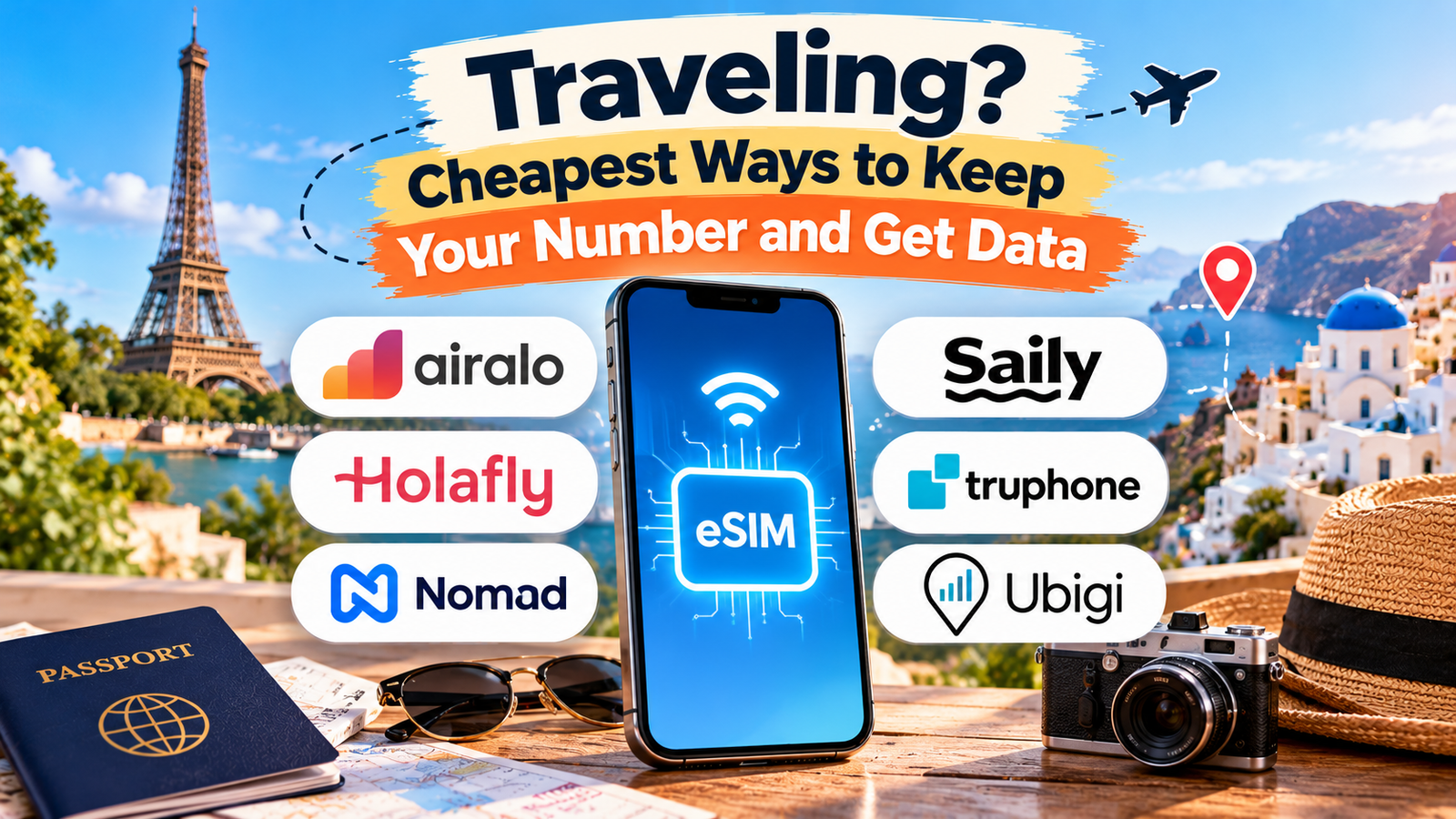
Cheapest Ways to Keep Your Number and Get Data
| Connectivity option | Best suited for | Main advantage | Possible drawback |
|---|---|---|---|
| Travel eSIM | Short trips and multi-country travel | Easy setup and prepaid data | Requires compatible, unlocked phone |
| Local SIM | Longer stays in one country | Often competitive local data rates | New number and registration |
| Home carrier roaming | Travellers who need their regular number fully active | Convenient, familiar service | Can be expensive |
| Wi-Fi and Wi-Fi Calling | Light data users and hotel-based travellers | Reduces mobile data usage | Not available everywhere |
| Dual-SIM setup | Travellers needing their number and affordable data | Keeps home line and travel data separate | Requires careful settings |
Cheapest Ways to Keep Your Number and Get Data: FAQs
1. Can I keep my existing phone number while using a travel eSIM?
Yes. If your phone supports dual SIM, you can retain your home SIM for your regular number and use a travel eSIM for mobile data. Your ability to receive calls and SMS depends on your home carrier’s international service and settings.
2. Is a travel eSIM cheaper than international roaming?
For many short trips, a data-only travel eSIM can be cheaper than a daily roaming pass. However, compare the actual data allowance, destination coverage and any additional cost of keeping your home number active.
3. Will I receive bank OTPs on my regular number abroad?
You may receive SMS verification codes if your home SIM remains active and your carrier supports SMS reception in that destination. Check the applicable roaming terms before travelling and keep an alternative authentication method where possible.
Also Read: Kovo Credit Builder Review: How Does It Work?