
Bluehost vs UltaHost vs Hostinger: Best Cheap Hosting Compared
Compare the best cheap hosting providers by price, features, performance, renewals, and value to find the right option for your website.

UltaHost currently lists shared hosting from $4.39/month, with that price shown as its current recurring monthly price. That makes this comparison more useful than simply asking which company has the cheapest first-year offer. Storage, number of websites, backups, email, CDN, WordPress tools, support, uptime commitments, and renewal costs can change the real value considerably.
Bluehost vs UltaHost vs Hostinger at a Glance
| Feature | Bluehost | UltaHost | Hostinger |
|---|---|---|---|
| Entry price | $3.99/mo | $4.39/mo | $2.99/mo |
| Entry-term | 36 months | Current monthly offer | 48 months |
| Renewal price | $9.99/mo | $4.39/mo currently shown | $10.99/mo |
| Entry websites | 10 | 1 | 3 |
| Entry storage | 10 GB NVMe | 30 GB NVMe | 20 GB SSD |
| Free SSL | Yes | Yes | Yes |
| Free domain | 1st year | Domain transfer | 1st year |
| Backups | Weekly | Free backups | Weekly |
| CDN | Free | Not highlighted on entry plan | Included |
| Money-back guarantee | 30 days | 30 days | 30 days |
| Best suited to | WordPress beginners | Budget-focused businesses | Overall value |
Prices and included features can change by location, billing term, and promotion, so the checkout price should always be treated as the final reference.
Hostinger: Best Overall Value

Source: Hostinger
Hostinger is the easiest pick if the priority is getting a lot of functionality without moving into higher-priced hosting tiers.
Its current Premium plan starts at $2.99/month when paid for 48 months. It supports three websites, provides 20 GB SSD storage, weekly backups, a free domain for one year, CDN access, AI tools, ecommerce support, and free email for the first year. The Unlimited plan starts at $3.99/month and increases storage to 50 GB NVMe, adds unlimited websites, and includes daily backups.
There is an important catch: the attractive $2.99 price is tied to a four-year commitment. Renewal rises to $10.99/month. That does not make Hostinger poor value, but it means the headline price should not be confused with the long-term cost.
For someone launching a portfolio, blog, small business site, or several WordPress websites, Hostinger currently offers one of the strongest feature-to-price ratios among these three.
Bluehost: Best for WordPress Beginners
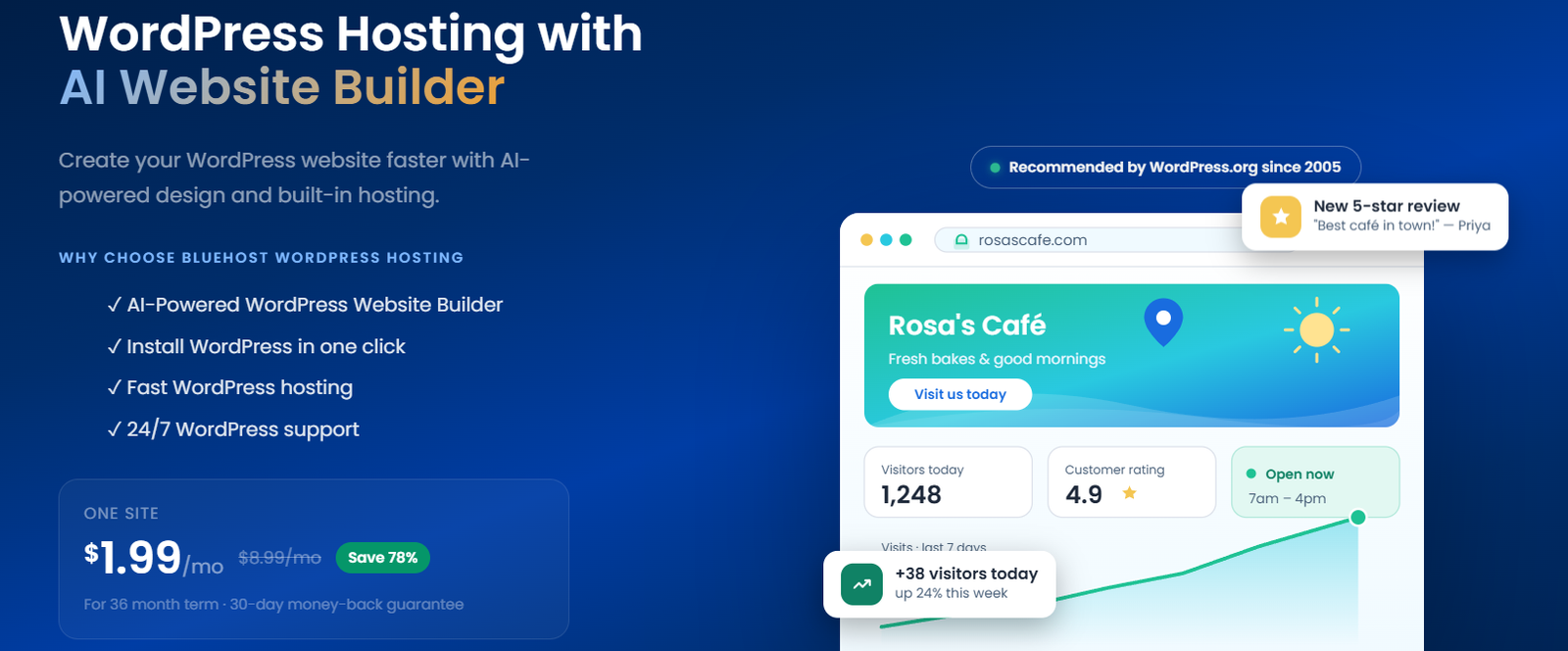
Source: Bluehost
Bluehost takes a slightly different approach. Its strength is not simply being cheap; it is making WordPress hosting relatively approachable.
- The current Starter plan costs $3.99/month for a 36-month term and renews at $9.99/month.
- It includes 10 websites, 10 GB NVMe storage, a free domain for the first year, free CDN, free migration tools, SSL, managed WordPress updates, AI site creation tools, weekly backups, and a 99.99% uptime SLA.
Bluehost also has an advantage in support.
- Its current plans provide 24/7 chat, while higher tiers add phone support.
- It is officially recommended by WordPress.org, which makes it particularly attractive to first-time WordPress users who want a mainstream ecosystem and guided setup.
The downside is the renewal price.
- Bluehost’s introductory price looks competitive, but the cost nearly triples after the initial term.
- Buyers should budget for the renewal rather than evaluating the service solely on the promotional rate.
UltaHost: Best for More Resources at the Entry Level
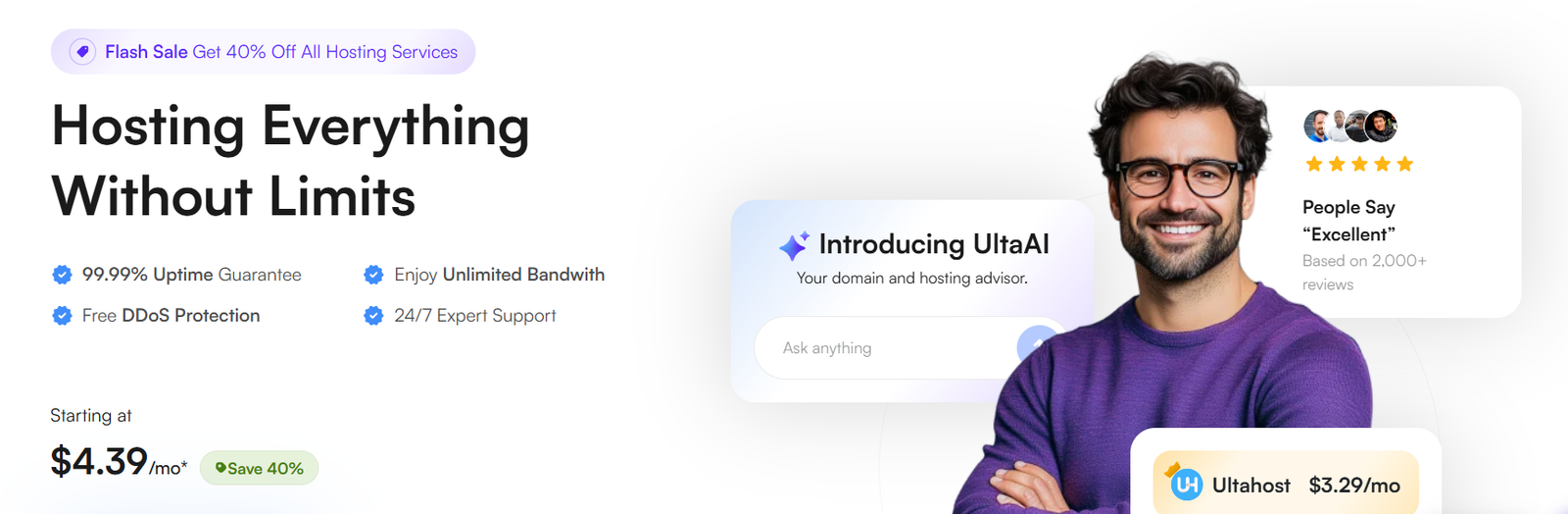
Source: Ultahost
UltaHost is the less obvious choice in this comparison, but its entry-level shared plan has an interesting specification.
Its Shared Starter plan is currently listed at $4.39/month and includes one domain, approximately 10,000 monthly visits, 30 GB NVMe SSD storage, unlimited bandwidth, free backups, free SSL, and free domain transfer. UltaHost also advertises a 99.99% uptime guarantee, DDoS protection, and 24/7 expert support.
The 30 GB NVMe allocation is considerably more generous than Bluehost’s 10 GB entry plan and Hostinger’s 20 GB Premium plan.
UltaHost also offers managed VPS hosting at relatively accessible prices, making it interesting for a business that expects to move beyond shared hosting later. An independent 2026 review found UltaHost particularly appealing for small and medium-sized businesses, although it also noted monthly visitor limits and some location-specific testing issues.
Best Cheap Hosting Providers: Where Each One Makes Sense
The best cheap hosting providers are not necessarily interchangeable.
- Choose Hostinger if your priority is the lowest introductory cost combined with multiple websites, modern tools, CDN access, AI features, and a simple dashboard.
- Choose Bluehost if WordPress is your main focus and you value a familiar platform, migration tools, managed WordPress features, and broader support options.
- Choose UltaHost if storage, unlimited bandwidth, backups, and a path toward managed VPS hosting matter more than having the absolute lowest introductory price.
Performance should also be considered alongside price. A recent 2026 comparison found Hostinger ahead of UltaHost in median real-world TTFB, although the underlying datasets were very different in size, so this should not be treated as a universal speed ranking.
Don’t Ignore Renewal Pricing
This is probably the most important point when comparing cheap hosting.
A $2.99 monthly promotional price sounds inexpensive, but four years at that rate means paying $143.52 upfront with Hostinger. Bluehost’s $3.99 rate similarly requires a 36-month term. After renewal, the monthly economics change substantially.
The cheapest-looking plan can therefore become the more expensive option if the website remains online for several years.
Also check whether backups, email, domain privacy, malware protection, and advanced security are included before comparing two plans purely by storage.
Final Verdict
Among these three, Hostinger is the strongest overall choice for cheap hosting, particularly for individuals, creators, small businesses, and users managing multiple websites.
Bluehost is the better fit for beginners who want a WordPress-oriented experience and more traditional support options. UltaHost is worth considering when larger storage and generous entry-level resources matter more than the lowest promotional price.
The key takeaway from comparing the best cheap hosting providers is simple: don’t buy based on the first number you see. Look at the contract length, renewal price, included backups, storage type, website limits, support, and upgrade path. A slightly more expensive plan can easily be cheaper over the life of a website if it includes features that would otherwise require paid add-ons.
FAQs
1. Is Hostinger cheaper than Bluehost?
On current advertised introductory pricing, yes. Hostinger starts at $2.99/month for a 48-month Premium term, while Bluehost starts at $3.99/month for a 36-month Starter term. Their renewal rates are $10.99 and $9.99 respectively.
2. Is UltaHost better than Hostinger?
Not universally. Hostinger currently has the lower entry price and a broader beginner-focused feature set, while UltaHost offers 30 GB NVMe storage and unlimited bandwidth on its entry shared plan.
3. Does cheap hosting mean poor performance?
Not necessarily. Shared hosting can provide good performance for blogs, portfolios, small business websites, and moderate traffic. The important factors are server resources, caching, CDN availability, storage technology, and how many sites share the infrastructure.
Also Read: How to Build Credit from Zero: A 12-Month Plan for the US