
The Complete Guide to Getting a Job with Online Certificates Only
Discover how to get a job with online certificates. Explore recognised certifications, career options, portfolio tips, resume strategies, and a practical 90-day job plan.

The idea that you need a traditional university degree to enter a professional career is gradually being challenged. Employers are increasingly recognising industry certifications, technical skills, practical assessments, and demonstrable work as additional ways to evaluate candidates. For someone who cannot afford a full-time degree or wants to enter a new industry, online certifications can provide a more flexible starting point. If you are considering getting a job with online certificates, the right strategy is to combine recognised credentials with practical projects and a targeted job search.
However, not all certificates carry the same weight. A short introductory course and an industry-recognised professional certification communicate very different levels of expertise.
According to Accredible’s 2025 State of Credentialing Report, 91% of surveyed HR and recruiting leaders actively look for digital credentials when reviewing candidates. Furthermore, 86% are more likely to interview someone with a digital credential demonstrating a relevant skill, and 63% have hired a candidate partly because of a digital credential.
This does not mean certificates have replaced university degrees. Rather, it shows that verified skills are becoming an important part of recruitment.
Identify Careers Where Online Certificates Can Open Doors
Before enrolling in courses, identify industries where employers are willing to consider skills-based qualifications. Some roles focus heavily on practical abilities, software knowledge, and demonstrable work rather than a specific academic background.
Here are some areas worth exploring:
| Industry | Job Roles to Target | Relevant Certifications |
|---|---|---|
| Digital Marketing | SEO Executive, PPC Specialist, Social Media Executive | Google Ads, HubSpot, Google Analytics |
| Data Analytics | Junior Data Analyst, Reporting Analyst | Google Data Analytics, Microsoft Power BI |
| IT Support | IT Support Technician, Help Desk Analyst | Google IT Support, CompTIA A+ |
| Cloud Computing | Cloud Support Associate | AWS Cloud Practitioner, Azure Fundamentals |
| Graphic Design | Junior Graphic Designer, Visual Content Designer | Adobe Certified Professional |
| Project Management | Project Coordinator, Junior Project Manager | CAPM, Google Project Management |
| Web Development | Junior Web Developer | Meta Front-End Developer, relevant coding certifications |
These are potential entry routes, not guaranteed degree-free career paths. Employers may still require formal qualifications for particular positions, especially in regulated professions and specialised technical roles.
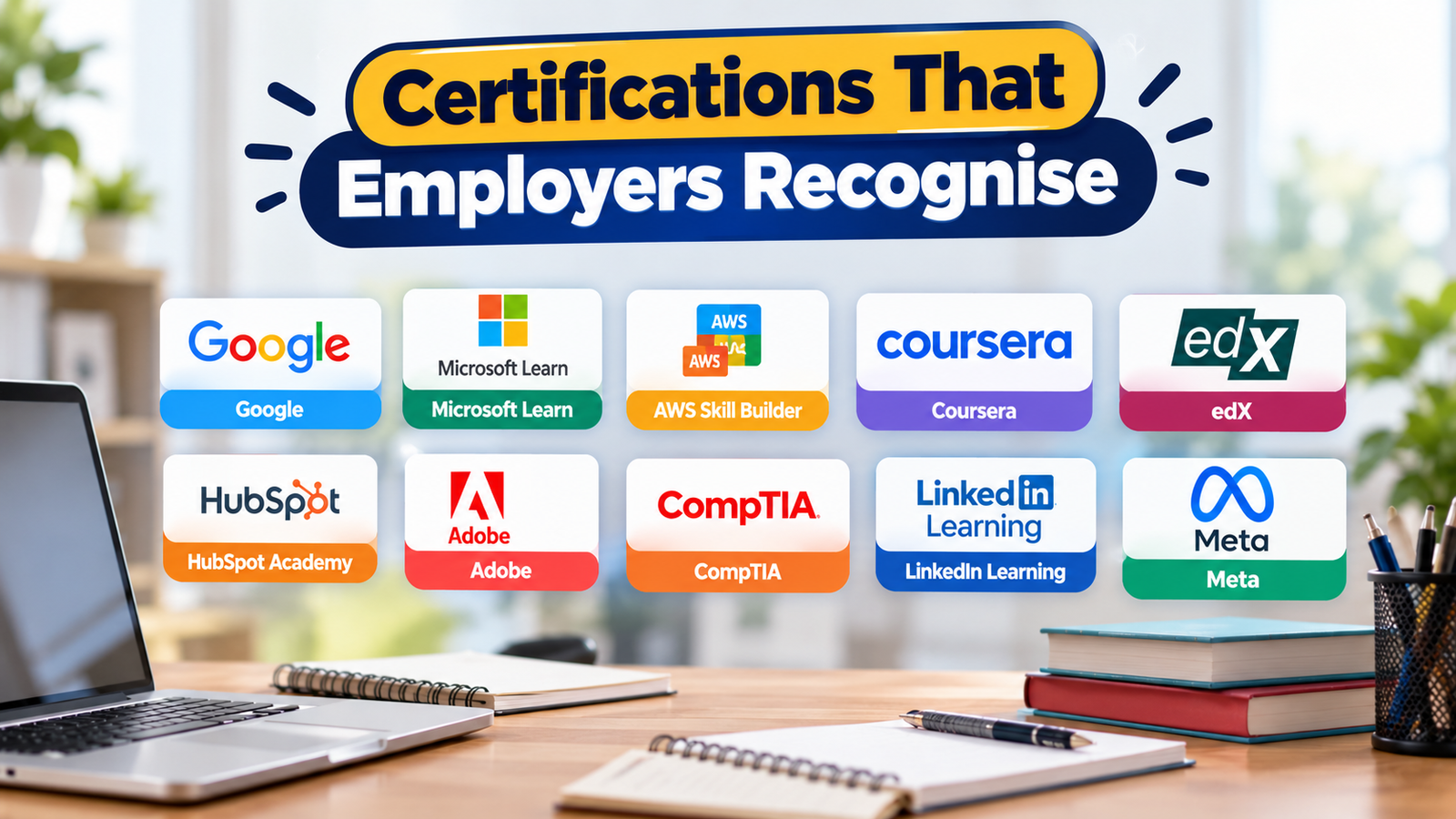
Choose Certifications That Employers Recognise
One of the biggest mistakes beginners make is enrolling in multiple courses simply because they offer free certificates.
Instead, prioritise certifications that are connected to actual job requirements.
Consider these platforms:
- Google Career Certificates: Google offers professional programmes in areas such as data analytics, digital marketing, IT support, cybersecurity, and project management. These are useful starting points for people exploring entry-level opportunities.
- Microsoft Learn: Particularly valuable for learning Excel, Power BI, Azure, Microsoft 365, and other Microsoft technologies. Some learning paths are free, while formal certification exams may involve fees.
- AWS Skill Builder: Offers training in cloud computing, infrastructure, and Amazon Web Services. It is a useful starting point for aspiring cloud professionals.
- HubSpot Academy: Provides certifications in inbound marketing, content marketing, email marketing, and sales.
- Coursera and edX: Host courses and professional programmes from universities and industry organisations. Check the actual certificate issuer and assessment requirements before enrolling.
When getting a job with online certificates, the credibility of the issuing organisation matters, but so does the depth of the assessment. A certificate backed by practical assignments or a recognised examination generally offers stronger evidence than passive video completion.
Build a Portfolio Alongside Your Certificates
This is where many candidates fall short.
Imagine two candidates applying for a junior digital marketing position. Both have completed a Google Ads course. However, one only lists the certificate on their resume, while the other presents a sample campaign structure, keyword research, ad copy, and a landing-page analysis.
The second candidate gives the recruiter something concrete to evaluate.
Your portfolio should demonstrate how you apply your knowledge.
Depending on your field, consider creating:
- Digital Marketing: A sample SEO audit, keyword research report, or Google Ads campaign plan.
- Data Analytics: Interactive Power BI dashboards, Excel reports, and SQL projects.
- Graphic Design: Social media creatives, brand identity concepts, and website designs.
- Web Development: A personal website, responsive landing page, or small application.
- Project Management: Project schedules, risk registers, workflow documentation, and case studies.
You do not need professional clients to create these projects. Start with realistic sample assignments and clearly label them as independent projects rather than paid client work.
Create a Resume That Highlights Skills, Not Just Certificates
Your resume should communicate what you can do, not simply list the courses you have completed.
Start with a short professional summary that identifies your target role and strongest skills.
For example:
Entry-level Data Analyst with practical knowledge of Excel, SQL, and Power BI. Completed professional training in data analytics and developed independent dashboard projects involving data cleaning, reporting, and visualisation.
Follow this with:
- Relevant technical and professional skills.
- Industry certifications with issuing organisations and completion dates.
- Portfolio projects with measurable outcomes where available.
- Internships, freelance assignments, volunteering, or relevant experience.
Include certificate verification links where available. You can also add recognised credentials to LinkedIn’s Licenses & Certifications section.
Apply Strategically and Prepare for Skill-Based Interviews
Once your resume and portfolio are ready, start applying to positions that match your actual capabilities.
Search for titles such as Junior Analyst, Trainee, Associate, Intern, Entry-Level Executive, and Graduate Trainee. Read the requirements carefully rather than applying based on job titles alone.
Use platforms such as LinkedIn, Indeed, Naukri, and company career pages.
During interviews, be prepared to explain:
- Why you selected your certifications.
- What you learned during each programme.
- How you applied those skills in practical projects.
- How you would approach a real workplace assignment.
A certificate may help you get noticed, but your ability to explain your work can determine whether you progress through the selection process.
A Practical 90-Day Plan to Become Job-Ready
If you are starting without relevant professional experience, give yourself a structured preparation period.
| Timeline | Focus Area | Expected Outcome |
|---|---|---|
| Days 1-15 | Research job roles and select a career path | Clear learning direction |
| Days 16-40 | Complete one or two relevant certifications | Foundational skills |
| Days 41-60 | Build two or three practical projects | Portfolio |
| Days 61-70 | Prepare resume and LinkedIn profile | Professional presentation |
| Days 71-90 | Apply for suitable jobs and practise interviews | Active job search |
This is a preparation framework, not a promise of employment within 90 days. Your timeline will depend on the complexity of the role and your existing knowledge.
Getting a Job with Online Certificates: FAQs
1. Can I get a job with online certificates and no degree?
Yes, some employers hire candidates based on relevant skills, certifications, and practical experience. However, eligibility depends on the industry, employer, and specific job requirements.
2. Which online certificate is best for getting a job?
There is no single best certification. Google Career Certificates, Microsoft certifications, AWS training, CompTIA certifications, and HubSpot Academy programmes are worth exploring depending on your chosen career.
3. Are free online certificates accepted by employers?
Yes, provided they come from credible organisations and demonstrate relevant knowledge. However, free course-completion certificates are not necessarily equivalent to professional certification exams.
Also Read: Humble Choice Review: Is the Monthly Subscription Worth It Now?