
From Zero to 10k Visitors: A Content-Led Growth Case Study Framework
Learn how to grow from zero to 10,000 monthly website visitors with a practical content-led growth framework, SEO strategy, examples and a 90-day plan.

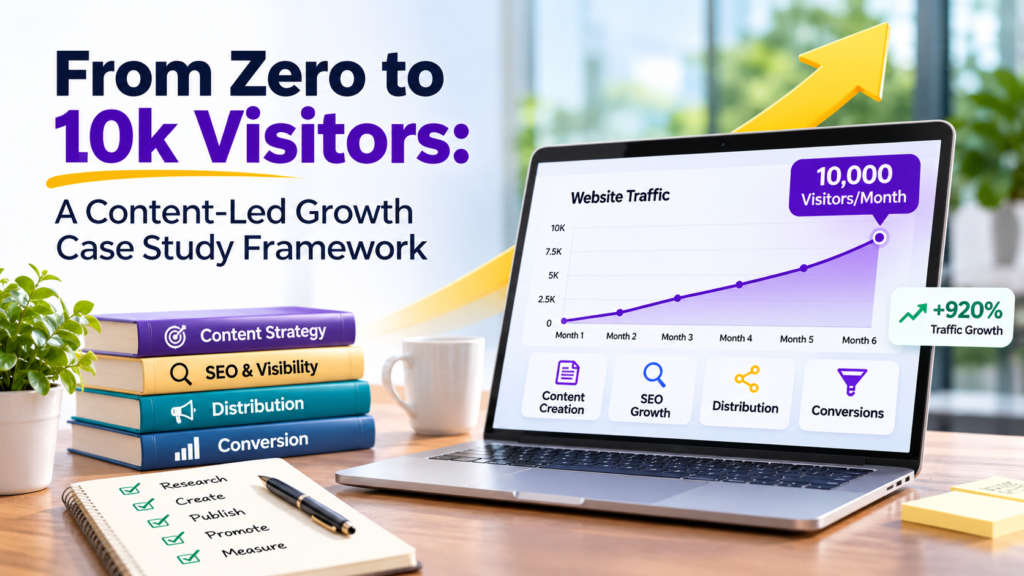
Reaching 10,000 monthly website visitors is a meaningful milestone for a new business, but it rarely happens through random blog publishing or social media posts alone. It requires a repeatable system that connects audience research, useful content, search visibility and distribution. That is the foundation of content-led growth.
There is a strong business case for taking this approach. HubSpot’s 2025 State of Blogging Report, based on more than 500 marketers, found that 65% worked at companies maintaining blogs, while 93% of those respondents considered blogging important or very important to their marketing strategy. Half reported higher blogging ROI in 2024 than the previous year. These figures suggest that blogging remains a valuable channel, but success depends on how strategically it is used.
This article presents a practical framework for taking a website from zero to 10,000 monthly visitors. The example uses a fictional project management software company, so the numbers illustrate how to plan and measure growth rather than claim a real-world result.
1. Start With a Narrow Audience, Not a Broad Topic
A new website cannot compete for every search term in its industry. Its first job is to become useful to a clearly defined group.
Imagine a project management SaaS company targeting small digital agencies. Instead of publishing broad articles about business productivity, it could focus on problems agency owners face every week:
- Managing client projects across multiple teams
- Tracking billable hours and deadlines
- Creating client onboarding workflows
- Choosing project management software
- Reducing missed deadlines and repeated revisions
This focus makes keyword research more practical. Build a list of questions from Google search suggestions, competitor content, customer interviews, sales conversations and relevant online communities.
Prioritise keywords by search intent, business relevance, ranking difficulty and the usefulness of the content you can realistically produce. A keyword with lower search volume but strong purchase intent may be more valuable than a broad term attracting thousands of unrelated visitors.
2. Build Topic Clusters Around Real Problems
Publishing isolated articles makes it harder to establish a recognisable subject focus. Instead, organise content into clusters.
For the fictional SaaS company, one cluster could be project management for agencies.
The main guide might be titled “The Complete Guide to Project Management for Digital Agencies”. Supporting articles could cover:
- How to create an agency project timeline
- Client onboarding checklist for marketing agencies
- How to manage multiple client projects
- Project management software comparison
- How to calculate project profitability
Each supporting article links to the main guide and to relevant related resources. This gives readers a useful path through the website and helps search engines discover the relationships between pages.
The principle behind content-led growth is to build depth around a subject instead of chasing unrelated keywords simply because they have high search volume.
3. Publish Content That Solves Specific Problems
A keyword is not a content brief. Before writing, examine what the searcher actually needs.
For example, someone searching “agency client onboarding checklist” probably wants a usable process, not a long introduction to customer relationships.
A strong article should include:
- A clear explanation of the problem.
- A practical process readers can follow.
- Examples, templates or screenshots where relevant.
- Common mistakes and ways to avoid them.
- Related resources and a logical next step.
Include original observations wherever possible. A software company could show how a sample agency organises tasks, assigns responsibilities and tracks approvals. That is more useful than repeating generic productivity advice.
Google’s people-first content guidance encourages original information, substantial value and demonstrable expertise rather than pages created primarily to attract search traffic.
4. Use a 90-Day Publishing and Distribution Plan
Publishing consistently matters, but distribution should be planned alongside production. A useful starting schedule is two high-quality articles each week, supported by smaller content assets.
| Period | Main activity | Example output |
|---|---|---|
| Days 1-30 | Research and foundations | 20-25 keyword targets, 6–8 articles, technical SEO setup |
| Days 31-60 | Build topical depth | 8-10 supporting articles, internal links, social distribution |
| Days 61-90 | Improve and expand | Refresh early articles, publish comparison pages, build relevant partnerships |
These are planning targets, not guaranteed ranking timelines. Search visibility can take longer, especially for a new domain.
Distribution should extend beyond publishing. Turn an article into a LinkedIn carousel, short email, checklist or short video. Share useful insights in relevant professional communities without dropping promotional links into unrelated conversations.
5. Measure the Journey to 10,000 Visitors
A traffic target becomes manageable when divided into smaller milestones. For example, a hypothetical website could aim for the following monthly sessions:
| Stage | Monthly visitors target | What to focus on |
|---|---|---|
| Starting point | 0-500 | Indexing, audience fit, first content |
| Early traction | 500-2,000 | Long-tail keywords, distribution |
| Building momentum | 2,000-5,000 | Topic clusters, content updates |
| Scaling | 5,000-10,000 | Winning topics, links, conversion paths |
These figures represent an illustrative growth model, not an expected result for every website.
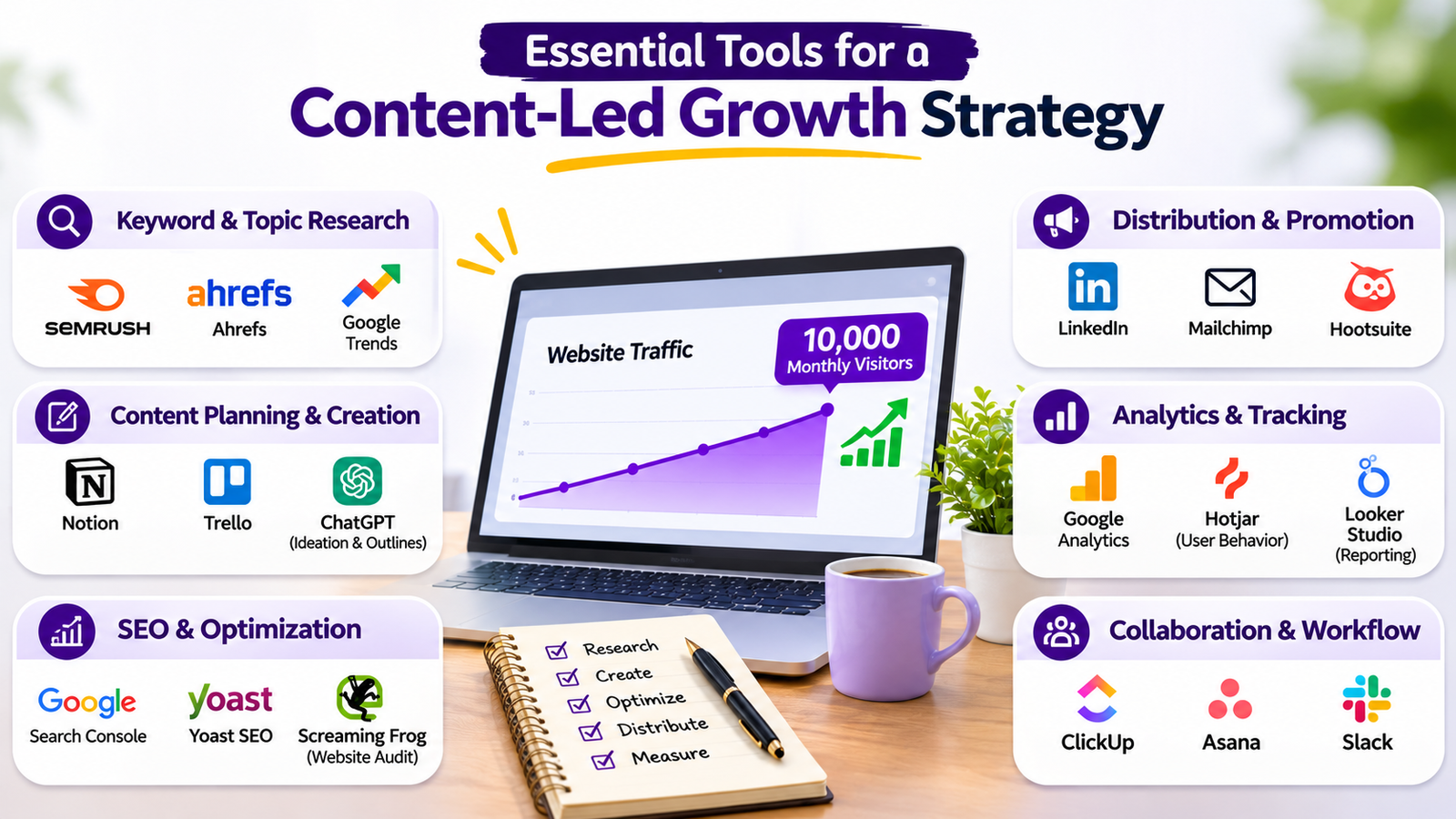
Track organic clicks and impressions in Google Search Console, and sessions, engagement and conversions in an analytics platform. Review landing pages separately. A page receiving 2,000 visits but producing no enquiries may need a different call to action or a better match between its content and the visitor’s intent.
6. Improve What Already Works
Once data starts coming in, resist the temptation to publish more simply to maintain a schedule.
Look for pages ranking between positions 5 and 20, articles receiving impressions but few clicks, and pages attracting traffic without meaningful engagement.
For example, if an article about agency onboarding receives impressions but has a low click-through rate, test a more descriptive title. If visitors leave before reaching the template, move the download link higher. If a comparison article attracts qualified readers, add clearer product differences and a relevant demo link.
This is where content-led growth becomes more efficient: the next improvement is guided by actual audience behaviour rather than guesswork.
7. Turn Traffic Into Business Outcomes
Ten thousand visitors are not automatically ten thousand potential customers. Build conversion opportunities into the content journey.
A beginner-focused guide might offer a downloadable checklist. A comparison article could link to a product demonstration. A detailed implementation guide might invite readers to book a consultation.
Measure newsletter subscriptions, demo requests, qualified leads and assisted conversions alongside traffic. The best-performing content is often the content that attracts the right audience and helps them take the next step.
Content-Led Growth: FAQs
1. How long does it take to reach 10,000 monthly visitors?
There is no fixed timeline. It depends on competition, domain history, publishing quality, distribution, technical health and search demand. A new website may need several months or longer.
2. How many blog posts are needed to reach 10k visitors?
There is no magic number. A focused library of 30 useful articles can outperform hundreds of thin, overlapping posts. Topic relevance and search demand matter more than volume.
3. Can a new website grow without paid advertising?
Yes. SEO, email newsletters, social distribution, partnerships and community participation can generate traffic without paid ads. However, these channels still require time and consistent effort.
Also Read: How to Speed Up a WordPress Site: 15 Fixes That Actually Work