
by parth@bidkinetic.com | Nov 24, 2026 | Business
Your credit report can influence whether you qualify for a mortgage, car loan, credit card or even a rental application in the United States. Yet many consumers focus only on their credit score without checking the financial information used to calculate it. Understanding how to read your credit report is important because an unfamiliar account, an incorrectly reported late payment, or an outdated balance could affect your ability to access credit and the interest rates you are offered.
In the US, three major credit bureaus- Equifax, Experian, and TransUnion- collect and maintain consumer credit information. Their reports are not always identical because lenders may report information to one, two or all three bureaus. Under the Fair Credit Reporting Act (FCRA), consumers have the right to access their credit reports and dispute information they believe is inaccurate or incomplete. You can currently obtain free reports from all three bureaus every week through AnnualCreditReport.com, the federally authorized website.
The important part is knowing what to look for. A few minutes reviewing your report could help you identify reporting mistakes, detect potential identity theft and avoid surprises when applying for your next loan.
What Does a US Credit Report Actually Contain?
A credit report is a record of your borrowing and repayment activity. It is different from a credit score: the report contains the underlying information, while a scoring model uses selected information to calculate a score.
| Report section |
What it contains |
What to check |
| Personal information |
Name, addresses, date of birth and identifying details |
Incorrect names or unfamiliar addresses |
| Credit accounts |
Credit cards, mortgages, auto loans and personal loans |
Unknown accounts and incorrect balances |
| Payment history |
Records of on-time and late payments |
Payments incorrectly marked late |
| Credit inquiries |
Records of businesses accessing your credit file |
Unrecognised hard inquiries |
| Collections and public records |
Certain reported collection accounts and applicable public records |
Accounts you do not recognise or inaccurate entries |
How to Read Your Credit Report Step by Step
1. Verify Your Personal Information
Start with your name, current and previous addresses, date of birth and other identifying details. An old address is not necessarily an error, but unfamiliar personal information may indicate that your file contains mixed information or that someone has used your identity.
Check that the report belongs to you before reviewing the financial details.
2. Review Every Credit Account
Look through the accounts section, sometimes called the tradelines section. It may include revolving credit accounts, such as credit cards, and installment loans, such as mortgages and auto loans.
Pay attention to:
- Account ownership and lender names.
- Opening dates and account status.
- Current balances and credit limits.
- Payment history and reported late payments.
- Closed accounts that still show an outstanding balance.
For example, if you paid off a car loan but it still appears as active with a balance, compare the entry with your final loan statement and account closure confirmation.
3. Understand Payment History and Credit Utilization
Payment history is an important factor in many US credit scoring models. Look for payments marked 30, 60 or 90 days late and compare them with your bank statements and payment confirmations.
For credit cards, also review your credit utilization ratio, the percentage of available revolving credit you are using. For example, a $2,000 balance on a card with a $5,000 limit represents 40% utilization. An incorrectly reported balance or credit limit could affect the utilization calculation.
4. Check Hard and Soft Inquiries
A hard inquiry generally occurs when you apply for credit, such as a new credit card or loan. A soft inquiry may occur when you check your own credit or when a company conducts a promotional or account-review check.
Unrecognised hard inquiries deserve attention. They could indicate an application you did not make, although not every unfamiliar inquiry automatically means identity theft.
Common Credit Report Errors That Can Cost You
| Error |
Why it matters |
What to do |
| Incorrect late payment |
May negatively affect credit scoring |
Provide payment confirmation |
| Paid loan shown as unpaid |
Makes your debt appear higher |
Submit the payoff statement |
| Unfamiliar credit account |
May indicate identity theft |
Contact the lender and dispute it |
| Incorrect card balance |
Can affect reported utilization |
Share the latest statement |
| Wrong credit limit |
May distort utilization calculations |
Request an account correction |
| Duplicate collection account |
May misrepresent outstanding debt |
Ask for verification and correction |
| Unauthorised hard inquiry |
May indicate an application made without permission |
Contact the company that accessed the report |
How to Dispute Credit Report Errors in the US

Under the FCRA, you have the right to dispute inaccurate or incomplete information. You should generally contact both the credit bureau reporting the error and the company that supplied the information, such as your bank, lender or collection agency.
Step 1: Gather supporting documents. Collect account statements, payment confirmations, payoff letters, correspondence and any relevant identity-theft documentation.
Step 2: Contact the credit bureau. Submit a dispute through the official website or by mail to Equifax, Experian or TransUnion. Clearly identify the account and explain what is inaccurate.
Step 3: Contact the information provider. Send the same explanation and supporting evidence to the lender or company that reported the incorrect information.
Step 4: Track the investigation. Credit bureaus generally have 30 days to investigate disputes, although certain situations allow up to 45 days. They must notify you of the investigation results, generally within five business days after completing the investigation.
Step 5: Escalate if necessary. If the issue remains unresolved after the dispute process, you can submit a complaint to the Consumer Financial Protection Bureau (CFPB). If identity theft is involved, use IdentityTheft.gov to report it and access recovery guidance.
You can find official instructions at ConsumerFinance.gov.
How Often Should You Check Your Credit Report?
Review all three reports at least once a year, and consider checking them more frequently before applying for a mortgage, auto loan or major credit card. Since reports can differ between bureaus, checking just one may not reveal every reporting issue.
Remember that checking your own credit report does not lower your credit score. Also, a corrected report does not guarantee an immediate score increase; the effect depends on the information changed and the scoring model used.
Take Control of Your Credit History
Your credit score tells lenders how your credit profile may look, but your credit report explains the information behind it. Understanding how to read your credit report allows you to identify inaccurate balances, incorrect payment records and unfamiliar accounts before they create problems. Make reviewing all three reports a regular financial habit, keep supporting documents and use your FCRA dispute rights when necessary. An accurate credit report is an important foundation for making informed borrowing decisions.
FAQs About How to Read Your Credit Report
1. Where can I get my credit report for free?
Visit AnnualCreditReport.com to access free reports from Equifax, Experian and TransUnion. Free weekly online access is currently available.
2. Does checking my credit report lower my score?
No. Checking your own report is a soft inquiry and does not negatively affect your credit score.
3. How long does a credit report dispute take?
Most disputes are investigated within 30 days. Certain circumstances allow the investigation period to extend to 45 days.
Also Read: Sleep and Exercise: How Training Time Affects Your Rest

by parth@bidkinetic.com | Nov 24, 2026 | Sports
Travelling can disrupt even the most disciplined fitness routine. Early flights, long road journeys, packed itineraries, unfamiliar food and irregular sleep make it difficult to maintain regular exercise. Yet staying active while travelling does not necessarily require a hotel gym or access to specialised equipment. The challenge is finding a routine that works around your travel schedule. Whether you are attending business meetings, exploring a new city or spending several days in a hotel, learning how to stay fit while traveling can help you maintain consistency without sacrificing your travel experience. Here are practical workouts, movement strategies and recovery tips that work even when you have limited space and no gym access.
Walking, climbing stairs, bodyweight exercises and everyday movement all contribute to an active lifestyle. According to the World Health Organization (WHO), adults should aim for 150-300 minutes of moderate-intensity aerobic activity or 75-150 minutes of vigorous activity every week, alongside muscle-strengthening exercises on at least two days. Importantly, physical activity does not have to happen in a gym.
Start With a 20-Minute Hotel Room Workout
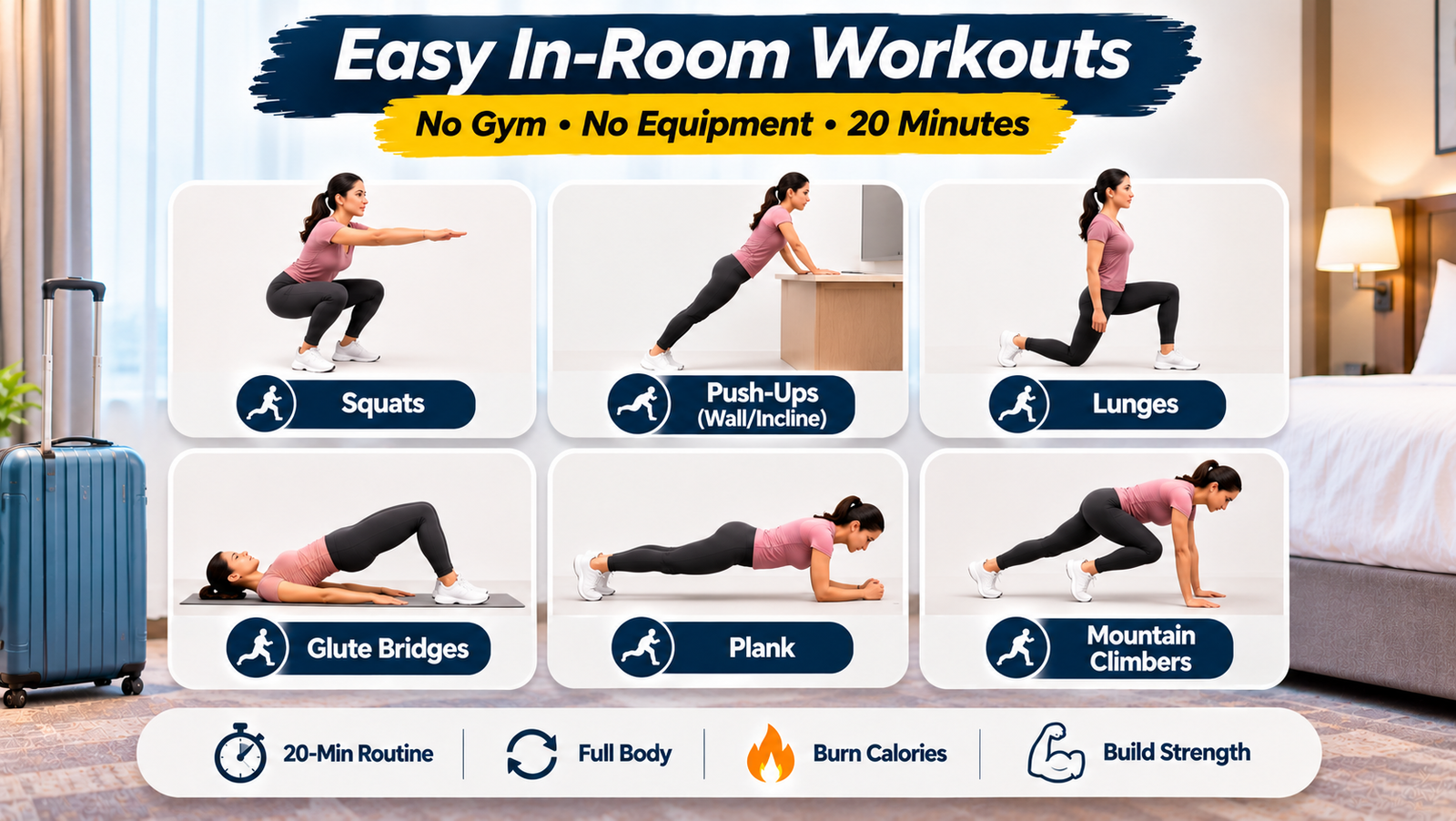
A hotel room can provide enough space for a simple full-body workout. You do not need dumbbells, machines or resistance equipment. Your body weight can provide sufficient resistance for a useful beginner-friendly session.
Try this 20-minute routine:
| Exercise |
Duration / Repetitions |
Main focus |
| Marching in place |
2 minutes |
Warm-up |
| Bodyweight squats |
15 repetitions |
Legs and glutes |
| Wall or incline push-ups |
12 repetitions |
Chest and arms |
| Reverse lunges |
10 per leg |
Lower-body strength |
| Glute bridges |
15 repetitions |
Glutes and hips |
| Plank |
30 seconds |
Core strength |
| Mountain climbers |
30 seconds |
Cardio |
| Standing stretches |
2 minutes |
Cool-down |
Complete the strength exercises in a circuit and repeat as your fitness level allows, using the remaining time for controlled rest and movement. Beginners can reduce repetitions or take longer breaks.
A useful tip: Choose exercises that do not involve jumping if you are staying in a hotel with neighbours below you. Controlled squats, wall push-ups and standing knee raises are quieter alternatives.
How to Stay Fit While Traveling: Outside Room Workouts
Not every workout needs to happen inside your room. Depending on your destination and schedule, you can use everyday surroundings to stay active.
1. Walking tours instead of vehicle rides
Exploring a city on foot is one of the easiest ways to add movement to your day. Walk to nearby restaurants, explore local markets or choose walking tours when practical. You get to experience the destination while increasing your daily activity.
2. Stair climbing at your hotel
If the hotel has accessible staircases, climbing a few flights can provide a short cardiovascular workout. Start with a comfortable number of floors and avoid rushing, particularly if you are unfamiliar with the building.
3. Swimming and outdoor activities
If your accommodation has a swimming pool, a short swimming session can work your upper and lower body. At outdoor destinations, consider cycling, hiking or walking trails, depending on your fitness level and local conditions.
Pack a Few Lightweight Fitness Essentials
You do not need to fill your suitcase with workout equipment. A few compact items can make exercising away from home more convenient.
- Resistance bands: Lightweight and useful for rows, shoulder exercises, squats and glute training.
- Skipping rope: A convenient cardio option when you have enough safe space and suitable flooring.
- Running shoes: Useful for hotel workouts, city walks and outdoor activities.
- Workout clothing: Carry quick-drying clothes that are easy to wash and reuse.
- Fitness app: Follow a saved workout routine or use a timer to manage exercise intervals.
A resistance band is particularly useful because it adds variety without taking up much luggage space. Travel health guidance also recommends planning workouts ahead and carrying compact exercise equipment such as resistance bands or skipping ropes.
Maintain Your Fitness Through Daily Movement
A common mistake is assuming that exercise only counts when you complete a structured workout. During travel, everyday movement can make a meaningful contribution.
Here are a few ways to increase activity without rearranging your itinerary:
- Walk around the airport terminal while waiting for your flight.
- Take stairs instead of elevators when practical.
- Walk to nearby cafes and restaurants.
- Explore hotel corridors or outdoor areas during breaks.
- Take a short walk after meals.
- If driving, stop periodically at safe rest areas to stretch and move.
The CDC specifically recommends walking at airports, using stairs and taking short activity breaks during road journeys.
These small decisions are especially useful on days when meetings, sightseeing or transportation leave little room for a formal workout.
Do Not Let Travel Disrupt Your Eating and Recovery
Exercise is only one part of maintaining fitness. Changes in meal timings, restaurant food, hydration and sleep can influence how you feel throughout a trip.
Try to include protein sources such as eggs, yoghurt, beans, lentils, fish or lean meat in your meals. Add vegetables, fruits and fibre-rich foods to maintain a balanced diet. Keep a reusable water bottle with you, especially when travelling in hot climates or spending time outdoors.
Sleep also deserves attention. Late-night flights, unfamiliar hotel rooms and changing time zones can affect recovery. Aim for a consistent sleep schedule where possible, and avoid intense workouts when you are exhausted or unwell.
A Simple Weekly Travel Fitness Schedule
You do not need to exercise intensely every day. The following schedule combines strength, cardio and everyday movement.
| Day |
Activity |
Suggested duration |
| Monday |
Hotel room full-body workout |
20 minutes |
| Tuesday |
City walking or sightseeing |
30 minutes |
| Wednesday |
Resistance band workout |
20 minutes |
| Thursday |
Walking and stair climbing |
25 minutes |
| Friday |
Hotel room bodyweight circuit |
20 minutes |
| Saturday |
Swimming, cycling or hiking |
30-45 minutes |
| Sunday |
Gentle stretching and recovery |
10-15 minutes |
Adjust the schedule to your travel commitments, fitness level and recovery needs. The objective is consistency, not completing every session perfectly.
Make Fitness Part of the Journey
Travelling does not have to mean putting your fitness goals on hold. You can maintain an active routine through short hotel workouts, walking tours, resistance band exercises and simple everyday movement. The secret to understanding how to stay fit while traveling is flexibility: adapt your routine to the destination instead of expecting every day to look like your usual schedule.
You may not complete every planned workout, and that is perfectly fine. Stay active when opportunities arise, eat balanced meals, prioritise recovery and enjoy the journey. A consistent approach will take you much further than an unrealistic fitness schedule.
How to Stay Fit While Traveling: FAQs
1. How to stay fit while traveling without a hotel gym?
Bodyweight exercises, walking, stair climbing and outdoor activities can help maintain your fitness without gym equipment.
2. How long should I exercise while travelling?
A 15–30-minute session is a practical option on busy days. You can also accumulate activity through walking and shorter movement breaks.
3. Are hotel room workouts effective?
Yes. Squats, lunges, push-ups and planks can train several major muscle groups. Their effectiveness depends on exercise selection, technique and gradually increasing the challenge.
Also Read: Sleep and Exercise: How Training Time Affects Your Rest

by parth@bidkinetic.com | Nov 24, 2026 | Health
Eight hours at a desk can leave your neck stiff, shoulders rounded, and lower back feeling uncomfortable, even if you exercise occasionally. The problem is not simply sitting with a bent back; it is spending too much time in the same position without enough movement. According to the World Health Organization, around 1.71 billion people worldwide live with musculoskeletal conditions, making these problems a major contributor to disability. Office workers are particularly familiar with neck, shoulder and back discomfort associated with prolonged computer use and poorly arranged workstations. The good news is that improving everyday posture does not always require expensive equipment or frequent appointments. A few adjustments to your chair, screen and keyboard, combined with regular movement and simple strengthening exercises, can make your workday more comfortable. Fixing posture without a physio starts with understanding what is putting unnecessary strain on your body and changing the habits that keep repeating it.
Why Desk Work Affects Your Posture
When you work at a computer, it is easy to lean towards the screen, push your head forward or allow your shoulders to roll inwards. Over time, these positions can increase the load on your neck and upper back. Sitting for long periods can also reduce movement around the hips and make your lower back feel stiff.
There is no single perfect posture that you must maintain all day. Even a well-arranged workstation can become uncomfortable if you remain still for hours. The better approach is to maintain a comfortable, supported position and change it regularly.
Start With Your Workstation Setup
Before buying a posture corrector or ergonomic chair, check how your existing workstation is arranged. Small changes can make a noticeable difference.
| Workstation element |
Recommended adjustment |
| Monitor |
Position the top of the screen around eye level |
| Chair |
Support your lower back and keep feet flat on the floor |
| Knees |
Keep them roughly level with or slightly below your hips |
| Keyboard |
Keep it close enough to avoid reaching forward |
| Mouse |
Place it beside the keyboard to reduce shoulder stretching |
| Elbows |
Keep them close to your body, around a right angle |
| Lighting |
Reduce glare so you do not lean towards the screen |
If your feet do not reach the floor comfortably, use a footrest or a stable support. Laptop users should consider a separate keyboard and mouse if they work at the same desk for extended periods. A laptop screen placed too low often encourages the head to tilt forward.
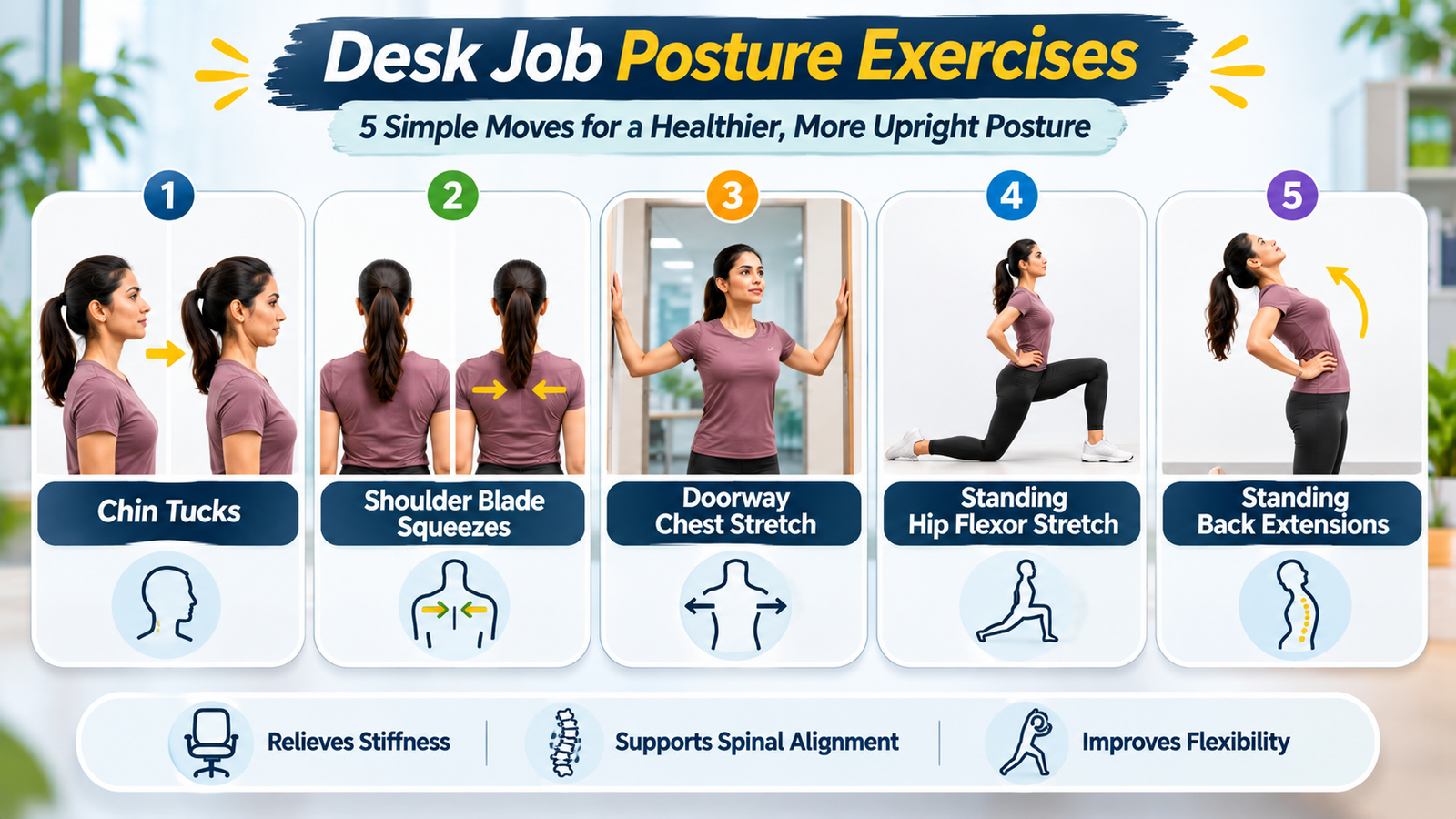
You do not need a gym session to move the areas that become stiff during desk work. Try these movements during breaks, staying within a comfortable range and avoiding anything that causes sharp pain.
1. Chin Tucks: For Forward Head Posture
Looking down at a laptop or phone for extended periods can encourage your head to move forward. Chin tucks help you practise bringing your head back into a neutral position.
- Sit upright and look straight ahead.
- Gently draw your chin backwards, as if making a double chin.
- Hold for 3-5 seconds and release.
- Repeat 8-10 times.
- Avoid tilting your head down or forcing the movement.
2. Shoulder Blade Squeezes: For Rounded Shoulders
When typing, your shoulders may gradually move forward. This exercise encourages better control of the muscles around your upper back.
- Sit or stand with your arms relaxed.
- Gently draw your shoulder blades towards each other.
- Hold for 5 seconds without lifting your shoulders.
- Repeat 10-12 times.
3. Doorway Chest Stretch: To Reduce Chest Tightness
Working with your arms in front of your body for hours can leave your chest feeling tight.
- Stand in a doorway and place your forearms against the frame.
- Step one foot forward gently.
- Lean slightly until you feel a comfortable stretch across your chest.
- Hold for 20-30 seconds.
Do not force the stretch or continue if it causes shoulder pain.
4. Standing Hip Flexor Stretch: For Tight Hips
Long periods of sitting keep your hips bent for much of the day. A gentle hip flexor stretch can help improve comfort and mobility.
- Step one foot forward into a short lunge.
- Keep your upper body upright.
- Gently move your hips forward until you feel a stretch at the front of the back leg.
- Hold for 20-30 seconds on each side.
5. Standing Back Extensions: After Long Sitting Sessions
If your lower back feels stiff after sitting, try a gentle standing extension.
- Stand with your feet hip-width apart.
- Place your hands on your hips.
- Gently lean backwards within a comfortable range.
- Return to an upright position and repeat 5-8 times.
Stop if the movement increases pain or causes symptoms to travel down your leg.
How Often Should You Take Movement Breaks?
Waiting until your back hurts is not the best strategy. Build movement into your workday before discomfort becomes a regular problem. A practical approach is to stand, walk or change positions every 30-60 minutes. Even a short walk to refill your water bottle or a few shoulder movements between meetings can help interrupt prolonged sitting.
Try this simple workday schedule:
| When |
What to do |
Time |
| Starting work |
Adjust chair, screen and keyboard |
2 minutes |
| Every 30-60 minutes |
Stand, walk or change position |
2-3 minutes |
| Mid-morning |
Chin tucks and shoulder blade squeezes |
2 minutes |
| Lunch break |
Walk or perform gentle mobility exercises |
5-10 minutes |
| Mid-afternoon |
Chest and hip flexor stretches |
3-5 minutes |
| End of day |
Take a short walk |
5-10 minutes |
The goal is not to follow a rigid timetable. Choose reminders that fit your workload and make movement a normal part of your routine.
Do Posture Correctors and Ergonomic Gadgets Actually Help?
Posture correctors, lumbar cushions, standing desks and ergonomic chairs are frequently marketed as quick solutions. Some can improve comfort, but none automatically fixes posture.
A lumbar cushion may provide additional lower-back support if your chair lacks it. A laptop stand can help raise the screen, while an external keyboard and mouse allow your arms to remain in a more comfortable position. A height-adjustable desk can make it easier to alternate between sitting and standing.
However, avoid relying on posture braces throughout the day without professional guidance. They do not replace movement, strength or good workstation habits. Fixing posture without a physio is more about developing sustainable habits than purchasing another product.
When Should You See a Physiotherapist?
Not every episode of desk-related stiffness requires professional treatment. However, persistent or worsening discomfort should not be dismissed as poor posture.
Seek medical advice if you experience:
- Pain that continues despite changing your workstation and activity habits.
- Tingling, numbness or weakness in your arms or legs.
- Pain that travels from your back into your legs.
- Significant discomfort that interferes with sleep or everyday activities.
- Pain following an injury.
Sudden severe weakness, loss of bladder or bowel control, or numbness around the groin requires urgent medical assessment. Self-care exercises are not a substitute for diagnosing an underlying condition.
Make Your Desk Workday Easier on Your Body
Good posture is not about keeping your back perfectly straight from morning to evening. It is about arranging your workspace comfortably, moving regularly and avoiding positions that repeatedly cause discomfort. Start with your screen and chair, introduce a few simple exercises and take short breaks between tasks. Consistently fixing posture without a physio can make desk work more comfortable, but remember that pain is not something you should simply learn to tolerate.
FAQs About Fixing Posture Without a Physio
1. Can I correct poor posture without visiting a physiotherapist?
You can improve everyday positioning through workstation adjustments, regular movement and gentle exercises. However, persistent pain or neurological symptoms should be assessed by a healthcare professional.
2. How long does it take to improve desk posture?
There is no fixed timeline. Comfort and movement habits may improve with consistent practice, but results depend on your starting point, daily routine and whether an underlying condition is present.
3. Is sitting straight all day good for your back?
No. Maintaining one rigid position for hours can also cause discomfort. A comfortable, supported posture combined with frequent position changes is a better approach.
Also Read: Sleep and Exercise: How Training Time Affects Your Rest

by parth@bidkinetic.com | Nov 23, 2026 | Sports
Running a 5K sounds like a simple goal until you start thinking about covering 5 kilometres without stopping. That’s approximately 3.1 miles, and for someone who spends most of the day sitting, even running for five minutes can feel challenging. The good news is that you do not need to be naturally athletic or have previous running experience to get started. A gradual running your first 5K plan can help you build stamina, improve cardiovascular fitness and develop the confidence to cover the distance. The NHS Couch to 5K programme, for example, uses three weekly sessions combining walking and running, progressing towards 30 minutes of continuous running over nine weeks.
There is a health benefit beyond the finish line, too. Adults are generally advised to get at least 150 minutes of moderate-intensity aerobic activity or 75 minutes of vigorous activity each week, alongside muscle-strengthening activities on two days. Running can contribute towards these targets, but beginners should build up gradually rather than trying to achieve everything immediately.
Before You Start: What Do You Actually Need?
You do not need expensive running equipment to begin. A few practical essentials will make training more comfortable:
- Running shoes: Choose comfortable shoes that fit properly and provide suitable support.
- Breathable clothing: Wear lightweight clothes that allow you to move freely.
- Water: Carry water, particularly in warm weather or during longer sessions.
- A timer or running app: Use it to track intervals and monitor progress.
- A safe route: Choose a flat, well-lit path with minimal traffic while learning to run.
Start every session with a five-minute brisk walk and finish with another five-minute easy walk. Keep your running pace comfortable. You should be able to speak in short sentences without gasping for breath.
Your 8-Week Couch-to-5K Training Plan
The plan below assumes three running or run-walk sessions per week, with at least one recovery day between them. Repeat the week’s intervals during all three sessions, adjusting the total duration to your comfort. The third session can be slightly longer by adding easy walking.
| Week |
Running and walking intervals |
Main goal |
| Week 1 |
Run 1 minute, walk 90 seconds × 8 |
Get comfortable with running |
| Week 2 |
Run 90 seconds, walk 2 minutes × 6 |
Build basic stamina |
| Week 3 |
Run 2 minutes, walk 2 minutes × 6 |
Improve breathing and rhythm |
| Week 4 |
Run 3 minutes, walk 2 minutes × 5 |
Extend running intervals |
| Week 5 |
Run 5 minutes, walk 2 minutes × 4 |
Develop endurance |
| Week 6 |
Run 8 minutes, walk 2 minutes × 3 |
Spend more time running |
| Week 7 |
Run 12 minutes, walk 2 minutes × 2 |
Build confidence over longer distances |
| Week 8 |
Run 20-30 minutes at an easy pace, using walk breaks when needed |
Prepare for your 5K attempt |
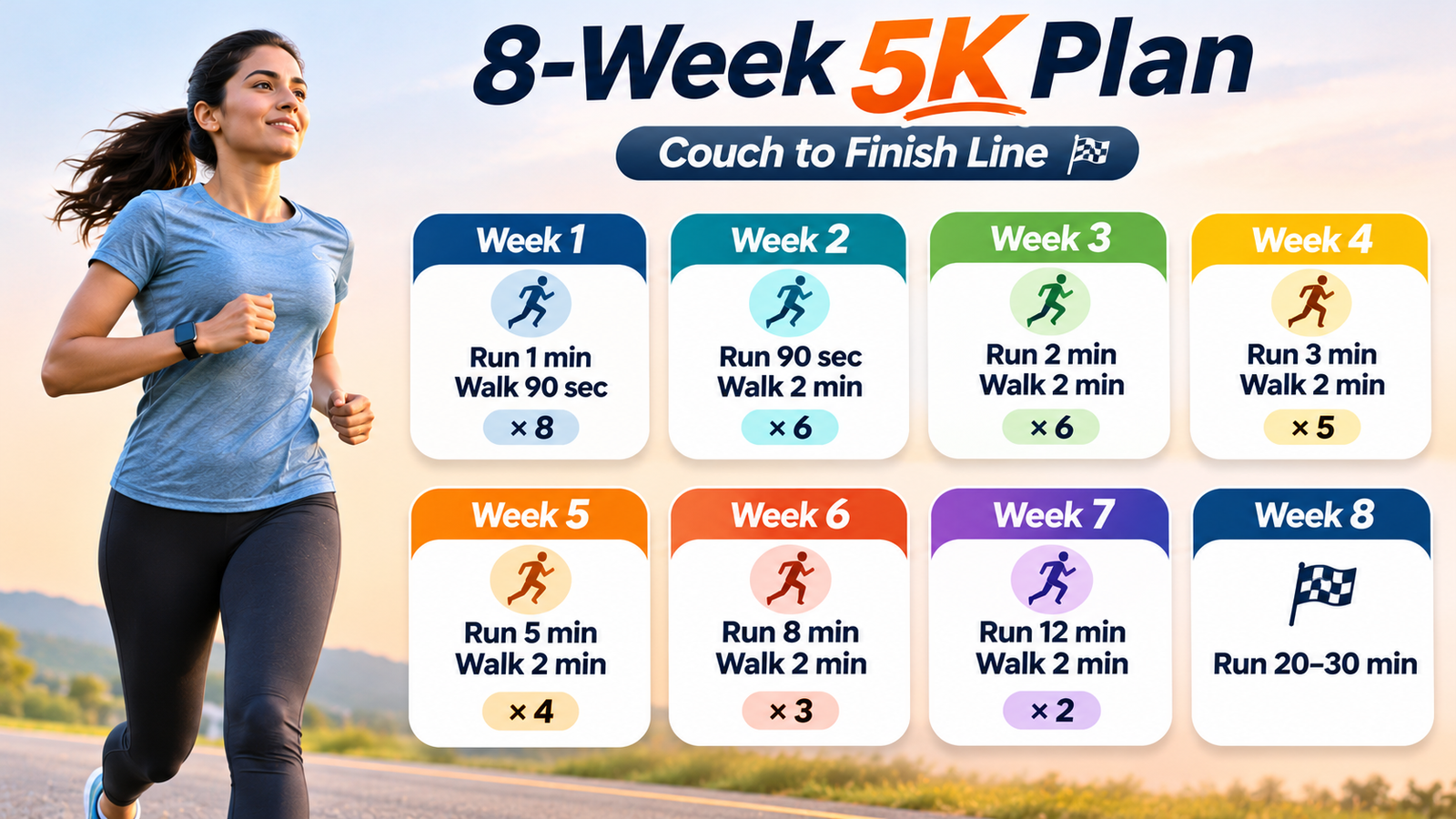
The intervals are a suggested beginner progression, not a guaranteed timetable. Add a five-minute warm-up and cool-down walk to every session. If a week feels too difficult, repeat it before progressing.
How to Make Each Week Count
The biggest mistake beginners make is treating every session like a fitness test. Your early runs should feel almost too easy. The goal is to develop the habit of running, not to prove how fast you can go.
During the first two weeks, focus on completing your sessions consistently. By weeks three and four, pay attention to your breathing and posture. Keep your shoulders relaxed, avoid taking unnecessarily long strides and let your pace develop naturally.
Weeks five and six may feel like a turning point because the running intervals become noticeably longer. Resist the temptation to increase your speed at the same time. In weeks seven and eight, practise running on a route similar to your planned 5K course. If you cannot comfortably run the full distance, use planned walking breaks. Completing 5K through a run-walk approach is still a successful finish.
Recovery Matters as Much as Running
Your body needs time to adapt to the new workload. Keep rest days between running sessions and consider adding two short strength-training sessions each week. Exercises such as squats, calf raises, glute bridges and simple planks can help build general strength.
Sleep well, eat balanced meals and drink enough fluids, especially after sweating. Mild muscle soreness can happen when starting a new activity, but sharp pain, swelling or discomfort that changes your running style should not be ignored. Stop exercising if you experience chest pain, faintness or unusual breathlessness, and seek medical attention when appropriate.
If you have a chronic health condition, have been inactive for a long time or are concerned about your fitness, speak with a healthcare professional before beginning vigorous exercise.
What Should You Do on Your First 5K Day?
Do not make race day your fastest training session. Have a familiar, light meal beforehand, arrive early and spend a few minutes walking to warm up. Start slower than you think you need to. The excitement of the event can make beginners run too quickly in the first kilometre.
Break the distance into smaller goals: reach the first kilometre, settle into your rhythm, manage the middle section and save your energy for the final stretch. Walking when needed is perfectly acceptable.
The Finish Line Is Only the Beginning
Your first 5K is not about setting a record. It is about building a routine, learning how your body responds to exercise and discovering that progress comes from consistency. Whether you run the entire distance or alternate between running and walking, completing running your first 5K is a meaningful achievement. Once you cross that finish line, you can decide whether your next goal is improving your time, running farther or simply making running a regular part of your life.
FAQs About Running Your First 5K
1. Can a complete beginner run 5K in eight weeks?
Some beginners can complete the distance in eight weeks using a gradual run-walk plan. Others may need longer, depending on their starting fitness, health and consistency. There is no disadvantage to extending the programme.
2. How many days a week should a beginner run?
Three sessions per week with recovery days between them are a practical starting point. This allows you to practise regularly without running every day.
3. Should I run continuously or take walking breaks?
Walking breaks are useful, particularly during the early stages. They help manage effort and make longer sessions more achievable. You can reduce them gradually as your stamina improves.
Also Read: Sleep and Exercise: How Training Time Affects Your Rest
by parth@bidkinetic.com | Nov 23, 2026 | Sports
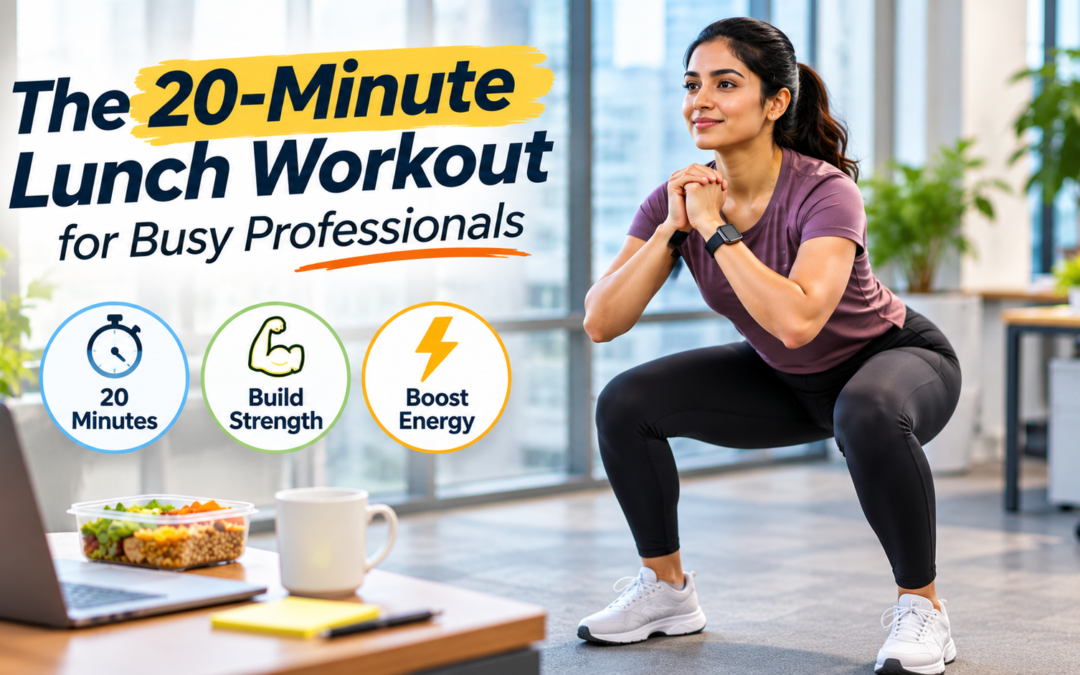
A packed calendar, back-to-back meetings and long hours at a desk can make exercise feel like another task on an already crowded to-do list. Yet skipping physical activity throughout the workday can affect more than fitness. Prolonged sitting is associated with increased health risks, while even short periods of movement can help break up sedentary time. According to the World Health Organization, adults should aim for 150-300 minutes of moderate-intensity aerobic activity each week, along with muscle-strengthening activities on at least two days. The good news? You do not need a gym membership or a full hour to make progress. A well-planned 20-minute lunch workout can help you move more, improve energy and build a consistent exercise habit without taking over your working day.
The key is to keep the routine simple, focused and realistic. Instead of spending your entire lunch break exercising, use 20 minutes for movement and leave time to cool down, freshen up and eat. Here is how to make that short window count.
Why a Midday Workout Makes Sense
Sitting for several hours can leave your hips, shoulders and back feeling stiff. A short movement break interrupts that pattern and gives you a chance to use muscles that may remain inactive during desk work.
A midday session can also be easier to maintain than an ambitious early-morning or late-evening routine. You already have a natural break in your schedule, and you do not need to commute to a gym if you choose exercises that can be done at home, in an office fitness room or in a nearby outdoor space.
Research on brief activity breaks suggests that interrupting prolonged sitting with movement can improve certain short-term health measures, including post-meal blood glucose responses. It is not a substitute for regular exercise, but it is a useful reason to avoid spending the entire day seated.
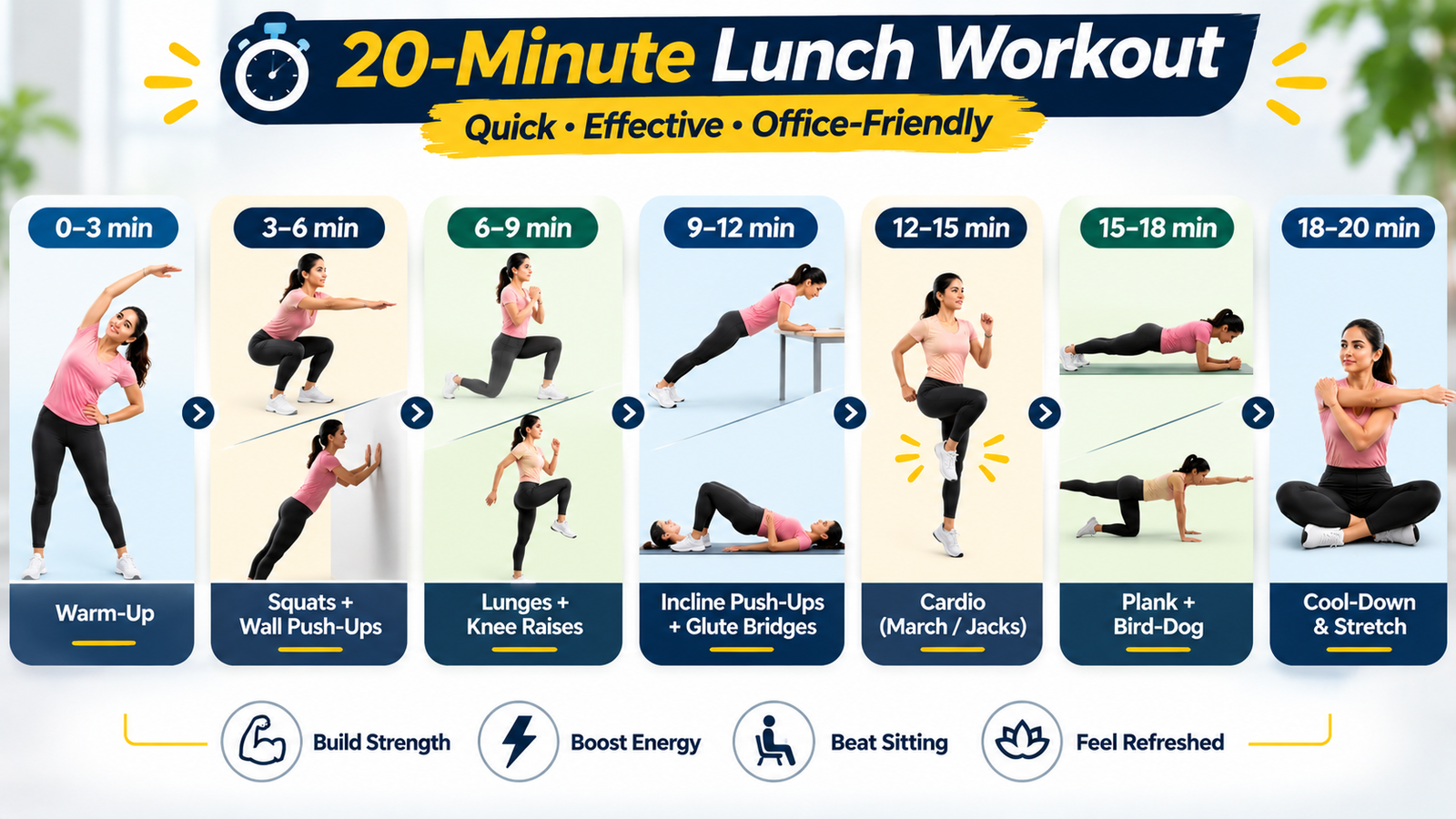
Your 20-Minute Lunch Workout Plan
This routine combines bodyweight strength exercises with short bursts of cardio. You will need comfortable clothing, a little floor space and a stable chair or bench. No equipment is essential.
| Time |
Exercise |
Duration |
| 0:00-3:00 |
Warm-up: marching, arm circles, hip rotations |
3 minutes |
| 3:00-6:00 |
Bodyweight squats and wall push-ups |
3 minutes |
| 6:00-9:00 |
Reverse lunges and standing knee raises |
3 minutes |
| 9:00-12:00 |
Incline push-ups and glute bridges |
3 minutes |
| 12:00-15:00 |
Marching or low-impact jumping jacks |
3 minutes |
| 15:00-18:00 |
Plank and bird-dog movements |
3 minutes |
| 18:00-20:00 |
Slow walking and gentle stretching |
2 minutes |
Work at a controlled pace, alternating exercises as needed. Beginners can take short breaks between movements, reduce repetitions or use easier variations. The aim is to finish feeling energised rather than completely exhausted.
How to Perform Each Exercise
The routine works best when you focus on good technique instead of rushing through repetitions. Here is what each movement contributes:
1. Warm-up (3 minutes)
Start with marching in place, followed by arm circles, shoulder rolls and gentle hip rotations. This gradually raises your heart rate and prepares your joints for movement.
2. Squats and wall push-ups (3 minutes)
- Bodyweight squats: Stand with feet around shoulder-width apart, bend your knees and push your hips backwards as if sitting on a chair. Return to standing.
- Wall push-ups: Place your palms against a wall at shoulder height, bend your elbows to bring your chest closer and push back.
These movements activate your legs, glutes, chest and arms without requiring equipment.
3. Reverse lunges and knee raises (3 minutes)
Step one foot backwards into a comfortable lunge, lower your body slightly and return to standing. Alternate legs. Follow this with standing knee raises to increase your heart rate without high-impact jumping.
4. Incline push-ups and glute bridges (3 minutes)
Use a sturdy desk or bench for incline push-ups, keeping your body straight as you lower and raise your chest. For glute bridges, lie on your back with knees bent, lift your hips and gently lower them. Avoid using an unstable office chair for support.
5. Low-impact cardio (3 minutes)
Choose brisk marching, step touches or low-impact jumping jacks. Keep moving at a pace that makes you breathe faster while still allowing you to speak.
6. Core and cool-down (5 minutes)
Alternate between a short plank and bird-dog movements, then finish with slow walking and gentle stretches. If you are new to exercise, perform the plank against a wall or elevated surface.
How to Fit the Workout Into a Real Working Day
A lunch break often includes eating, checking messages and preparing for afternoon meetings. Planning ahead makes the routine easier to follow.
- Keep your workout clothes ready: Store comfortable shoes and a spare T-shirt at your workplace.
- Choose your location beforehand: An empty meeting room, office gym, terrace or nearby park can work.
- Schedule the session: Block 20 minutes on your calendar so meetings do not automatically take over.
- Keep lunch practical: Prepare or pack your meal in advance rather than spending the entire break ordering food.
- Allow time to freshen up: Keep a towel, deodorant and spare clothes handy if you tend to sweat.
If your office has limited space, replace lunges and floor exercises with standing alternatives. A brisk walk around the building, stair climbing and chair-free squats can still create a useful movement break.
Is 20 Minutes Enough to Make a Difference?
A short workout is a valuable starting point, but it should be viewed as part of your weekly activity rather than a complete replacement for exercise.
The World Health Organization recommends 150-300 minutes of moderate aerobic activity per week for adults, or an equivalent amount of vigorous activity. It also recommends muscle-strengthening activities on at least two days each week. A daily 20-minute moderate-intensity session adds up to 140 minutes across seven days, putting you close to the lower weekly target.
There is also growing evidence for breaking up long periods of sitting. A 2026 systematic review and meta-analysis covering 53 studies found that short activity breaks reduced post-meal glucose and insulin responses compared with uninterrupted sitting. Walking breaks appeared particularly useful. These findings support moving regularly during the workday, although they do not mean one lunch workout alone guarantees the same benefits.
Make Your Lunch Break Work for Your Health
You do not have to reorganise your entire schedule to become more active. A practical 20-minute lunch workout gives you a manageable opportunity to strengthen your muscles, raise your heart rate and interrupt hours of sitting. Start with simple exercises, adjust the intensity to your fitness level and build consistency before making the routine harder. Most importantly, remember that movement outside your lunch break counts too. A short walk between meetings or a few minutes away from your desk can help make an otherwise sedentary working day more active.
FAQs About Lunch Workouts
1. Can I do a 20-minute lunch workout every day?
You can do light movement daily, but vary the intensity. Alternate strength-focused sessions with walking, mobility or gentle cardio, and allow recovery when your muscles feel tired.
2. Should I work out before or after lunch?
If possible, exercise before eating your main lunch and have your meal afterwards. If you prefer exercising after eating, allow time for digestion and choose a gentler session if you feel uncomfortable.
3. Can I lose weight with a 20-minute lunch workout?
It can contribute to overall energy expenditure and help establish consistent activity habits. However, weight management also depends on food intake, sleep, daily movement and other lifestyle factors.
