
by parth@bidkinetic.com | Aug 18, 2026 | Travel
If your trip is only a few days away, how to book a trip this week without overpaying depends less on finding a magical discount and more on knowing which parts of the trip you can still change. Flights often become expensive as seats disappear, while hotels may reduce prices to fill rooms that would otherwise remain empty. That creates an important distinction: last-minute hotel deals can be worth chasing, but waiting too long for a flight can easily backfire. The smartest approach is to compare airports, dates, destinations and the total cost before committing.

Start With Transport, But Don’t Lock Everything In
For a trip this week, check flights first because availability is usually more limited than hotel inventory. Search your main airport alongside nearby airports and compare the complete cost after adding fuel, parking, train tickets or airport transfers.
Also test different departure days. A Tuesday or Wednesday flight may be cheaper than a Friday departure, but there is no universal cheapest day. Your route and current demand matter more than booking-day myths.
If your destination is flexible, reverse the process. Instead of deciding on one city and accepting its airfare, search several destinations and compare what flights and hotels cost together.
Target Hotels With Unsold Rooms
Hotels are where last-minute travellers can sometimes find genuine bargains. A property would rather sell a room at a reduced rate than leave it empty, particularly outside major events and peak periods.
Search the same property across a metasearch platform, major booking websites and the hotel’s own website. Check rates for tonight, tomorrow and the next two or three nights if your schedule allows.
Do not compare only the advertised nightly rate. A cheaper room with no breakfast, expensive parking and a non-refundable policy may cost more in practice.
Tips and Tricks to Crack Last-Minute Deals
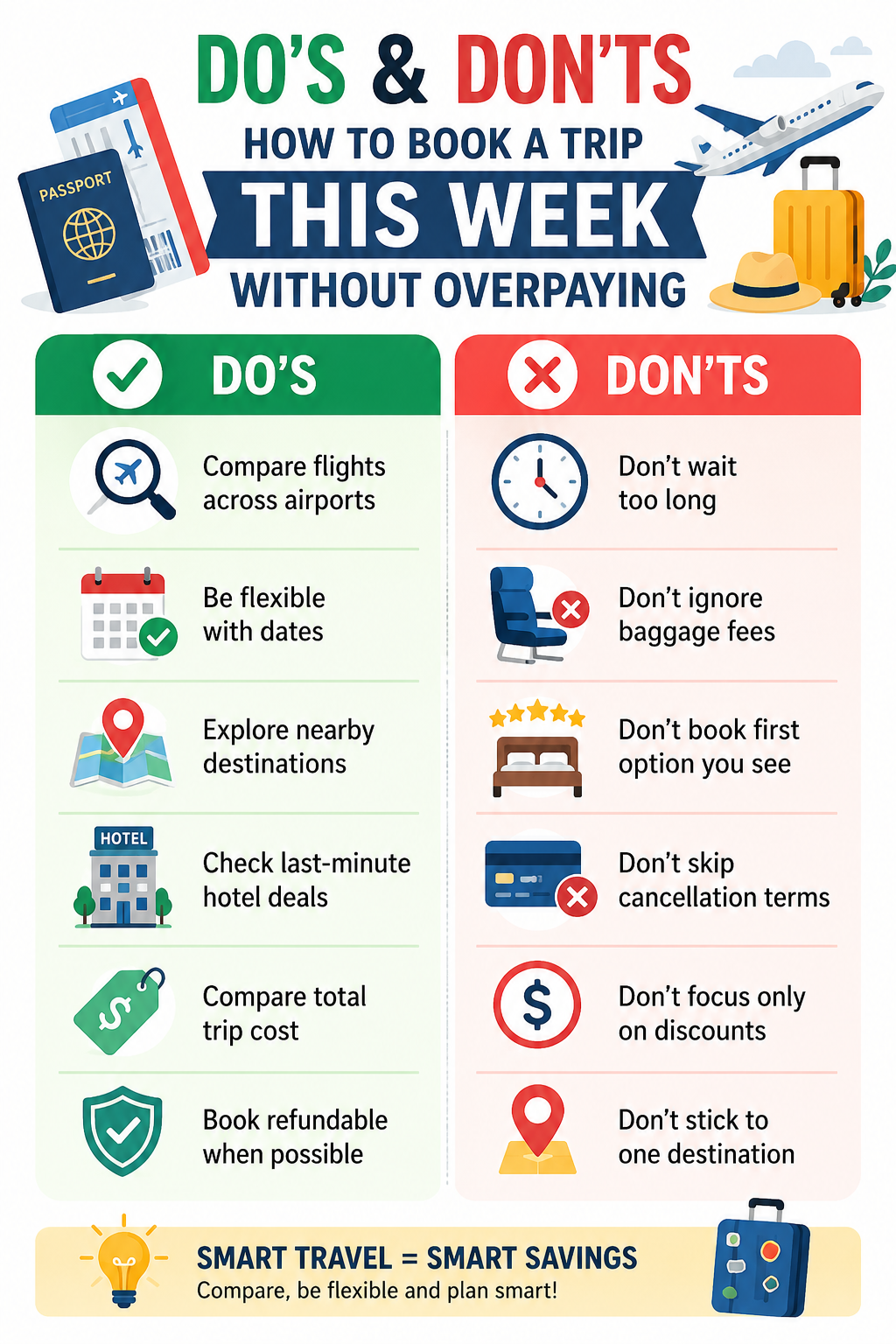
The easiest way to know how to book a trip this week without overpaying is to create several versions of the same trip and compare them.
- Search nearby airports: Calculate airfare plus parking, fuel and transfers.
- Shift travel dates: Check one or two days before and after your preferred dates.
- Try nearby destinations: Compare cities offering similar experiences and shorter routes.
- Check hotel packages: Flight-and-hotel bundles can sometimes beat separate bookings.
- Search 24-72 hours ahead: Hotels may discount remaining rooms close to arrival.
- Call the hotel: Ask whether a direct rate or complimentary upgrade is available.
- Check loyalty accounts: Member prices, points and unused travel credits can reduce costs.
- Use deal alerts: Set alerts rather than repeatedly checking prices manually.
- Compare final totals: Include baggage, taxes, meals, parking and transfers.
- Book refundable hotels: Secure a reasonable rate and keep watching for a drop.
Don’t Fall for Fake Bargains
A large percentage discount does not automatically mean a good deal. Always compare the current price with competing properties or booking channels.
For flights, check baggage allowances before paying. A basic fare can become considerably more expensive after adding luggage, seat selection and airport transfers.
For hotels, compare identical room categories and cancellation conditions. A $90 refundable room can be better value than a $75 non-refundable room if your plans are uncertain.
This is why how to book a trip this week without overpaying is really about comparing the complete trip cost, not hunting for the biggest percentage discount.
A Simple Last-Minute Booking Strategy
| Step |
What to Check |
| 1 |
Compare nearby airports |
| 2 |
Test flexible travel dates |
| 3 |
Search alternative destinations |
| 4 |
Compare flight baggage costs |
| 5 |
Check hotels across platforms |
| 6 |
Compare direct hotel rates |
| 7 |
Calculate complete trip cost |
| 8 |
Review cancellation conditions |
If you find a good refundable hotel rate, book it and continue monitoring prices. Just make sure you understand the cancellation deadline before replacing the reservation.
How to Use Trivago, Lastminute.com and TourRadar for Last-Minute Deals
When you’re booking within days rather than weeks, each platform can be used differently to uncover better-value options. The trick is not to search once and book immediately; compare, adjust and recheck.
Trivago: Catch Hotel Price Drops
Use Trivago to compare the same hotel across multiple booking websites. For a trip this week, search your preferred dates first, then test one day earlier and later.
Try this:
- Compare the cheapest three hotels.
- Check the hotel’s direct website.
- Compare refundable and non-refundable rates.
- Look at tonight and tomorrow’s prices.
- Expand your search to nearby areas.
- Check the final price after taxes.
If you find a refundable room at a reasonable price, booking it first and continuing to monitor rates can give you an opportunity to switch if the price falls.
Lastminute.com: Look for Package Deals
Lastminute.com is particularly useful when you need a flight and hotel together. Search your destination with flexible dates and compare the package against booking the flight and accommodation separately.
Try this:
- Search several nearby destinations.
- Compare different departure dates.
- Check flight-plus-hotel packages.
- Compare baggage-inclusive prices.
- Look for short city breaks.
- Check cancellation conditions carefully.
A package is only a bargain if the final price remains lower after baggage, transfers and other necessary extras are considered.
TourRadar: Find Unfilled Tour Departures
For travellers who prefer organised trips, TourRadar can be useful for finding multi-day tours with upcoming departures. Last-minute availability can sometimes work in your favour when operators still have spaces to fill.
Try this:
- Filter for your departure week.
- Prioritise confirmed departures.
- Compare similar itineraries.
- Read the newest reviews.
- Check what’s included.
- Look for optional-cost activities.
Don’t book solely because a tour has a large discount. A slightly more expensive itinerary with airport transfers, meals and better accommodation included could have a lower overall cost.
The Smartest Approach
Use the platforms together rather than relying on just one. Check Trivago for accommodation, Lastminute.com for packages and TourRadar for organised tours, then compare the final costs. This approach gives you more ways to find a genuine last-minute deal instead of simply accepting the first discounted price you see.
When Waiting Can Hurt
Booking a trip this week without overpaying does not mean waiting until the last possible moment. If you are travelling during a festival, sporting event, school holiday or major conference, waiting can leave you with expensive flights and poor hotel choices.
The better strategy is to be flexible before availability becomes scarce. Changing your destination by 50 kilometres, shifting your flight by a day or choosing a hotel slightly outside the centre can sometimes save more than chasing a promotional code.
FAQs on How to Book a Trip This Week Without Overpaying
1. Are last-minute trips actually cheaper?
They can be, particularly for hotels with unsold rooms, but flights can become more expensive as departure approaches.
2. Should I book flights or hotels first?
Generally, check flights first because seat availability is more limited. Once you know the realistic transport cost, build the hotel around it.
3. Is it cheaper to book on a particular day?
There is no dependable universal cheapest booking day. Prices respond to route-specific demand and availability.
Ultimately, how to book a trip this week without overpaying comes down to flexibility and comparison. Don’t chase a mythical secret deal; change the dates, airport, destination or hotel and let the actual numbers determine the best option.
Also Read: How to Book Multi-Day Tours Online: A TourRadar Guide for First-Timers

by parth@bidkinetic.com | Aug 17, 2026 | Travel
Let me paint a familiar picture. You’re planning a trip; you’ve got five browser tabs open – Booking.com, Expedia, Hotels.com, the hotel’s own website – and somehow none of them agree on the price. One site says $189 a night and another says $214. A third throws in “free breakfast” but buries the real rate in fine print. Twenty minutes later, you’ve forgotten what you were even comparing. That’s the exact mess Trivago was made to clean up.

The Idea Behind It
At its core, Trivago is a hotel price comparison engine. You type in a destination and your dates, and it pulls rates from hundreds of booking platforms at once, lining them up so you can see who’s actually offering the best deal – without clicking through a dozen sites yourself.
It doesn’t take your booking. It just points you to the right place.
The company started in Düsseldorf back in 2005, which feels like ancient history in internet terms. Today it operates across more than 50 countries, covering everything from a $60 motel outside Memphis to a five-star property overlooking the Amalfi Coast. The range is genuinely impressive.
Using It Day-to-Day
The search itself is fast – almost annoyingly so, because the results load before you’ve fully processed what you’re looking at. Enter where you’re going, when you’re arriving, how many people, and you’re done. What comes back is a full list of hotels with prices stacked side by side from different booking sites, photos, star ratings, and something called the Trivago Rating Index.
That last part is worth mentioning. Instead of hunting across TripAdvisor, Google Reviews, and Booking.com to piece together what guests actually thought of a place, Trivago rolls all of it into one score. It’s not perfect – no aggregated number ever is – but it cuts down a surprising amount of decision fatigue.
There’s also a Deal Finder that flags rooms priced below their typical range. Useful if you’re flexible on timing, or just curious whether waiting a week might save you $40.
Who Actually Gets the Most Out of This
Honestly? Anyone who’s ever felt annoyed by the hotel booking process. But practically speaking, it’s most valuable for people with some flexibility – travellers who aren’t locked into one specific hotel or exact date and can actually act on a good price when they see it.
- Business travellers like it because it’s fast.
- Leisure travellers like it because it’s thorough.
- Budget travellers like it because nothing stings quite like discovering the same room was $30 cheaper on a site you didn’t check.
One Thing Worth Knowing
Trivago is free to use because the booking platforms pay to appear in results – a cost-per-click arrangement. That’s standard for comparison sites. It doesn’t mean the results are skewed toward whoever paid more, but it’s worth understanding how the lights stay on.
Price differences of 20-30% for the same room aren’t rare. Finding them takes about 30 seconds on Trivago. That alone makes it worth knowing about.
Also Read: How to Find Genuinely Cheap Hotels: Trivago, Metasearch, and Timing Tricks

by parth@bidkinetic.com | Aug 17, 2026 | Gadgets
Most phone cases exist to do one thing: stop your screen from shattering when you drop it on the kitchen tiles. That’s it. They don’t care how you hold your phone, whether you film content standing up, or how many times a day you prop your device against a coffee cup because you’ve run out of hands. They just sit there and absorb impact. TORRAS decided that was too small an ambition.

More Than a Case Company
TORRAS is a consumer tech accessories brand that builds phone cases, screen protectors, chargers, power banks, and a growing range of device peripherals. The product lineup covers iPhones, Samsung Galaxy devices, and Google Pixel phones-essentially the three ecosystems that matter to most people-along with iPads and a handful of companion accessories that fill the gaps in a mobile setup.
But the design philosophy is what separates it. The brand talks about what it calls “Phone Case 3.0”, a shift from pure protection, through style, and into what it describes as creative enablement. Whether or not that framing lands for you, the hardware behind it is genuinely interesting.
The Ostand Line: Where the Real Work Happens
The signature product family is the Ostand series, and it’s where TORRAS has put most of its engineering effort. These cases ship with a built-in adjustable stand, not the flimsy kickstand that snaps off after three uses, but a precisely articulated ring mechanism that clicks into position and holds.
The Ostand Q3 Air is probably the most polished version of the idea. It’s built around an 18N magnetic hold for MagSafe compatibility, drop protection rated to eight feet, and a stand that rotates smoothly enough to use without thinking about it. Colors like Shadow Black, Glacier, and Cosmic Orange feel considered rather than slapped on. It runs $65.99, which puts it above the budget tier but well below what you’d pay for a premium case from a fashion brand.
For those who want the next level up, the Ostand Q3 Air Pro adds 360-degree spin capability, useful if you’re switching between landscape video and portrait scrolling constantly, which more people do than they probably admit. At $79.99, it’s the kind of thing a content creator would justify quickly.
There’s also the Ostand O3 Air, which leans into ultra-light construction at around 52 grams with gradient colorways, Dusk Haze and Misty Fjord, that feel more like something you’d find in a design studio than a phone accessories aisle.
Charging, Thoughtfully Done
The accessories side has evolved well beyond cables and wall plugs. The PearlGo Power Bank is a 10,000mAh unit that TORRAS describes as lipstick-sized, compact, magnetic, and built with a retractable cable so you’re not fishing through a bag for the right wire. The MiniMag Pro, at 5,000mAh, goes further with semi-solid-state battery tech and wireless charging support. These aren’t afterthoughts padded into a product catalog. They solve specific frustrations.
The Polar Circle wireless charger uses TEC cooling technology to manage heat during fast charging, a detail that matters more as Qi2 speeds climb and phones start running warm on the pad.
TORRAS Lab and the Engineering Backstory
TORRAS publishes a fair amount about the technology inside its products under a section called TORRAS Lab. It covers things like dual-air chamber shock absorption, proprietary forged frame components, and oleophobic coatings on screen protectors. Whether you read any of that or not, the visible result is hardware that feels more considered than the price suggests.
The brand ships to over 150 countries, offers a 30-day no-questions return policy, a one-year trade-in program, and 24/7 customer support-the kind of backend that usually signals a company planning to stick around.

Who It’s For
TORRAS makes the most sense for people who actually use their phones rather than just carry them.
- Creators who prop their devices to film.
- Remote workers who want a stand without buying separate hardware.
- Anyone who’s tired of owning a great phone wrapped in a mediocre case.
The lineup is wide enough now that there’s likely something in it for most iPhone and Android users. And unlike a lot of brands that started with cases and coasted, TORRAS seems to be genuinely adding to what a phone accessory is supposed to do.
That’s worth noticing.
Also Read: How to Build a Smart Home Under $300: A Room-by-Room Plan
by parth@bidkinetic.com | Aug 17, 2026 | Games
Here’s something most people don’t think about until the bills add up: the average household is paying full price for four, five, maybe six subscriptions every single month: Netflix, Spotify, ChatGPT, YouTube Premium, Adobe, etc. It’s a lot. And for what it costs, you’d expect it to hurt less. GamsGo noticed that gap – and built something around it.
What It Actually Is
GamsGo is a digital marketplace that lets you access premium subscriptions and gaming products at a fraction of their official retail prices – sometimes up to 85% off. It’s not a coupon site. It’s not a sketchy grey-market reseller with a two-day lifespan. The platform has processed transactions for over 10 million users across 150+ countries, which is the kind of scale that doesn’t happen by accident.
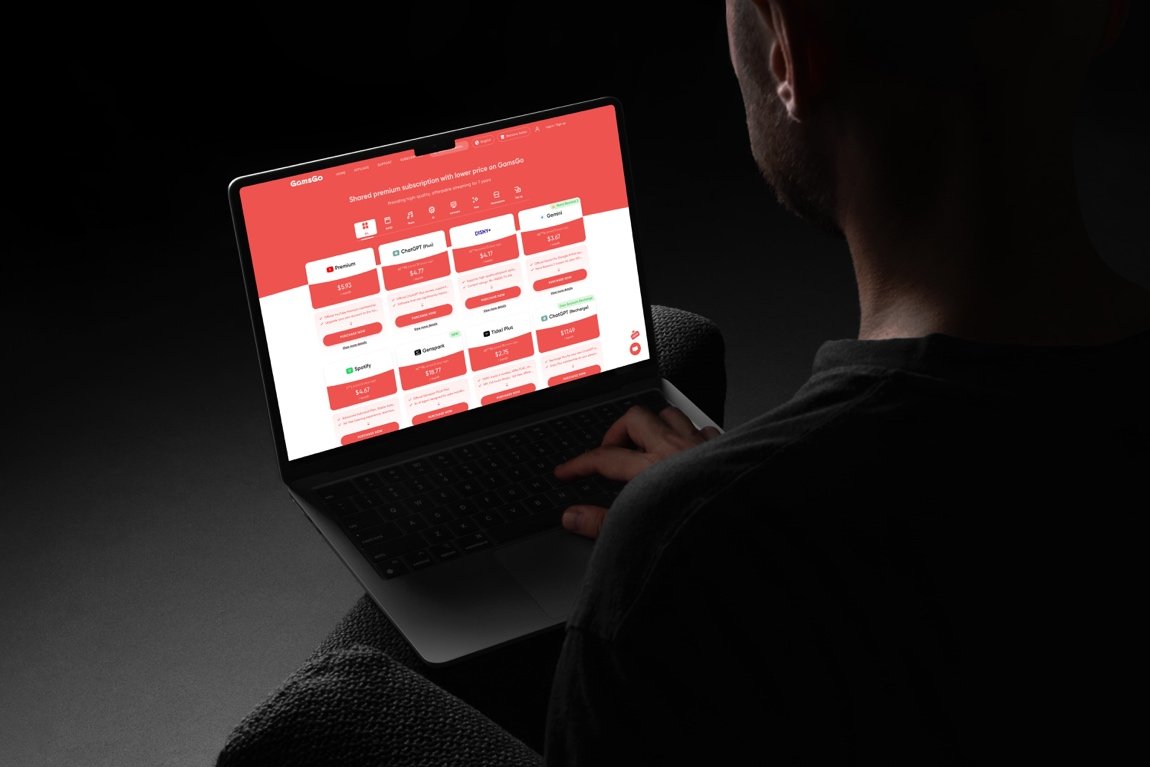
The catalogue is wider than you’d expect. On one side, you’ve got streaming and AI subscriptions – ChatGPT Plus, YouTube Premium, Midjourney, Cursor, Perplexity, Gemini, and more. On the other, a full gaming section covering in-game top-ups for titles like Valorant, Genshin Impact, PUBG Mobile, and Fortnite, plus game accounts, in-game items, gift cards, and virtual currency.
It’s genuinely a lot of ground for one platform to cover. Most of the time, that’s a warning sign. Here, it actually works.
The Part That Matters: How the Savings Work
The subscription side runs on a shared-plan model. Instead of paying for an individual premium seat yourself, you’re essentially splitting a family or group plan with other users – each person gets their own private slot, and the cost gets divided. The service handles all the logistics. You just log in and use it.
Is it the same as owning your own account outright? No. But for someone who needs ChatGPT Plus for work and doesn’t want to pay the full monthly rate indefinitely, it closes the gap considerably.
The gaming top-up side works differently – those are direct purchases delivered instantly to your account. Pick your game, choose the currency or item pack, pay, done. No waiting, no codes that expire in 48 hours, no jumping through hoops.
Who’s Actually Using This
- Students who need AI tools for coursework but can’t justify the full price.
- Freelancers running lean who need Adobe or Canva without a full annual commitment.
- Gamers who top up regularly and have done the math on how much they’re spending per year.
- Content creators juggling multiple software subscriptions at once.
The 24/7 live support is worth noting too – it’s not an afterthought FAQ page. When something goes wrong with a digital product, response time matters, and GamsGo seems to understand that.
The Bottom Line
GamsGo isn’t trying to be flashy about what it does. It sits between “paying full price” and “doing without,” and for a lot of people, that middle ground is exactly where they want to be. If your subscription spending has crept up over the years and you haven’t looked at alternatives, this is a reasonable place to start.
Also Read: How to Cut Your Email Time in Half: Superhuman, Shortcuts, and AI

by parth@bidkinetic.com | Aug 17, 2026 | Travel
There’s a certain kind of airline that treats flying as purely transactional. You pay, you board, you sit in a seat that may or may not recline properly, and you land. Nobody’s particularly happy, but nobody expected to be. It gets the job done. Etihad is trying to be something else entirely. Flying with Etihad feels less like simply getting from one destination to another and more like being looked after along the way.
Abu Dhabi’s Airline to the World

Founded in 2003 and headquartered in Abu Dhabi, Etihad Airways is the national carrier of the UAE, though calling it merely a “national carrier” undersells what it’s built into. From its hub at Zayed International Airport, the airline connects passengers to destinations across six continents, with a network that spans everything from regional short-hauls within the Middle East to long-haul routes touching Bangkok, New York, London, Mumbai, and dozens of points beyond.
The airport itself is worth mentioning. Zayed International opened a new terminal in 2023, and it’s a genuinely different kind of transit experience: spacious, well-designed, and less chaotic than the major hubs in Dubai or Doha that travellers often dread connecting through. For anyone routing through Abu Dhabi, that friction reduction alone makes Etihad worth considering.
Cabin Classes Done With Intention

Economy on Etihad is comfortable without being memorable, and that’s not a backhanded compliment. The seats have solid legroom by industry standards, the meals are a step above average, and free Wi-Fi chat is included on most routes. It won’t redefine your relationship with air travel, but it won’t make you miserable either.
Business Class is where the airline has put serious effort. The seats convert to fully flat beds, privacy panels give each passenger their own pod-like space, and the meal service takes restaurant-style ordering seriously. Award circuits like the World Travel Awards have repeatedly recognised Etihad’s business cabin as one of the leading products in the sky — not just among Gulf carriers, but globally.
The First Class suites, when available on long-haul routes, push further still. Private doors, dedicated service, dine-on-demand menus, and noise levels low enough that you can actually sleep. It’s the kind of product that justifies the phrase “turning left when you board.”
The Stopover Angle
One often-overlooked aspect of flying Etihad is the Abu Dhabi Stopover programme. If you have a layover of a certain duration, or if you can engineer one, Etihad makes it reasonably easy to spend a night or two in the emirate without paying for a separate trip. The airline has partnered with hotels and tour operators around the city to offer bundled packages, and for travellers who’ve never visited Abu Dhabi, it’s a low-friction way to see the place without committing to a dedicated holiday.
Given Abu Dhabi’s considerable development, the Louvre Abu Dhabi alone warrants a visit, a more compelling proposition than it might sound on paper.
Etihad Guest: The Loyalty Programme
Frequent flyers earn miles through Etihad Guest, the airline’s loyalty scheme. Miles accumulate on flights and through a wide network of retail, dining, hotel, and car hire partners. Tiers climb from Silver through Gold and Platinum, each unlocking perks like lounge access, priority boarding, and bonus earnings.
The programme’s most practical element for occasional travellers is the Etihad Wallet, a digital balance that stores cash credits, vouchers, and refunded amounts in one place, redeemable directly at booking. It removes the friction that makes redeeming miles with most airlines feel like solving a puzzle.
Medical Travel Insurance: A Quiet But Meaningful Add-On
For routes into Abu Dhabi specifically, Etihad offers complimentary medical travel insurance with comprehensive coverage and round-the-clock health support included with the booking. It’s the kind of benefit that goes unnoticed until it matters enormously. For families travelling with elderly relatives or anyone with health concerns, it shifts the risk calculus in a meaningful way.
The Bigger Picture
Etihad has had a complicated decade behind the scenes: financial restructuring, strategic pivots, a leaner network. What emerged from that process is a carrier that’s more focused and, arguably, more coherent. The product is sharper. The airport experience is genuinely good. And the routes, while not as extensive as Emirates or Qatar, cover most places the typical international traveller actually wants to go.
Flying Etihad is not the cheapest way to fly. But it’s one of the more thoughtful ones, and in an industry where that’s rare, it counts.
Also Read: How to Book Multi-Day Tours Online: A TourRadar Guide for First-Timers