
How Much Do Online Courses Really Cost? Hidden Fees Compared
Discover how much online courses really cost, compare popular platforms, uncover hidden fees and learn how to budget for certificates, exams and subscriptions.

Online learning is often advertised as an affordable alternative to traditional education. Some courses are free, while others promise professional certificates for a monthly subscription. But the amount displayed on the enrolment page may not be the amount you eventually spend. Certificate upgrades, subscription renewals, examination fees, software access and other extras can increase the final bill. So, how much do online courses really cost? The answer depends on the platform, course format, certificate requirements and how quickly you complete the programme.
For example, edX allows learners to audit many courses for free, but verified certificates generally require payment. Coursera lists individual programmes at approximately $49-$79 per month, while its Coursera Plus subscription is advertised at $59 monthly or $399 annually on its US pricing page. These figures show why comparing only the starting price can be misleading.
Before enrolling, it is worth understanding what the advertised fee includes, what costs extra and how to calculate the real price of learning to actually know how much online courses really cost.
What Is the Average Cost of an Online Course?
There is no universal price for online education. A short introductory course may cost nothing, while a university-backed professional programme or an industry certification pathway can cost several hundred dollars or more.
The following ranges are broad budgeting estimates, not fixed market rates. Actual prices vary by subject, provider, country and promotional offer.
| Course type | Typical advertised cost | What to check |
|---|---|---|
| Free introductory courses | $0 | Whether assessments and certificates are included |
| Individual self-paced courses | $10-$200 | Lifetime access, updates and certificate charges |
| Verified university courses | $50-$300 | Graded assignments and certificate access |
| Professional certificate programmes | $300-$1,000+ | Number of courses and subscription duration |
| Exam preparation courses | $20-$500+ | Whether the actual certification exam is included |
| Bootcamps and intensive programmes | $1,000-$10,000+ | Mentoring, placement support and refund terms |
The important distinction is between learning access and a recognised credential. A free course may provide excellent study material, but the certificate, graded assignments or final examination may require a separate payment.
Comparing Popular Online Learning Platforms
Different platforms use different pricing models. Some charge per course, others use monthly subscriptions, and a few allow free access with paid certificate upgrades.
Coursera: Coursera offers individual courses and multi-course professional programmes. Its US pricing page lists individual programmes at around $49-$79 per month, while Coursera Plus is listed at $59 per month or $399 per year. The subscription covers many courses, but not every programme is included. Check eligibility before subscribing.
edX: Many edX courses can be audited without paying. However, the free route generally excludes graded assignments and verified certificates. edX states that verified certificate fees commonly range from $50 to $300, depending on the course.
Udemy: Udemy allows learners to purchase individual courses, with listed prices ranging from $19.99 to $199.99 on its platform page. Prices can vary with discounts and location. A single-course purchase generally provides access to that course, while its Personal Plan offers subscription-based access to a selected catalogue.
LinkedIn Learning: Access requires an active subscription rather than a one-time purchase of an individual course. It may be useful if you plan to complete several short courses, but check the subscription options and renewal terms available in your country.
SWAYAM: For learners in India, SWAYAM offers courses free of cost. However, learners who want a certificate generally need to register for and take a proctored examination, for which a nominal fee applies. Check the individual course page for examination details.
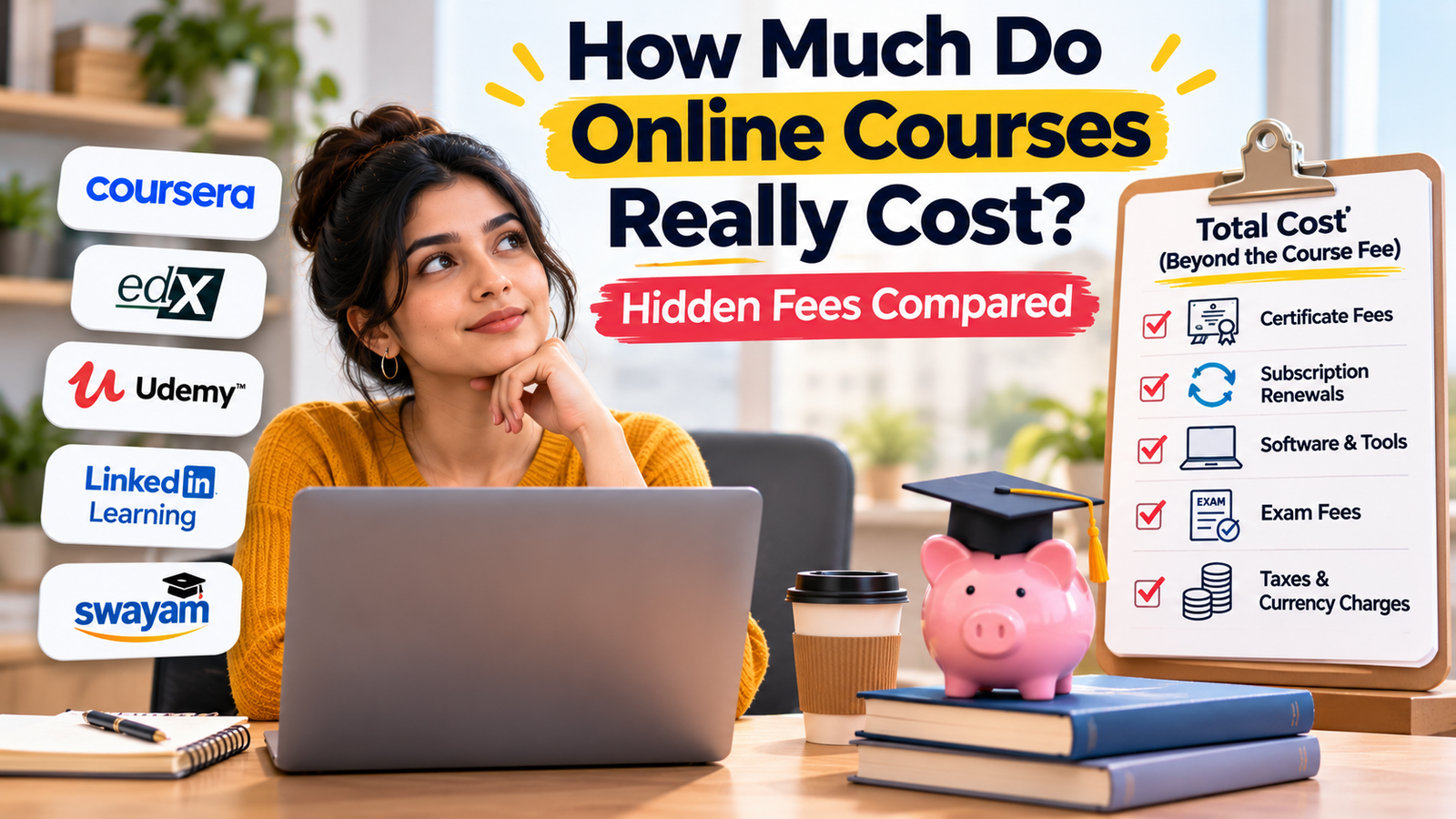
The Hidden Fees That Can Increase Your Course Budget
The biggest pricing mistake is assuming that the course fee covers everything. These are the expenses worth checking before you pay.
1. Certificate and assessment charges
Some platforms let you study for free but charge for a verified certificate. Others include the certificate in a subscription. Confirm whether the advertised price covers assessments, final projects and credential issuance.
2. Subscription renewals
A monthly subscription can look inexpensive until a course takes longer than expected. A programme estimated to take three months could cost substantially more if you need five or six months. Check the billing date, cancellation process and whether access ends immediately after cancellation.
3. Certification examination fees
A preparation course is not necessarily the same as the official certification examination. This matters in fields such as cloud computing, cybersecurity and project management. The course may teach the material, but the external examination could be charged separately by the certification provider. Retakes may also cost extra.
4. Software, tools and study materials
Some courses require paid software, cloud environments, textbooks or specialist tools. A design course might require access to creative software, while a programming course may recommend cloud services or development environments. Check whether free alternatives are acceptable before purchasing anything.
5. Taxes, currency conversion and payment fees
International platforms may display prices in a foreign currency. Your final bank statement can include applicable taxes, exchange-rate differences or foreign transaction charges. Always check the checkout total in your local currency rather than relying only on the advertised price.
How to Calculate the Real Cost Before Enrolling
A useful way to compare programmes is to calculate the total cost of completion rather than the initial fee.
Use this simple formula:
Total course cost = Course fee + Certificate fee + Exam fee + Software/materials + Subscription renewals + Applicable taxes and payment charges
For example, imagine a learner chooses a four-month subscription at $40 per month, pays $60 for an external examination and spends $25 on required study materials. The total becomes $245, before any applicable taxes or payment charges.
That is a more realistic figure than looking at the $40 monthly price alone.
Before enrolling, ask yourself three questions: Do I need the certificate or only the learning material? Can I realistically finish within the subscription period? Are there any compulsory costs outside the platform?
How to Save Money Without Compromising Learning Quality
Start by comparing the syllabus, instructor credentials and practical assignments, not just the discount percentage. A cheaper course that does not teach the required skills may become an expensive mistake.
Use free audit options or previews to assess the teaching style before paying. If you need several courses, compare the cost of individual purchases with a subscription. However, do not pay for an annual plan unless you are confident you will use it.
For professional certifications, separate the cost of preparation from the official exam fee. Look for student discounts, financial assistance, employer-sponsored learning and free resources from recognised providers. In India, check SWAYAM and NPTEL offerings where relevant.
Most importantly, choose a course that supports a clear outcome: a portfolio project, a practical skill, a recognised credential or preparation for a specific role.
How Much Do Online Courses Really Cost: FAQs
1. Are online courses really free?
Some are. Platforms such as SWAYAM and edX offer free learning options, but certificates, graded assessments or proctored examinations may require payment.
2. Why do online courses charge separately for certificates?
The course provider may offer learning materials at no cost while charging for assessment, verification and certificate issuance. The exact arrangement depends on the platform.
3. Are monthly subscriptions cheaper than buying individual courses?
They can be cheaper if you complete several eligible courses within a short period. If you study slowly or need only one course, an individual purchase may cost less.
When comparing how much do online courses really cost, look beyond the headline price. A free course may be enough to explore a subject, while a paid programme may be worthwhile when it offers structured assessments, credible instruction and practical work. The smartest choice is not necessarily the cheapest one. It is the course whose full cost makes sense for your learning and career goals.
Also Read: AirAsia MOVE Review: Flights, Hotels, Deals and Booking Experience