
Best AI and Machine Learning Courses for Non-Programmers
Explore the best AI and Machine Learning courses for non-programmers. Learn AI fundamentals, generative AI and practical tools without coding.

The biggest misconception about artificial intelligence is that you need to become a programmer to work with it. That simply isn’t true. Businesses need professionals who understand AI applications, can identify opportunities for automation, interpret results and use these tools responsibly. A marketing manager, HR professional, business owner or financial analyst can all benefit from AI knowledge. The following AI and Machine Learning courses are worth considering if you want to understand the technology before deciding whether to pursue a technical career.
8 Best AI and Machine Learning Courses for Non-Programmers
1. AI for Everyone: DeepLearning.AI
Best for: Complete beginners, managers and business professionals.
Created by Andrew Ng, this is one of the most approachable introductions to artificial intelligence. The course explains what AI can and cannot do, how machine learning projects work and how organisations can identify suitable AI opportunities.
You will explore AI terminology, project workflows, business applications and the social impact of automation. No technical or programming background is required.
Duration: Approximately 7 hours.
Why take it: It helps you understand AI from a business perspective rather than focusing on coding.
2. Google AI Essentials: Google
Best for: Professionals who want to use AI in everyday work.
This practical course focuses on using generative AI tools to improve productivity. Its five modules cover AI fundamentals, workplace productivity, prompt engineering, responsible AI and emerging developments.
You will practise writing prompts, generating ideas, organising information and using AI to support everyday tasks.
Google describes the programme as requiring zero previous experience. It takes under 10 hours to complete at your own pace.
Why take it: It focuses on practical applications rather than technical theory.
3. Elements of AI: University of Helsinki
Best for: Learners who want to understand how artificial intelligence and machine learning actually work.
Elements of AI is particularly interesting because it goes beyond teaching people how to use popular AI tools. It explains the concepts behind the technology.
The introductory course covers problem-solving, machine learning, neural networks and the wider impact of AI. Its beginner exercises do not require programming or advanced mathematics.
The follow-up course, Building AI, goes deeper into algorithms and recommends some Python knowledge for its more advanced exercises.
Why take it: It provides a stronger conceptual foundation than a course focused only on prompt writing.
4. Generative AI for Everyone: DeepLearning.AI
Best for: Professionals interested in ChatGPT, generative AI and business applications.
This course explains how generative AI works, what large language models can do and where their limitations lie.
It also introduces practical applications such as summarising information, generating content and improving workplace processes. You will learn about the opportunities and risks of using generative AI in organisations.
No prior programming experience is required.
Duration: Approximately 5 hours.
Why take it: It connects AI concepts with practical workplace decisions.
Explore Generative AI for Everyone
5. AI Foundations for Everyone: IBM
Best for: Business professionals seeking structured AI learning.
IBM’s four-course specialisation introduces artificial intelligence to learners with little or no technical background.
It explores AI fundamentals, applications, ethical considerations and the role of AI in business. Learners also encounter tools and examples that help connect theoretical concepts with practical scenarios.
The programme is designed for beginners and does not require programming skills.
Why take it: It offers a broader learning path for people who want more than a short introductory course.
Explore IBM AI Foundations for Everyone
6. Career Essentials in Generative AI: Microsoft and LinkedIn
Best for: Employees and professionals who want workplace-ready AI skills.
This learning path contains five courses and approximately four hours of content. It covers generative AI fundamentals, Microsoft Copilot, content creation, workflow automation and responsible AI.
It is especially useful if you want to understand how AI assistants can support everyday professional responsibilities.
Why take it: It connects AI knowledge with tools and tasks used in modern workplaces.
Explore the Microsoft and LinkedIn learning path
7. YUVA AI for ALL: IndiaAI Mission
Best for: Indian students, beginners and professionals looking for free AI education.
Launched by India’s Ministry of Electronics and Information Technology in November 2025, YUVA AI for ALL is a free, self-paced introductory programme.
The 4.5-hour course covers AI fundamentals, real-world applications, generative AI, responsible usage and the technology’s impact on education and work. It includes examples relevant to the Indian context.
Learners who complete the programme receive a Government of India certificate.
Why take it: It is accessible, free and particularly relevant to Indian learners starting their AI journey.
8. Introduction to Generative AI: Google
Best for: Anyone who wants a quick introduction before committing to a longer programme.
This short introductory training explains what generative AI is, how it works at a basic level and how it differs from traditional machine learning.
It is useful for understanding the technology behind AI-generated text, images and other content.
Why take it: It offers a quick starting point for learners who want foundational knowledge without a lengthy course commitment.
Explore Google’s AI learning resources
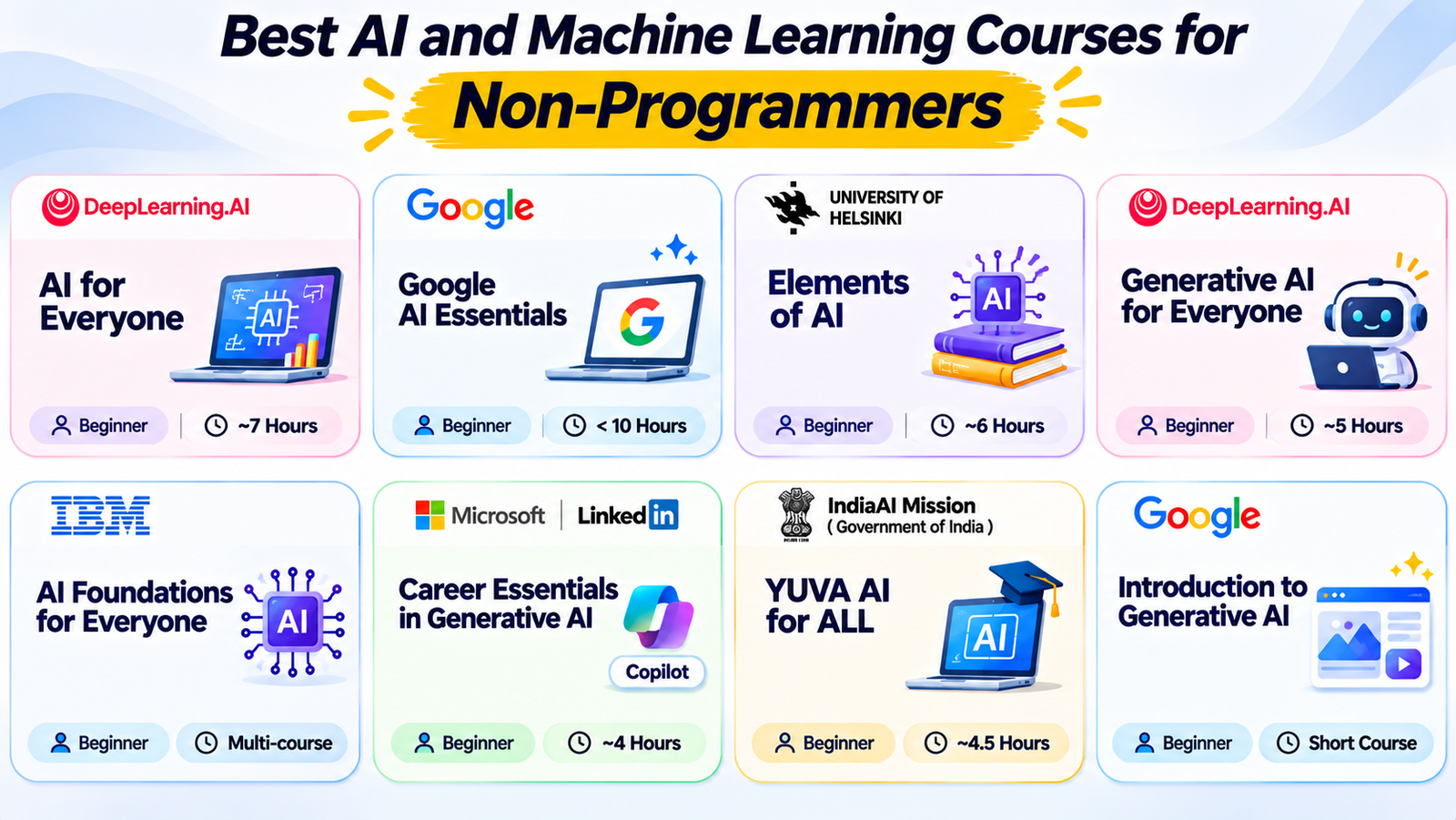
Course Comparison: Which One Should You Choose?
| Course | Main focus | Best suited for |
|---|---|---|
| AI for Everyone | AI strategy and fundamentals | Managers |
| Google AI Essentials | Productivity and prompting | Working professionals |
| Elements of AI | AI and ML concepts | Curious beginners |
| Generative AI for Everyone | Generative AI applications | Business users |
| IBM AI Foundations | AI across industries | Career development |
| Microsoft and LinkedIn | Copilot and workplace AI | Employees |
| YUVA AI for ALL | AI literacy | Indian learners |
| Google Introduction to GenAI | Generative AI basics | Absolute beginners |
Can You Learn Machine Learning Without Coding?
Yes, at the foundational level. You can understand supervised and unsupervised learning, neural networks, training data, prediction models and real-world applications without writing code.
However, building and training machine learning models independently usually requires programming, mathematics and practical experience with datasets.
A sensible approach is to first understand the concepts and business applications. Once you know which area interests you, you can move towards technical training if necessary.
Final Thoughts
Learning artificial intelligence doesn’t have to begin with complicated code or expensive qualifications. Start with the fundamentals, experiment with real tools and identify how AI can improve the work you already do.
The best AI and Machine Learning courses are not necessarily the most technical ones. They are the courses that help you understand the technology, question its output and apply it to meaningful problems. Once you have that foundation, moving into more advanced learning becomes much easier.
AI and Machine Learning Courses: Frequently Asked Questions
1. Which AI course is best for someone with no technical background?
AI for Everyone and Google AI Essentials are excellent starting points. Choose the former for conceptual understanding and the latter for practical workplace applications.
2. Are AI and machine learning the same thing?
No. Artificial intelligence is the broader field of creating systems that perform tasks associated with human intelligence. Machine learning is a branch of AI in which systems learn patterns from data.
3. Can I get an AI job without programming?
Yes. Roles such as AI product coordinator, AI business analyst, AI trainer and AI adoption specialist may prioritise business knowledge, communication and tool proficiency. Requirements vary by employer.
Also Read: Humble Choice Review: Is the Monthly Subscription Worth It Now?