
7 In-Demand Skills Employers Want in 2026 and Where to Learn Them
The workplace is changing faster than traditional job descriptions can keep up. Artificial intelligence is becoming part of everyday work, businesses are relying more heavily on data, and employees are expected to solve problems rather than simply follow instructions. According to the World Economic Forum’s Future of Jobs Report 2025, 39% of workers’ existing skill sets are expected to change or become outdated between 2025 and 2030. The report also identifies analytical thinking as a core skill for 69% of surveyed employers. LinkedIn’s Skills on the Rise 2026 report highlights growing demand for AI expertise, business growth, communication and risk management. Meanwhile, Upwork reported that demand for top AI-related skills on its marketplace increased by 109% year over year. These findings point towards an important shift: employers increasingly value people who can use technology, understand business needs and work effectively with others. Here are 7 in-demand skills employers want in 2026, along with practical platforms where you can start developing them.
1. AI Literacy and Practical AI Skills
Knowing how to use AI tools is becoming a workplace advantage across marketing, finance, HR, software development and customer support. Employers increasingly need people who can write effective prompts, evaluate AI-generated results, automate repetitive tasks and understand where human judgement is necessary.
You do not necessarily need to become a machine-learning engineer. A marketing professional who can use AI for research, a recruiter who can streamline candidate screening, or an analyst who can automate reporting already brings useful AI skills to a role.
Where to learn:
- Microsoft Learn: AI fundamentals and practical learning paths.
- Google AI: AI concepts and workplace applications.
- DeepLearning.AI: Prompt engineering and applied AI courses.
2. Data Analysis and Data Literacy
Businesses generate enormous amounts of information, but collecting data is not the same as understanding it. Employers need professionals who can identify patterns, interpret performance and turn numbers into useful recommendations.
Start with spreadsheets, data cleaning, basic statistics and visualisation. Then move towards SQL, Power BI, Tableau or Python, depending on your career direction. For example, a sales executive who can analyse conversion rates and identify why leads are dropping out of the funnel can contribute beyond routine reporting.
Where to learn:
- Google Career Certificates: Data Analytics.
- IBM SkillsBuild: Data analytics fundamentals.
- Kaggle Learn: Practical exercises in Python, data visualisation and machine learning.
3. Cybersecurity and Digital Risk Management
Cybersecurity is no longer limited to IT departments. Employees across organisations handle customer information, financial records, internal systems and confidential documents. A single careless action can expose sensitive business data.
Understanding phishing, access control, password security, data privacy and basic threat prevention is increasingly valuable. For specialist roles, learners can progress towards networking, security operations, cloud security and recognised certifications.
Where to learn:
- Cisco Networking Academy: Free introductory cybersecurity and networking courses.
- Google Career Certificates: Cybersecurity professional training.
- TryHackMe: Hands-on cybersecurity exercises and labs.
4. Analytical Thinking and Problem-Solving
Technology can process information, but people still need to ask the right questions and decide what to do with the answers. Analytical thinking helps professionals identify the actual cause of a problem instead of treating its symptoms.
Consider an e-commerce business experiencing declining sales. The issue might be poor traffic quality, a complicated checkout process, pricing or delivery delays. Someone with strong analytical skills can investigate the evidence before recommending a solution.
The World Economic Forum identifies analytical thinking as the leading core skill in its employer survey.
Where to learn:
- Coursera: Courses in critical thinking, business analysis and decision-making.
- Harvard Online: Courses in data, computer science and analytical subjects.
- Khan Academy: Foundations in mathematics, statistics and logical reasoning.
5. Communication and Cross-Functional Collaboration
As organisations become more connected, employees rarely work in isolation. A product designer may coordinate with developers, marketing teams and customers. A project manager may need to communicate with finance, operations and senior leadership.
Clear writing, active listening, presentation skills, stakeholder management and the ability to explain complex ideas simply can make a significant difference. LinkedIn’s 2026 skills research specifically highlights cross-functional collaboration, team management and stakeholder communication.
Where to learn:
- LinkedIn Learning: Business communication and collaboration courses.
- Toastmasters International: Public speaking and presentation practice.
- Coursera: Communication and leadership programmes.
6. Project Management and Business Growth
Employers value professionals who can turn ideas into completed work. Project management involves planning tasks, managing timelines, coordinating people, tracking budgets and handling risks.
You do not need to hold a project manager title to use these skills. Marketing executives manage campaigns, HR teams coordinate recruitment projects, and developers work against product release schedules. Understanding Agile, Scrum, workflow management, and business priorities can improve performance across these roles.
Where to learn:
- Atlassian University: Agile, Jira and team collaboration.
- Google Career Certificates: Project Management.
- HubSpot Academy: Sales, marketing and business growth.
7. Adaptability, Creative Thinking and Continuous Learning
Tools, processes and customer expectations change. Employees who can learn new systems, adjust to unfamiliar situations and approach problems creatively are better prepared for those changes.
The WEF identifies resilience, flexibility, agility and creative thinking among the skills employers consider important. These abilities are developed through experience as much as formal courses. Take on unfamiliar assignments, experiment with new tools and seek feedback instead of repeating the same processes.
Where to learn:
- LinkedIn Learning: Adaptability, creative thinking and professional development.
- FutureLearn: Courses across business, technology and personal development.
- Coursera: Creative problem-solving and lifelong learning programmes.
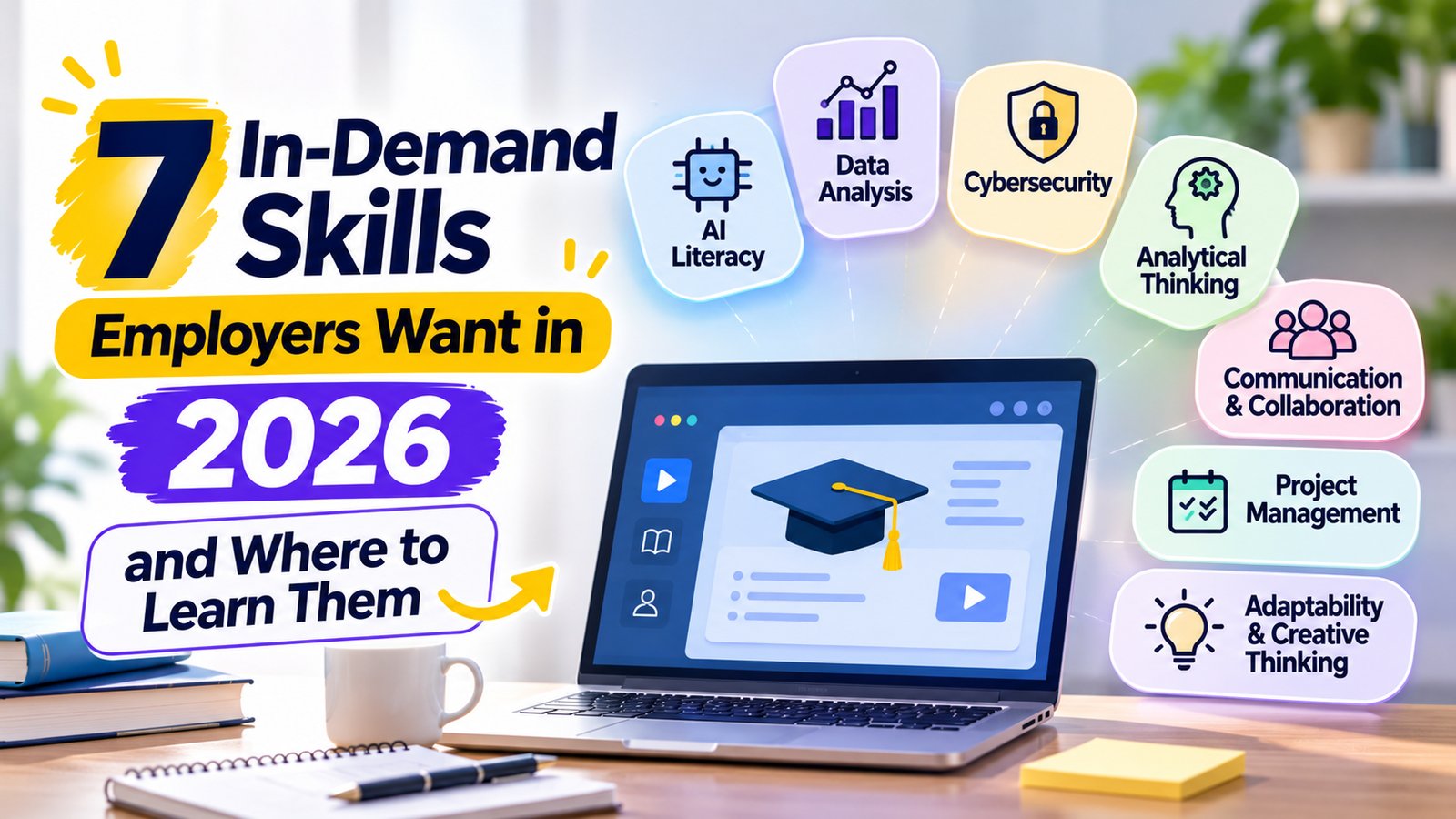
Quick Comparison: Skills and Learning Platforms
| In-demand skill | Platforms to explore |
|---|---|
| AI literacy | Microsoft Learn, Google AI, DeepLearning.AI |
| Data analysis | Google, IBM SkillsBuild, Kaggle |
| Cybersecurity | Cisco, Google, TryHackMe |
| Analytical thinking | Coursera, Harvard Online, Khan Academy |
| Communication | LinkedIn Learning, Toastmasters |
| Project management | Atlassian University, Google, HubSpot |
| Adaptability and creativity | LinkedIn Learning, FutureLearn |
Final Thoughts
The 7 in-demand skills employers want are not limited to technical specialists. AI literacy, data analysis, cybersecurity, problem-solving, communication, project management and adaptability can strengthen careers across industries.
You do not need to master everything in one year. Choose skills that connect with your career direction, learn through credible resources and apply them to real problems. A certificate may help you get noticed, but the ability to demonstrate what you can actually do is what makes the learning valuable.
7 In-Demand Skills Employers Want: FAQs
1. Which skill is most important for jobs in 2026?
AI literacy and analytical thinking are particularly valuable, but the right priority depends on the role. Employers increasingly look for combinations of technical and interpersonal skills.
2. Can I learn these skills online for free?
Yes. Platforms such as Cisco Networking Academy, Kaggle Learn and Microsoft Learn offer free learning resources. Some advanced programmes and certificates require payment.
3. Do employers value online certificates?
Certificates can demonstrate structured learning, but practical ability matters too. Apply what you learn through projects, case studies, internships or work assignments.
Also Read: Termly Review: Is It Worth Using for Website Privacy Compliance?