
E-Commerce Payment Stack: Choosing Gateways for Global Customers
A customer can love your product, add it to their cart and still abandon the purchase because their preferred payment method is missing. For an online business selling across borders, payment processing is not simply about accepting Visa or Mastercard. Customers expect familiar digital wallets, local payment options, transparent currency conversion and a secure checkout experience. According to the 2026 Global Payments Report by Worldpay, digital wallets accounted for 56% of global e-commerce transaction value in 2025, making them the leading online payment method worldwide. The report also projects this share to reach 63% by 2030. This makes choosing an E-Commerce payment stack an important business decision, particularly for brands expanding into international markets. Your payment infrastructure should support different currencies, local preferences, fraud prevention, refunds and reliable settlements without creating unnecessary checkout friction.
Here is how to build a payment stack that works for global customers.
1. Understand What an E-Commerce Payment Stack Includes
A payment stack is the combination of technologies and services responsible for accepting, processing, securing and reconciling customer payments.
It generally includes:
- Payment gateway: Collects payment information and securely sends transaction requests.
- Payment processor: Communicates with financial institutions to process transactions.
- Payment methods: Cards, digital wallets, bank transfers and local payment options.
- Fraud prevention: Identifies suspicious transactions and reduces payment risks.
- Settlement and reconciliation: Tracks payments, refunds, fees and money received.
- Some providers combine several of these services into one platform. Others require integrations with separate providers.
The right setup depends on your sales volume, customer locations, product category and business model.
2. Choose Payment Gateways Based on Your Target Markets
Not every gateway supports every country, currency or business type. Compare providers based on where your customers live and where your business is registered.
Stripe
Stripe is popular with technology companies, SaaS businesses and international online stores. It supports card payments, subscriptions, digital wallets and various local payment methods, depending on merchant eligibility and country.
Its APIs and integrations make it suitable for businesses requiring customised checkout experiences.
PayPal
PayPal is widely recognised by international shoppers. It can be useful for businesses whose customers prefer paying through an existing PayPal account or linked payment methods.
Consider its transaction charges, currency conversion costs and country-specific receiving restrictions.
Adyen
Adyen is designed for businesses managing payments across multiple countries and channels. Its platform supports more than 200 payment methods, including cards, wallets and bank transfers.
It is particularly relevant for larger e-commerce businesses seeking centralised payment operations.
Razorpay
Razorpay is worth considering for businesses registered in India. Eligible businesses can accept international payments through cards issued by overseas banks, subject to account activation and applicable requirements.
Payment Gateway Comparison
| Provider | Best suited for | Key consideration |
|---|---|---|
| Stripe | SaaS and global ecommerce | Country and method eligibility |
| PayPal | International retail | Conversion and transaction fees |
| Adyen | Large global businesses | Enterprise-oriented setup |
| Razorpay | India-based businesses | International payment eligibility |
Do not select a provider simply because it supports many countries. Confirm that it supports your business location, settlement currency and target payment methods.
3. Offer Payment Methods Customers Already Use
Your checkout should reflect local shopping habits rather than forcing every international customer to pay the same way.
Consider these examples:
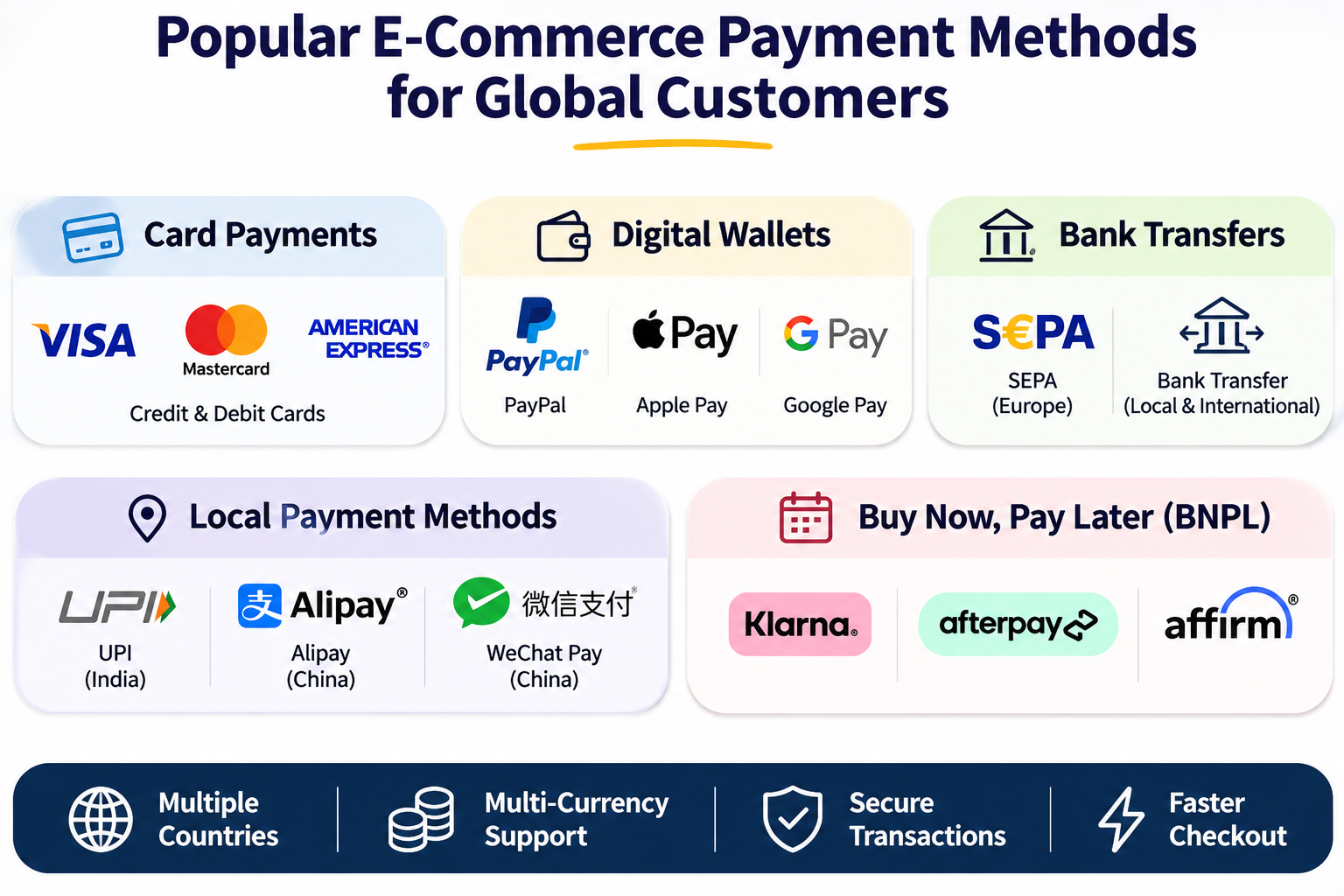
- United States: Credit cards, debit cards, PayPal and Apple Pay.
- United Kingdom: Cards, Apple Pay, Google Pay and eligible buy-now-pay-later options.
- Europe: Cards, PayPal, SEPA-based bank payments and local options.
- India: UPI, cards, net banking and eligible international card payments.
- China: Alipay and WeChat Pay, subject to provider and merchant eligibility.
These are starting points, not universal preferences. Research the actual markets where your customers live.
Offering local methods can improve payment acceptance because shoppers recognise and trust familiar options. Adyen also highlights the importance of local payment methods for improving conversion.
4. Support Multiple Currencies and Transparent Pricing
International shoppers should understand what they are paying before reaching the final checkout step.
A good payment setup should support:
- Displaying prices in relevant local currencies.
- Transparent currency conversion.
- Clear tax and shipping calculations.
- Consistent refund policies.
- Settlement into your preferred business currency.
For example, a customer in Germany may prefer seeing prices in EUR rather than converting USD mentally. However, displaying multiple currencies does not automatically mean you can settle in all of them.
Check conversion margins, foreign transaction fees and settlement charges before enabling multi-currency pricing.
5. Build Security and Fraud Prevention Into Checkout
International payments introduce risks such as stolen cards, chargebacks, account takeovers and suspicious transactions.
Your gateway should support appropriate security features, including:
- PCI DSS-compliant payment handling.
- 3D Secure authentication where applicable.
- Address and card verification.
- Fraud detection and transaction monitoring.
- Secure tokenisation for returning customers.
Avoid adding unnecessary authentication steps to every transaction. Use risk-based controls that balance customer convenience with fraud prevention.
6. Calculate the Real Cost of Processing Payments
A gateway’s advertised transaction fee is only one part of its cost.
Your payment budget should account for processing fees, international card charges, currency conversion, refunds, chargebacks and any monthly or integration costs. For example, a business processing $50,000 monthly may find that a small difference in processing rates creates a meaningful annual expense.
Compare providers using the same transaction volume, average order value, currency mix and refund assumptions.
7. Test the Complete Payment Journey
Before launching internationally, test payments from different countries and devices.
Check successful payments, declined cards, refunds, partial refunds, failed transactions, duplicate orders and payment notifications. Verify that your e-commerce platform updates order status correctly and that settlement reports match your internal records.
Also monitor payment authorisation rates, checkout abandonment, fraud losses and chargeback ratios. These numbers help identify whether the problem is your gateway, payment method mix or checkout experience.
Final Thoughts
Building an effective E-Commerce payment stack requires more than integrating a popular gateway. You need payment methods customers recognise, transparent pricing, reliable settlements and security that protects both shoppers and your business.
Start with your top three international markets. Identify how customers prefer to pay, compare eligible providers and test the complete checkout journey before expanding. A payment system that works smoothly behind the scenes can make a significant difference to the buying experience.
Frequently Asked Questions
1. What is an E-Commerce payment stack?
It is the collection of gateways, processors, payment methods, security tools and settlement systems used to accept and manage online payments.
2. Which payment gateway is best for international e-commerce?
Stripe, PayPal and Adyen are common options, while Razorpay can serve eligible India-based businesses. The best choice depends on your business location, target markets and payment requirements.
3. Should an e-commerce website use multiple payment gateways?
It can be useful when one provider does not support all target markets or payment methods. However, additional integrations increase maintenance and reconciliation complexity.
Also Read: How Small Agencies Can Automate Client Communication with Chatbots