
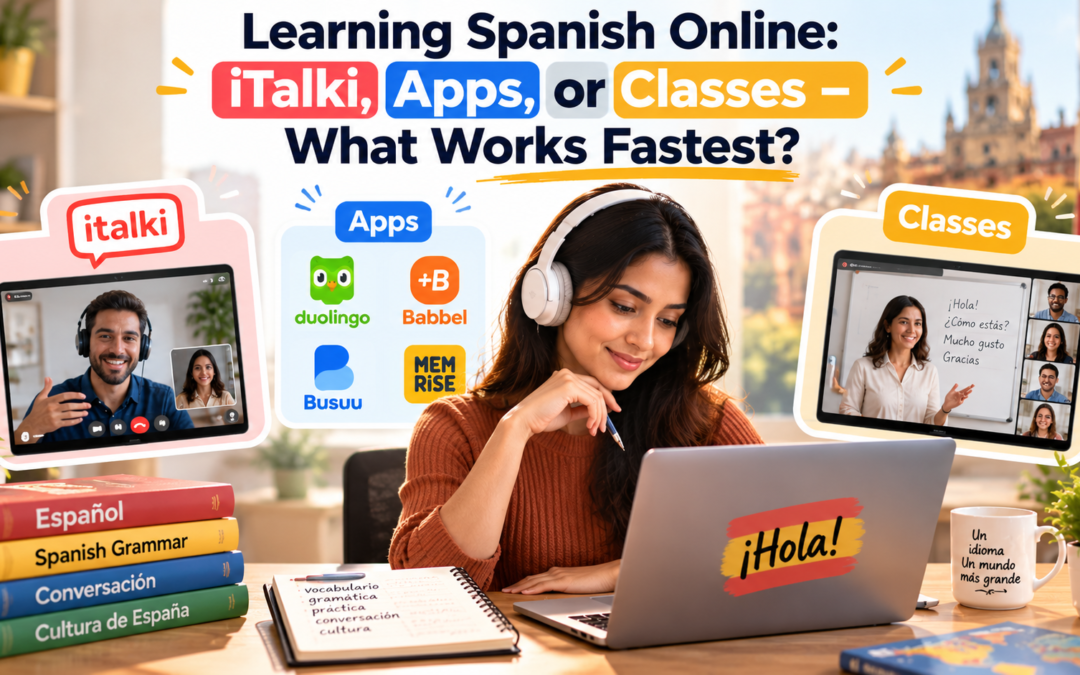
Learning Spanish Online: iTalki, Apps, or Classes – What Works Fastest?
Learning Spanish online has become easier than ever, but choosing the right learning method can make a significant difference in how quickly you become conversational. Whether you want to communicate confidently while travelling, improve your career opportunities, prepare for relocation, or simply learn a new language, there are several ways to get started. The most common options include language-learning apps, one-to-one tutoring platforms such as iTalki, and structured online classes.
But which one actually delivers results faster?
Research published in Foreign Language Annals examined 54 English-speaking adults learning Spanish through Babbel over 12 weeks, with a target of approximately 10 minutes of daily practice. Participants improved their Spanish vocabulary, grammar, and oral communication skills. The study also found that the amount of time spent practising was the strongest predictor of improvement.
This tells us something important: you do not necessarily need hours of classroom instruction every day. What matters is how consistently you practise and whether your learning method gives you opportunities to use the language.
Let’s compare the three approaches, understand their strengths, and identify which one makes sense for your learning goals.
1. Learning Spanish Through Apps: Best for Daily Practice
Language-learning apps are often the first choice for beginners because they are affordable, accessible, and easy to incorporate into everyday routines.
Platforms such as Duolingo, Babbel, and Busuu offer structured lessons covering vocabulary, grammar, pronunciation, listening, and sentence construction.
What makes apps useful?
- Short lessons that can fit into a 10-15-minute break.
- Vocabulary exercises with repetition to improve recall.
- Listening and pronunciation activities.
- Progress tracking and daily learning reminders.
- Beginner-friendly lessons that gradually introduce complex concepts.
For example, you can use Duolingo to practise everyday Spanish phrases, Babbel to understand sentence structures, and Busuu to work through more structured language lessons.
However, there is one limitation. Completing vocabulary exercises does not automatically prepare you for a real conversation. You may recognise hundreds of Spanish words but still struggle to order food, ask for directions, or understand someone speaking naturally.
Our take: Apps are excellent for building a foundation, developing vocabulary, and maintaining a daily learning habit. However, they should not be your only learning method if your goal is conversational fluency.
2. iTalki: Best for Speaking and Real Conversations
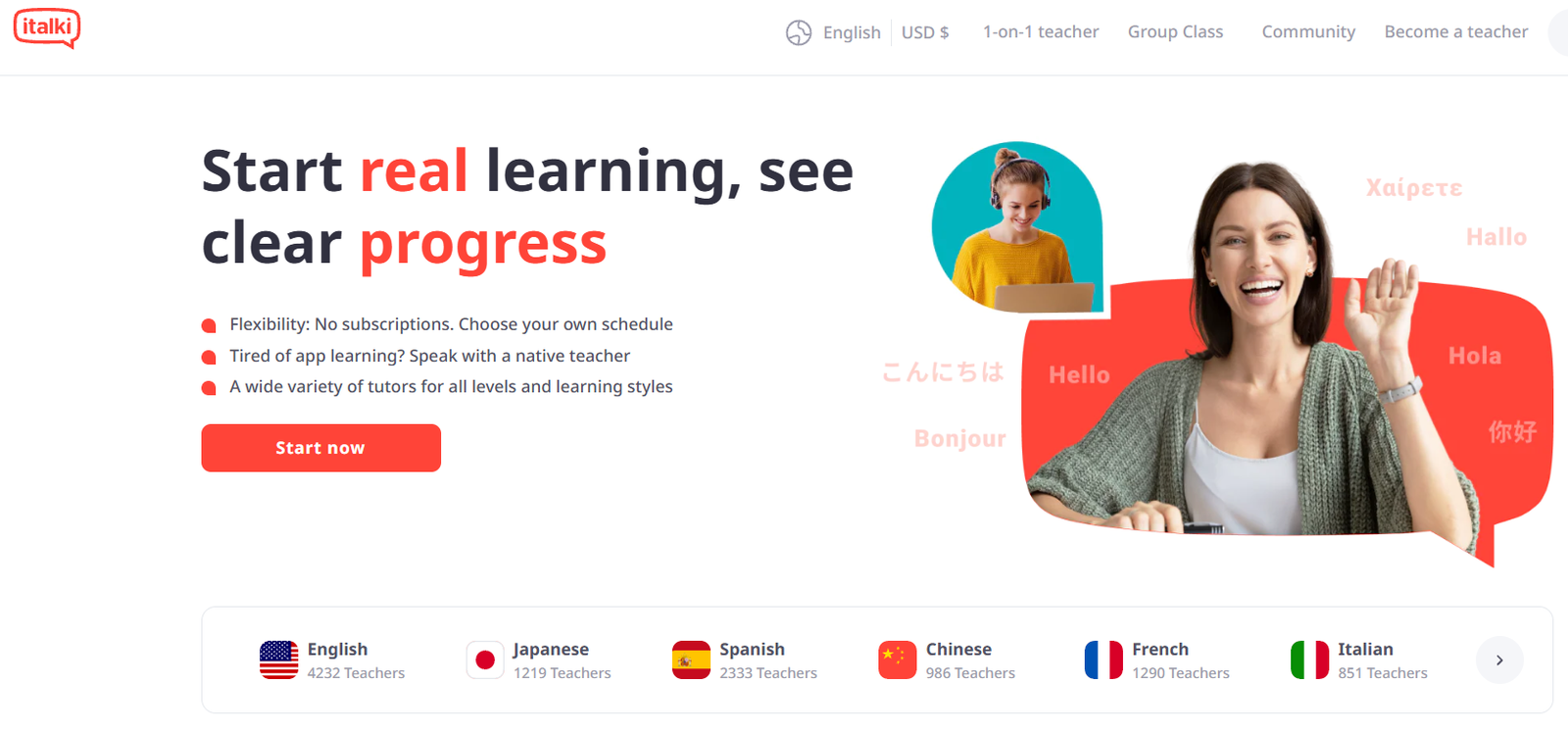
Source: iTalki
If your primary goal is to speak Spanish confidently, iTalki offers something that most self-learning apps cannot replicate: direct interaction with a real person.
iTalki is an online language-learning marketplace where you can find Spanish teachers and community tutors for individual video lessons. You can choose tutors based on their teaching experience, availability, language background, and learning specialisation.
Unlike a fixed course, lessons can be adapted to your requirements.
For instance, a beginner might spend the first few sessions learning introductions, basic sentence formation, numbers, and common expressions. An intermediate learner could focus on conversational Spanish, pronunciation, or professional communication.
Why consider iTalki?
- Personalised lessons based on your current proficiency.
- Immediate feedback on pronunciation and grammar.
- Real-time speaking and listening practice.
- Exposure to different Spanish accents, including those from Spain and Latin America.
- Flexible lesson schedules.
You can also choose between professional teachers and community tutors. Professional teachers are suitable for structured learning, grammar explanations, and exam preparation, while community tutors can provide additional conversational practice.
The main consideration is cost. Unlike free learning apps, iTalki lessons are generally paid individually, and prices vary depending on the tutor.
Our take: If you want to start speaking Spanish rather than simply recognising words, one-to-one tutoring can accelerate practical communication skills.
3. Online Spanish Classes: Best for Structured Learning
Online Spanish classes provide a more organised learning experience. They are particularly useful for people who prefer a defined curriculum, regular teaching sessions, and a clear progression from beginner to advanced levels.
These classes may be conducted in small groups or individually, depending on the institution.
A structured programme generally covers:
- Spanish grammar and sentence construction.
- Vocabulary development across everyday situations.
- Reading and listening comprehension.
- Speaking exercises and pronunciation.
- Assessments, assignments, and progress evaluations.
Platforms such as Instituto Cervantes offer Spanish-learning programmes, while other online language schools provide instructor-led courses for different proficiency levels.
Another advantage is that structured classes can prepare learners for recognised Spanish proficiency examinations, such as DELE (Diplomas de Español como Lengua Extranjera).
However, fixed schedules and course commitments may be challenging for people with busy work routines. Group classes may also provide less individual speaking time compared with one-to-one tutoring.
Our take: Choose structured classes if you need academic guidance, systematic grammar instruction, or preparation for a formal Spanish proficiency examination.
iTalki vs Apps vs Online Classes: Which Should You Choose?
Each method serves a different purpose. The best choice depends on your budget, available time, current proficiency, and how quickly you want to start communicating.
| Comparison | Language Apps | iTalki | Online Classes |
|---|---|---|---|
| Learning style | Self-paced | One-to-one tutoring | Structured lessons |
| Speaking practice | Limited | Extensive | Depends on class size |
| Personalisation | Limited | High | Moderate to high |
| Flexibility | Very high | High | Depends on schedule |
| Cost | Free and paid options | Paid per lesson | Usually paid |
| Best for | Vocabulary and basics | Conversational fluency | Grammar and structured learning |
| Main limitation | Limited real interaction | Requires regular bookings | Fixed schedules |
What Is the Fastest Way to Learn Spanish Online?
If speed is your priority, relying on just one method may not be the most effective approach.
A combination of structured lessons, daily app practice, and real conversations creates a more balanced learning experience. Here is a practical weekly routine for someone starting from scratch:
| Day | Learning Activity | Time |
|---|---|---|
| Monday | Vocabulary and basic phrases using an app | 20 minutes |
| Tuesday | Grammar and sentence construction | 30 minutes |
| Wednesday | One-to-one Spanish conversation on iTalki | 45 minutes |
| Thursday | Listening to Spanish podcasts or videos | 20 minutes |
| Friday | Vocabulary revision and pronunciation | 20 minutes |
| Saturday | Online Spanish class or guided lesson | 60 minutes |
| Sunday | Revision and speaking practice | 30 minutes |
This routine gives you exposure to different aspects of the language without requiring several hours of study every day.
A useful additional habit is to start thinking in Spanish. Describe your surroundings, prepare your shopping list, or narrate simple daily activities using Spanish words and sentences.
You can also change your phone’s language settings once you become comfortable with basic vocabulary.
How Long Does It Take to Become Conversational in Spanish?
There is no universal timeline. Your progress depends on your starting level, native language, learning consistency, and opportunities to practise speaking.
A beginner studying regularly may start handling basic introductions and everyday interactions within a few months. More complex conversations require considerably more vocabulary, listening experience, and grammatical understanding.
The Common European Framework of Reference for Languages (CEFR) provides six proficiency levels, from A1 (beginner) to C2 (proficient). Setting a target such as reaching A2 or B1 gives you a clearer way to measure progress.
Instead of focusing only on completing lessons, measure what you can actually do: introduce yourself, describe your day, understand simple conversations, and communicate your needs without constantly translating.
Frequently Asked Questions (FAQs)
1. Is iTalki better than Duolingo for learning Spanish?
They serve different purposes. Duolingo is useful for daily vocabulary and grammar practice, while iTalki provides personalised speaking opportunities and direct feedback. Using both can create a more balanced learning experience.
2. Can I learn Spanish online for free?
Yes. Duolingo offers free learning options, and you can supplement your practice with Spanish podcasts, YouTube lessons, online dictionaries, and free learning resources. However, personalised tutoring and structured classes generally involve fees.
3. How many hours should I study Spanish every day?
Beginners can start with 20-30 minutes of daily practice. Add longer speaking sessions during the week as your confidence improves. Regular practice is more useful than occasional intensive sessions.
Also Read: Coupert Review: Does the Coupon Extension Actually Save Money?