
by parth@bidkinetic.com | Oct 24, 2026 | Sports
Watching live sports without a traditional cable subscription is easier than it used to be, but finding the right combination of services has become its own challenge. In a 2025 sports-market report, investment bank Houlihan Lokey estimated that global spending on sports media rights through streaming platforms would reach $12.5 billion in 2025, representing approximately 20% of total sports media rights spending. The shift explains why major games are increasingly distributed across broadcast television, standalone streaming apps, and premium sports packages rather than one channel bundle. For fans searching for how to watch live sports without cable, the biggest challenge is not finding a streaming service. It is finding one that carries the right games without paying for channels that rarely get used.
NFL football, NBA basketball, MLB baseball, Premier League soccer, and college sports can all have different broadcast arrangements, even within the same season.
The solution is to start with your favourite teams, identify where their games are shown, and build a viewing setup around those requirements. With a digital antenna, a carefully chosen streaming subscription, and an understanding of broadcast restrictions, you can watch live sports while keeping your monthly entertainment spending under control.
Start With Free Over-the-Air Sports
Before paying for another subscription, check which games are available through local broadcast networks. In the United States, an indoor or outdoor digital antenna can receive accessible local channels such as ABC, CBS, FOX, and NBC, depending on your location and signal conditions.
These channels carry selected NFL games, college football, basketball, and other major sporting events. Coverage varies by market and schedule, so an antenna will not provide every game. However, it can eliminate the need for a paid service for some of the biggest matchups.
Use the FCC’s reception resources or a reputable local signal checker to assess which stations reach your home. An antenna works best when positioned for a clear signal, away from major obstructions. Check reception before spending money on an expensive model; a basic antenna may be sufficient.
Choose a Streaming Service Based on Your Sport
The smartest way to watch live sports without cable is to match subscriptions to the competitions you follow, rather than subscribing to several services first and figuring out their value later.
NFL fans may need a combination of local broadcasts and streaming services. For example, Prime Video carries Thursday Night Football, Peacock streams selected NBC sports coverage, and Paramount+ carries eligible local CBS NFL games. NFL Sunday Ticket, available through YouTube and YouTube TV, is designed for out-of-market Sunday afternoon games. These packages do not all include the same games.
Basketball fans should check national broadcaster schedules, league-specific subscriptions, and local coverage. Baseball followers can explore MLB.TV, while soccer fans should check services carrying their particular competition, such as the Premier League or UEFA Champions League. Rights can change between seasons, so verify the current schedule before subscribing.
Live Sports Streaming Options at a Glance
| Option |
Best for |
What to consider |
| Digital antenna |
Local broadcast games |
Free after equipment purchase; reception varies |
| YouTube TV |
Broad live-TV channel coverage |
Monthly subscription and regional channel availability |
| Sling TV |
Fans seeking a selected channel bundle |
Package and sports-channel availability vary |
| Prime Video |
Selected exclusive live sports |
Some events require a Prime membership or eligible subscription |
| Peacock |
Selected NBC sports and exclusive events |
Not every event is available on every plan |
| Paramount+ |
Eligible CBS sports broadcasts |
Local-market availability and plan terms matter |
| League-specific services |
Dedicated fans of a particular sport |
Blackouts and out-of-market restrictions may apply |
Treat this as a starting point, not a guarantee of complete coverage. Confirm the event, location restrictions, and current subscription terms on the provider’s official website.
Understand Blackouts and Regional Restrictions
One of the most frustrating cord-cutting surprises is discovering that a subscription does not include the game you want to watch. A league pass may offer extensive coverage but exclude local games or events carried by a regional broadcaster.
For example, NFL Sunday Ticket focuses on out-of-market Sunday afternoon games and does not replace every national broadcast or postseason package. Similarly, league-specific services may restrict live viewing in certain regions because of broadcast agreements.
Before buying, check three things: whether the game is included, whether your location affects availability, and whether the subscription supports your preferred device. If you travel, review the service’s rules for watching away from home. Avoid assuming that a VPN will bypass restrictions; providers may block access under their terms.
Build a Budget-Friendly Sports Setup
You do not need every sports subscription throughout the year. Start by listing the teams and competitions you watch most often. Then identify the services that carry their games and calculate the combined monthly cost.
A simple setup might include a digital antenna for local broadcasts and one paid streaming service during your favourite league’s season. A dedicated baseball or soccer subscription may be worthwhile if you watch regularly, but it may not make sense during the off-season.
Review your subscriptions monthly. Cancel services you no longer use, watch for annual-plan commitments, and check whether a bundle genuinely costs less than separate subscriptions. Remember to include taxes, premium add-ons, and any required live-TV package when comparing prices.
Improve Your Streaming Experience
A stable internet connection matters as much as the subscription itself. Live sports can be frustrating when the picture buffers during a crucial play, especially when several devices share the same connection.
For a smoother experience, connect your television or streaming device to the router through Ethernet when possible. If you use Wi-Fi, keep the device within a strong signal range and limit heavy downloads during a game. Update streaming apps before major events and test your login in advance.
A streaming device can also simplify the experience by bringing your chosen apps together on one television. Check compatibility before buying new hardware, since many smart TVs already support popular services.

Make Your Cord-Cutting Plan Work for You
Learning how to watch live sports without cable comes down to knowing which games matter most and paying only for the access you need. Free local broadcasts can cover some events, while a targeted streaming subscription fills the gaps. Checking rights, blackout rules, and total costs before paying helps avoid unwanted subscriptions and last-minute surprises.
Start with your favourite teams, map their broadcast schedules, and build the simplest setup that covers them. Review it as seasons change, and you can keep watching the action without letting your entertainment budget run away.
How to Watch Live Sports Without Cable: FAQs
1. Can I watch live sports without cable for free?
Yes. A digital antenna can receive local broadcast games where signals are available. Some services also offer selected free events, highlights, or promotional access, but full league coverage usually requires payment.
2. What is the cheapest way to stream live sports?
Start with free over-the-air broadcasts and add only the service carrying the games you regularly watch. The cheapest setup depends on your location and preferred leagues.
3. Do sports streaming services have blackouts?
Yes. Some games are restricted by location or broadcast rights. Read the provider’s blackout policy before purchasing a league pass or sports package.
Also Read: Traveloka Review: Is It Worth Using for Booking Flights and Hotels?
by parth@bidkinetic.com | Oct 24, 2026 | LifeStyle
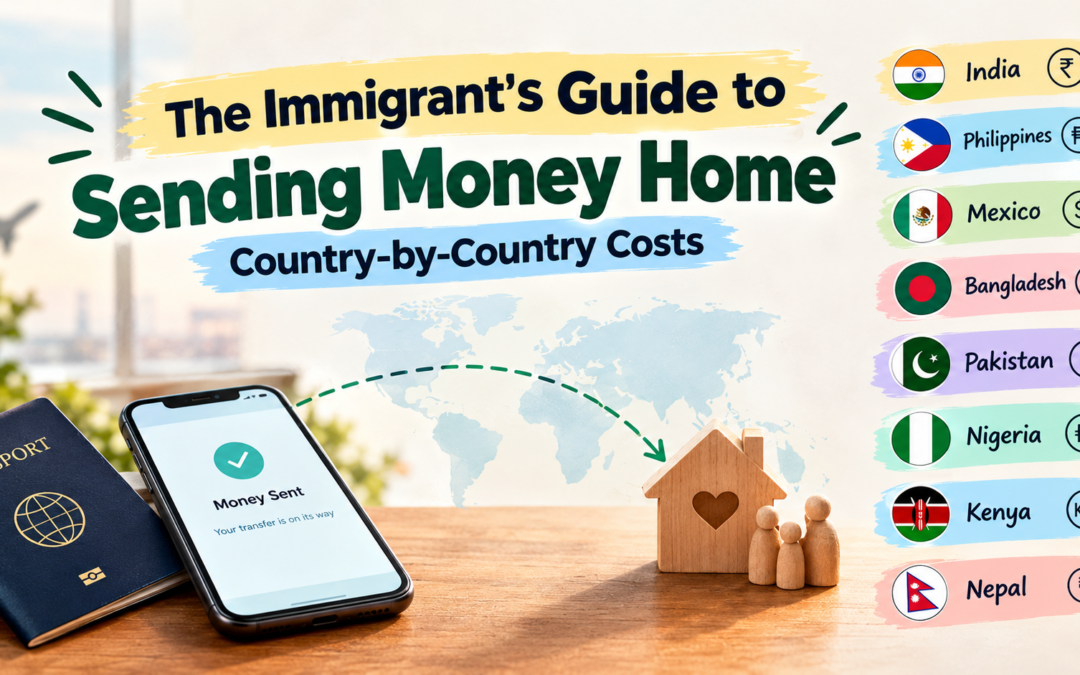
For millions of immigrants, sending money home is more than a financial transaction. It helps pay school fees, cover medical expenses, support parents, manage household bills, and fund important family milestones. But transfer fees and unfavorable exchange rates can make a meaningful difference to how much loved ones actually receive. This guide to sending money home explains how international transfer costs differ across popular destinations, which fees to look for, and how to choose a service based on the amount your family receives, not just the advertised transfer fee.
According to the World Bank’s Remittance Prices Worldwide report, the global average cost of sending money internationally stood at 6.36% in the third quarter of 2025. Digital transfers were cheaper on average, at around 4.59%, while Sub-Saharan Africa remained the most expensive receiving region, with an average cost of 8.46%. These figures show why comparing transfer services matters, especially for people who send money regularly.
What Does It Really Cost to Send Money Home?
The cost of a remittance is not simply the fee displayed on the transfer screen. Three factors determine the real expense:
- Transfer fee: A fixed charge or percentage applied to the amount you send.
- Exchange-rate margin: The difference between the provider’s exchange rate and a relevant market rate. A transfer advertised as “fee-free” may still cost more because of this margin.
- Receiving charges: The recipient’s bank or cash-pickup provider may deduct a fee, depending on the service and destination.
For example, if you send $500 and the combined transfer fee and exchange-rate loss equal 5%, the total cost is approximately $25. Your family receives the equivalent of about $475 in value, before any additional receiving charges. The precise amount depends on the quoted rate and how the provider calculates its fees.
Country-by-Country Remittance Costs
There is no single price for sending money to a country. Costs change according to the country you send from, the destination, the amount, the payment method, and whether the recipient chooses a bank deposit, mobile wallet, or cash pickup.
The table below offers a practical comparison of common remittance destinations. These are cost considerations, not fixed country-specific rates. Check the World Bank’s Remittance Prices Worldwide comparison tool for current provider-level prices before sending.
| Destination |
What can affect the cost |
What to compare |
| India |
Pricing varies by sending country, provider, and payout method. |
Exchange rate, bank deposit fees, transfer limits, and delivery time. |
| Philippines |
Bank deposits and mobile-wallet transfers may have different pricing. |
Wallet availability, cash-pickup fees, and the final amount in pesos. |
| Mexico |
Competition among providers can result in different rates and fees. |
The amount received in pesos, payment method, and pickup location. |
| Bangladesh |
Payout options and eligibility for regulated remittance incentives may affect the recipient’s final amount. |
Applicable fees, exchange rate, documentation, and official eligibility rules. |
| Pakistan |
Transfer costs depend on the corridor, provider, and delivery method. |
Recipient-bank deductions, transfer limits, and exchange-rate margin. |
| Nigeria |
Costs and payout options can vary considerably by corridor. |
Available receiving channels, local currency payout terms, and the net amount received. |
| Kenya |
Mobile-money services can be convenient, but fees and limits differ by provider. |
Wallet charges, transaction limits, conversion rate, and withdrawal costs. |
| Nepal |
Provider availability and permitted transfer channels depend on the sending country. |
Regulatory requirements, payout options, and the final amount in Nepalese rupees. |
The World Bank’s global average of 6.36% is a useful benchmark, but it should not be treated as the expected price for every destination. Some corridors are considerably cheaper, while others cost much more. The most useful comparison is between services that support the same sending country, destination, transfer amount, and payout method.
How to Compare Transfer Providers Properly
When using a guide to sending money, compare the total value delivered rather than relying on promotional claims.
Check the amount your recipient gets.
- Enter the same amount and destination into at least two or three reputable providers.
- Compare the final payout shown before confirming the transaction.
Look beyond “zero transfer fees.
- A provider may charge no upfront fee but offer a weaker exchange rate.
- Calculate the difference in the recipient’s currency to understand the real cost.
Match the payment method.
- Funding a transfer with a bank account, debit card, credit card, or cash can lead to different fees.
- Card issuers may also apply additional charges.
Consider speed and convenience.
- A bank deposit arriving the next day may be suitable for routine family support, while urgent medical expenses may justify a faster service, provided the recipient can access the funds.
Verify limits and regulations.
- Identity checks, transfer limits, reporting requirements, and permitted payment channels differ across countries.
- Use regulated providers and confirm the rules that apply to your location and destination.
Country-Specific Factors Immigrants Should Know
Beyond the headline cost, local banking rules and payment systems can affect your transfer.
For India, confirm the beneficiary’s bank details, applicable transfer limits, and the exchange rate offered by your provider. If you send money from the United States, United Kingdom, UAE, Canada, or Australia, compare quotes separately because pricing varies by corridor.
For the Philippines and Kenya, if your family uses a mobile wallet, check whether the transfer service supports direct wallet deposits and whether cash withdrawals incur an extra fee.
For Mexico, check the recipient’s cash-pickup location and opening hours if you choose cash delivery. A low-cost transfer is less useful if collecting it requires a long trip.
For Nigeria and Bangladesh, confirm the available payout currencies, documentation requirements, and any applicable government rules before sending. Never assume that a service available in another country will offer the same options in your destination.
For reliable comparisons, use the World Bank’s Remittance Prices Worldwide database, which tracks prices across international sending and receiving corridors. Its data is periodically updated, so check the date and obtain a fresh quote before making a transaction.
Practical Ways to Reduce Remittance Costs
Small savings can add up when you send money every month. If you transfer $500 monthly, a two-percentage-point reduction in total costs saves approximately $10 per transfer, or $120 over a year.
- Compare before every transfer: Exchange rates and promotional offers change, so a provider that was cheapest last month may not be cheapest today.
- Choose the right frequency: If fees include a fixed charge, sending a larger amount less often may reduce costs per dollar. Only do this if your family can comfortably wait and the money remains secure.
- Watch exchange-rate movements: Compare the quoted rate with a reliable reference rate, but remember that rates can change before a transfer is completed.
- Use referral offers carefully: Discounts can be useful, but check the standard price after the promotion ends.
- Avoid informal channels: Unlicensed brokers and strangers offering unusually favorable rates can expose your money and personal information to fraud.
Protect Your Money Before You Send It
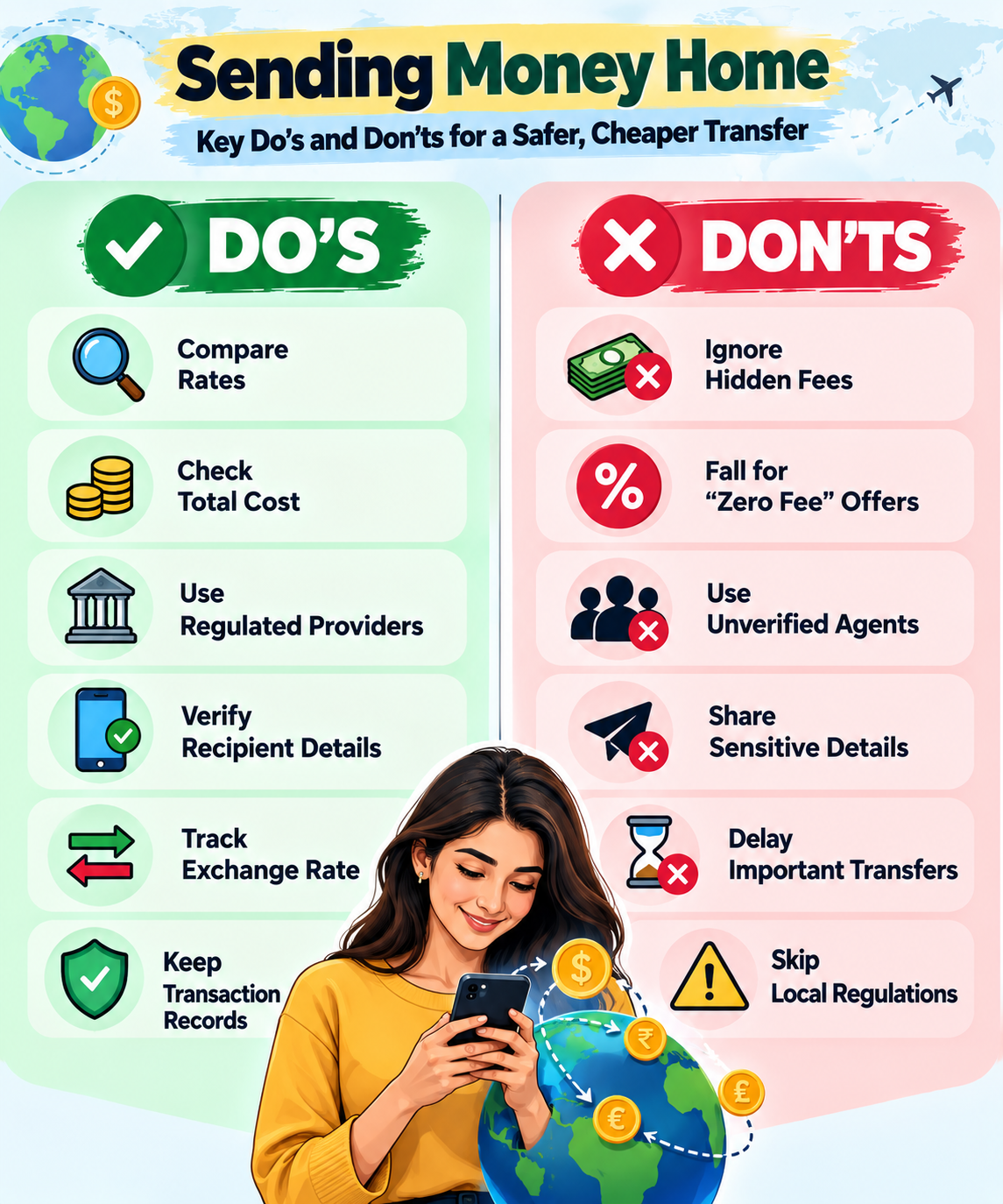
Use a regulated transfer provider, verify its official website or app, and double-check the recipient’s name and account details. Be cautious of unsolicited messages offering special rates or asking you to transfer funds to a personal account. Keep the transaction receipt and reference number until the recipient confirms the money has arrived.
If a transfer is delayed, contact the provider through its official support channel rather than paying an unexpected “release fee” to someone claiming to be an intermediary.
Guide to Sending Money: Final Thoughts
Sending money home is an ongoing responsibility for many immigrants, and unnecessary transfer costs can quietly reduce the support their families receive. A reliable guide to sending money should help you compare the full cost, understand exchange-rate margins, check country-specific rules, and select a delivery method that works for your recipient.
Before your next transfer, compare at least three providers using the same amount and payout method. Focus on the final amount received, not just the advertised fee. That simple habit can help you make every transfer count.
Guide to Sending Money: Frequently Asked Questions
1. What is the cheapest way to send money internationally?
There is no universally cheapest service. Compare the transfer fee, exchange rate, payment method, and recipient payout charges for your exact corridor.
2. Are digital money transfers cheaper than banks?
They are often cheaper on average. The World Bank reported an average digital remittance cost of 4.59% in Q3 2025, compared with a global average of 6.36%. Individual quotes can differ substantially.
3. How can I calculate the true cost of a transfer?
Compare the total amount deducted from your payment with the value your recipient receives, accounting for the exchange rate and any additional charges. Check the final quote before confirming.
Also Read: Traveloka Review: Is It Worth Using for Booking Flights and Hotels?
by parth@bidkinetic.com | Oct 23, 2026 | LifeStyle
An unexpected job loss, medical bill, urgent home repair, or car breakdown can disrupt months of financial planning. Yet many households still lack enough savings to manage a prolonged setback. According to the Federal Reserve’s Economic Well-Being of U.S. Households in 2025 report, published in May 2026, only 55% of adults said they had set aside enough money to cover three months of expenses. Another 30% said they could not cover three months of expenses through savings, borrowing, asset sales, or other means. These figures highlight why emergency fund math matters: you need a specific savings target based on your actual costs, not an arbitrary number pulled from a financial checklist.
The goal is to create a reserve that covers essential expenses when your regular income is interrupted. Getting the calculation right helps you avoid unnecessary debt, make better decisions under pressure, and protect investments meant for longer-term goals.
How Much Should Your Emergency Fund Cover?
A common guideline is to save three to six months of essential living expenses. Some households need more, particularly if income is unpredictable or several people depend on one earner.
Start by calculating what you would genuinely need to pay if you lost your income tomorrow. Include:
- Rent or mortgage payments
- Groceries and basic household supplies
- Electricity, water, internet, and essential phone bills
- Health insurance, medication, and necessary medical costs
- Transportation, fuel, and vehicle payments
- Minimum debt repayments
- Childcare, insurance, and other unavoidable commitments
Exclude expenses you could temporarily pause, such as restaurant meals, holidays, entertainment subscriptions, and discretionary shopping.
Emergency Fund Math: Calculate Your Target
Use this straightforward formula:
Emergency fund target = Essential monthly expenses × Number of months covered
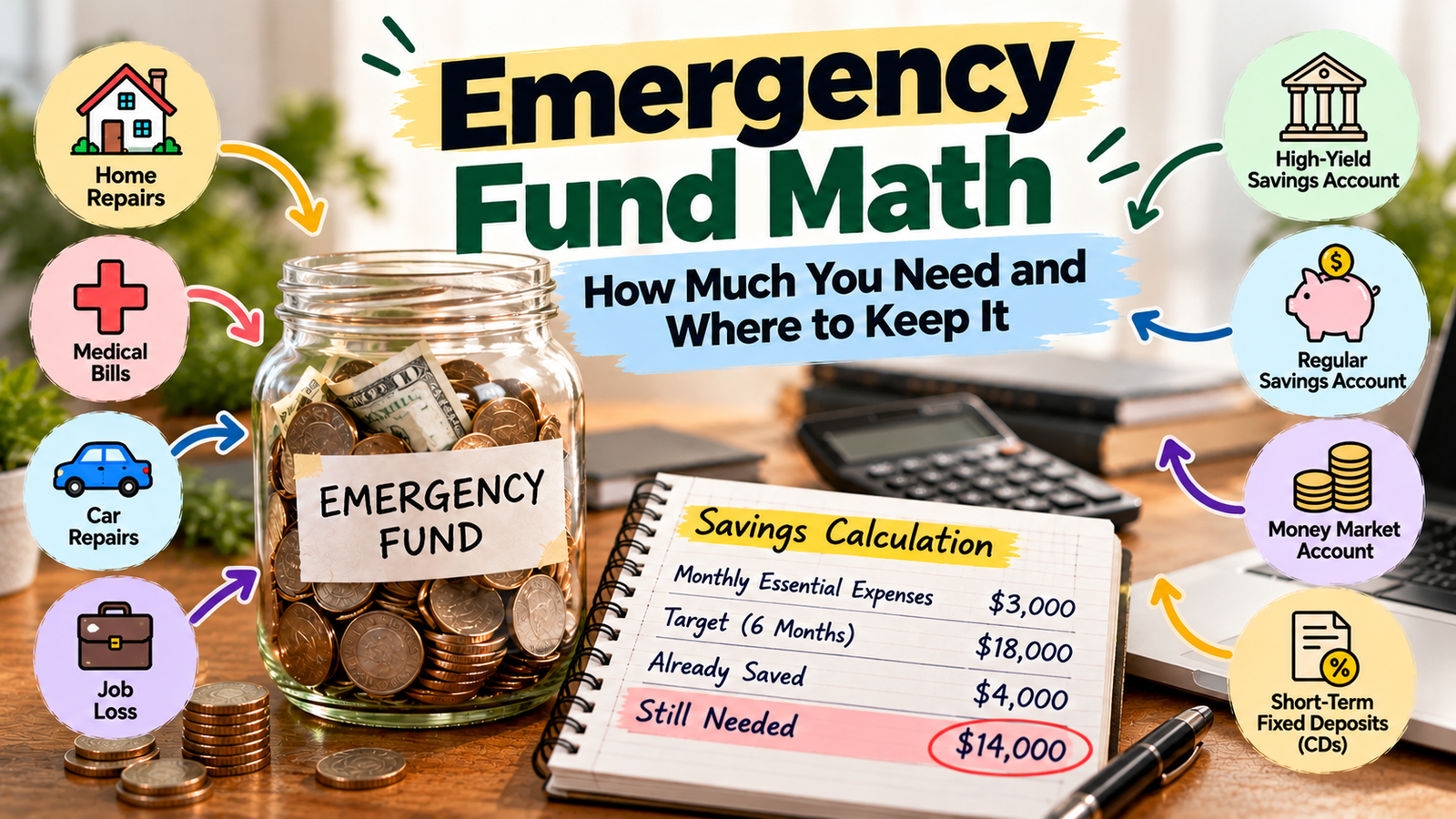
Suppose your essential monthly expenses total $3,000. Your target would look like this:
| Coverage period |
Monthly expenses |
Emergency fund target |
| 1 month |
$3,000 |
$3,000 |
| 3 months |
$3,000 |
$9,000 |
| 6 months |
$3,000 |
$18,000 |
| 9 months |
$3,000 |
$27,000 |
A three-month reserve may suit someone with stable employment, another household income, and few dependants. Six months or more may be appropriate for freelancers, commission-based workers, single-income families, or people working in industries where finding a new job can take time.
Your target should reflect your circumstances rather than a universal rule. If you have expensive ongoing medical needs or support family members financially, include those obligations in the calculation.
How Quickly Can You Build Your Fund?
A large savings target can feel discouraging when you are starting from zero. Break it into milestones instead.
For example, if your six-month target is $18,000, your first goal could be $1,000, followed by one month of essential expenses, then three months, and eventually six.
Your monthly contribution determines how long it takes to reach each milestone. Saving $300 every month would produce $3,600 in a year before interest. At $500 per month, you would save $6,000 over the same period.
Set up an automatic transfer shortly after payday, even if the amount is modest. You can also direct part of a bonus, tax refund, or unexpected cash inflow into the fund. Review your contribution whenever your income or expenses change.
The practical value of an emergency fund is that it turns a vague intention to save into a measurable plan.
Where Should You Keep Your Emergency Fund?
The best account balances three priorities: safety, accessibility, and a reasonable return. An emergency reserve is not designed to maximise investment growth. It is there to be available when life becomes unpredictable.
1. High-yield savings account
A high-yield savings account is often a strong choice for the main reserve. It can earn interest while keeping money accessible for unexpected bills. Compare interest rates, minimum balances, withdrawal rules, account fees, and deposit insurance before opening one.
2. Regular savings or checking account
A separate savings account can help you distinguish emergency money from everyday spending. You might also keep a smaller amount in checking for immediate bills, with the rest held in savings.
Avoid keeping the entire fund in an account where daily spending makes it too easy to dip into the balance.
3. Money market deposit account
Depending on the bank and account terms, a money market deposit account may offer interest and convenient access to funds. Check minimum balance requirements, fees, transaction restrictions, and insurance coverage. Do not confuse a bank deposit account with a money market mutual fund, which is an investment product and does not carry FDIC deposit insurance.
4. Certificates of deposit
Certificates of deposit (CDs) can offer a fixed interest rate, but withdrawing money before maturity may trigger a penalty. Because emergencies rarely arrive on schedule, avoid locking your entire reserve into a product that restricts access. If you use CDs, keep enough readily available cash elsewhere and understand the withdrawal terms.
Stocks, cryptocurrency, and other volatile investments are generally poor choices for the core emergency fund. Their value can fall just when you need the money.
In the United States, eligible deposits at FDIC-insured banks are generally insured up to $250,000 per depositor, per insured bank, per ownership category. Credit union members should check applicable NCUA share insurance. Coverage rules differ by country, so confirm the protections available where you live.
When Should You Use the Fund?
Use your emergency reserve for necessary, unplanned expenses that cannot reasonably wait: an urgent repair, a medical bill, or essential costs during unemployment. A planned holiday, routine annual insurance premium, or predictable car service should normally come from a separate sinking fund.
If you withdraw money, rebuild it when your finances stabilise. Recalculate the target after major changes such as moving house, having a child, changing jobs, or taking on a mortgage.
The Bottom Line
A strong emergency fund starts with realistic numbers, not guesswork. Calculate essential monthly costs, choose a coverage period that reflects your risks, and keep the money somewhere secure and accessible. With consistent contributions and regular reviews, emergency fund math becomes a practical way to prepare for setbacks without sacrificing your long-term financial goals.
Emergency Fund Math: Frequently Asked Questions
1. Should I pay off debt before building an emergency fund?
Consider building a small starter reserve first so that an unexpected bill does not force you to borrow again. Then balance high-interest debt repayment with continued saving, based on your cash flow and obligations.
2. Should my emergency fund earn interest?
Yes, if you can earn interest without sacrificing safety or access. Compare account fees, rates, withdrawal terms, and deposit protection rather than choosing an account based on its advertised rate alone.
3. How often should I review my target?
Review it at least once a year and whenever your essential expenses, income, household size, or employment situation changes.
Also Read: Malaysia Airlines Economy Review: Seats, Food, Baggage and Service
by parth@bidkinetic.com | Oct 23, 2026 | Games
When a major esports final sells out, a popular streamer announces a live show, or a gaming convention releases its last batch of passes, the pressure to secure a ticket can make buyers overlook warning signs. Knowing how to avoid ticket scams is essential when purchasing tickets for gaming tournaments, creator events, fan conventions, live podcasts, and streaming entertainment experiences. The UK government reported in August 2026 that research by O2 estimated annual ticket fraud losses at £150 million, with 14% of surveyed gig-goers saying they had purchased a fake ticket. While this research focused on gig-goers, the same risks apply to buyers navigating online resale listings and social media offers.
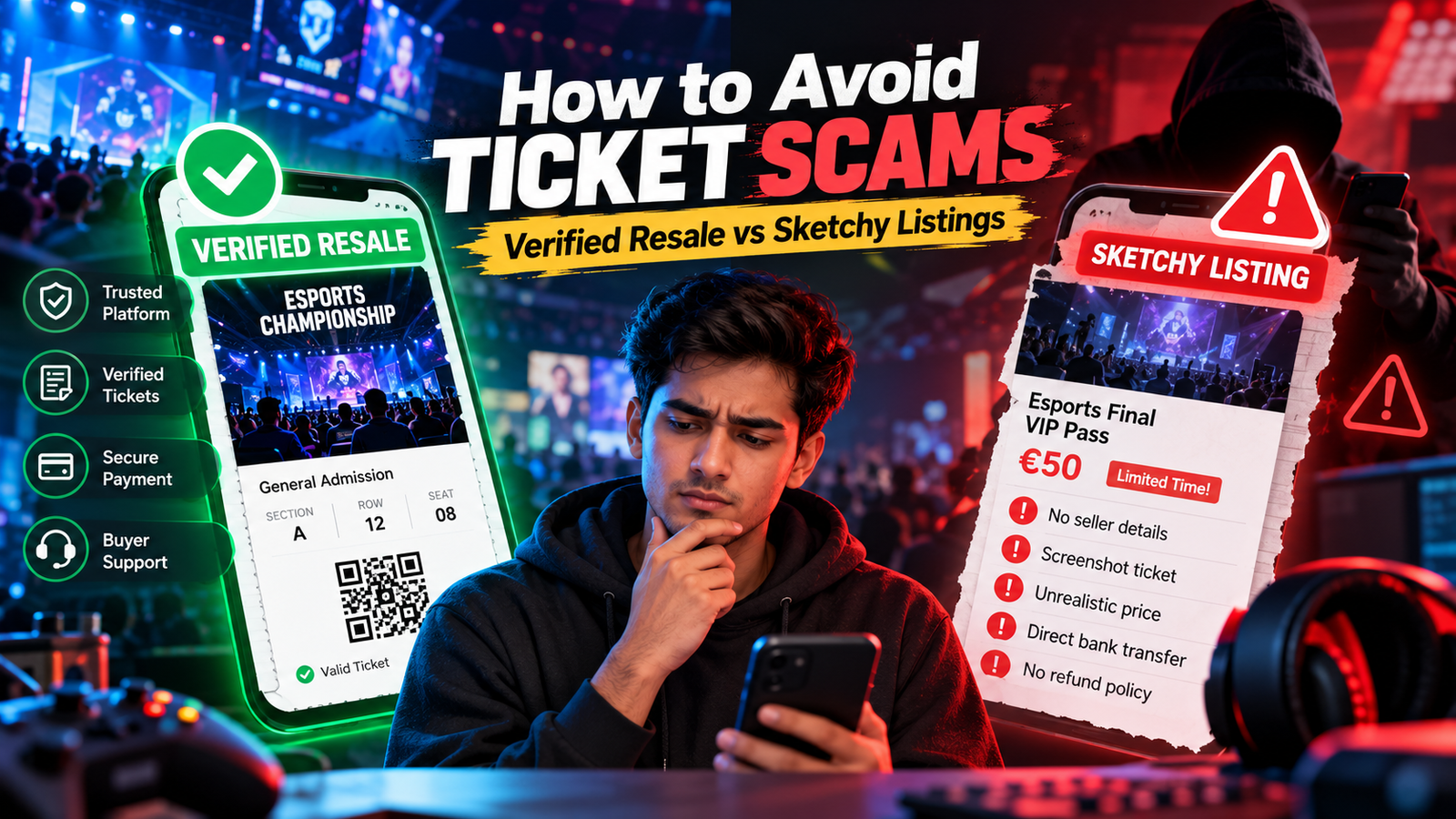
The challenge is that fraudulent listings can look convincing. Scammers may use genuine event artwork, copied ticket screenshots, fake testimonials, and profiles that appear established. The safest approach is to understand the difference between verified resale and an unverified seller before making a payment.
Verified Resale vs. Sketchy Listings: What’s the Difference?
A verified resale ticket is offered through a platform or process that provides specific checks or protections. Depending on the service, this might include ticket validation, secure transfer, buyer support, or a guarantee if a ticket is invalid. However, the word verified does not mean every resale ticket is automatically valid at every event. Always check what the platform actually guarantees.
A sketchy listing typically appears on an unofficial website, social media post, gaming community server, or direct message without reliable proof of ownership or a secure transaction process.
| What to check |
Verified resale |
Sketchy listing |
| Seller and platform |
Identifiable platform with published policies |
Anonymous profile or unclear business details |
| Ticket delivery |
Supported transfer through the official ticketing system |
Screenshot, PDF, or vague delivery promise |
| Payment |
Checkout with documented buyer protection |
Direct bank transfer, cryptocurrency, or gift cards |
| Pricing |
Clear total price and fees |
Unrealistic discount or surprise charges |
| Refund policy |
Written rules and a support process |
No clear refund terms or guarantees |
| Event eligibility |
Transfer rules can be checked |
Seller cannot explain restrictions |
A resale platform can still carry risks, so check the event organiser’s authorised resale options first.
Start With the Official Event Website
Before searching social media for tickets, visit the official website of the tournament organiser, gaming convention, streamer, venue, or promoter. Follow its ticketing link rather than clicking the first advertisement in search results.
This is particularly important for esports events, where tickets may be tied to specific seating sections, access tiers, VIP experiences, or age restrictions. Some events also limit resale or prohibit ticket transfers altogether.
If the official seller shows that an event is sold out, look for a resale partner linked directly by the organiser. Do not assume a site is authorised simply because it uses the event logo or appears prominently in search results.
Check How the Ticket Will Be Transferred
Digital tickets are convenient, but screenshots are not reliable proof of ownership. A barcode or QR code can be copied and sent to several buyers, with only one person potentially gaining entry.
Ask whether the ticket can be transferred through the original ticketing platform. If the event uses an official mobile app, check its instructions for accepting transferred tickets.
Be cautious when a seller claims that a screenshot is all you need, refuses to explain the delivery process, or promises to transfer a ticket that the event rules say is non-transferable. Never share your own account password or one-time verification code to receive a ticket.
Recognise the Warning Signs of Fake Listings
Scammers often exploit excitement and fear of missing out. A seller might claim that another buyer is waiting, demand immediate payment, or offer a premium gaming convention pass at a price far below comparable listings.
Other warning signs include newly created profiles, inconsistent usernames, copied event images, poor-quality websites, and requests to continue the transaction privately after you have contacted a resale platform.
For gaming and streaming events, be especially careful in Discord communities, Reddit threads, Facebook groups, and direct messages from accounts claiming to represent creators. A familiar username or profile picture does not prove that the person is genuine.
Protect Your Payment and Personal Information
Use the official checkout or the resale platform’s own payment system.
- Depending on your country and provider, a credit card or another payment method with a dispute process may offer more options if a transaction goes wrong.
- Avoid sending money directly through bank transfers, cryptocurrency, gift cards, or payment methods that offer little recourse for a fraudulent purchase.
- Never pay an extra fee through an unrelated link to “unlock” a ticket after checkout.
- Before entering payment details, inspect the website address carefully.
- A secure connection alone does not establish that a seller is legitimate.
- Read the refund policy, check the full price including fees, and save your order confirmation.
Check the Rules for Gaming and Streaming Events
Not every ticket provides the same access. An esports championship may distinguish between general admission, premium seating, meet-and-greet access, and backstage experiences. A creator event might require identification that matches the booking, while a gaming convention pass may be valid only on a specific day.
Confirm the date, venue, ticket category, transfer eligibility, and any age or identity requirements before paying. If a listing promises merchandise, early entry, or a creator meet-and-greet, verify that these benefits are included in the official ticket description.
Understanding how to avoid ticket scams also means checking what you are actually buying, not just whether a digital ticket file looks authentic.
What to Do If You Suspect a Ticket Scam
Stop communicating with the seller if you notice inconsistencies or pressure to make another payment. If you have already paid, contact your bank or payment provider promptly and ask whether the transaction can be disputed. Keep the listing, messages, payment receipt, seller details, and any ticket files as evidence.
Report the account or listing to the platform where you found it. You can also contact the event organiser or original ticket provider to ask whether the transfer is legitimate. If you shared passwords or verification codes, secure the affected account immediately and enable multifactor authentication.
Frequently Asked Questions
1. Can screenshots of gaming event tickets be trusted?
Not reliably. Screenshots can be copied, reused, or altered. Prefer an official ticket transfer that places the ticket in your own account.
2. Is every verified resale ticket guaranteed to work?
No. Protection depends on the platform’s actual terms and the event’s transfer rules. Read the guarantee carefully and confirm that resale is permitted.
3. Is it safe to buy tickets through Discord or social media?
It is riskier when the seller cannot be independently verified, or the transaction takes place outside a protected checkout. Use official sales channels or authorised resale options wherever possible.
How to Avoid Ticket Scams: Final Thoughts
A sold-out gaming final or a rare chance to see your favourite creator live can make an unofficial offer feel tempting. But a convincing screenshot, an urgent message, or a bargain price is not proof of a genuine ticket.
The best way to avoid ticket scams is to start with the event organiser, use authorised resale channels, verify the transfer process, and keep payments within a platform that clearly explains its buyer protections. A few checks before checkout can help protect both your money and the experience you have been looking forward to.
Also Read: AirAsia MOVE Review: Flights, Hotels, Deals and Booking Experience
by parth@bidkinetic.com | Oct 23, 2026 | Business
Online shoppers often focus on the discount displayed on a product page and overlook the rewards available through their payment card or shopping portal. Cashback stacking offers a way to earn multiple benefits from a single eligible purchase by combining different reward programmes. The opportunity is meaningful: according to the U.S. Federal Reserve’s 2024 Diary of Consumer Payment Choice, credit cards accounted for 35% of consumer payments by number in 2023, while debit cards accounted for 30%. With card payments already part of everyday spending, understanding how payment rewards interact with online shopping offers can help consumers make better purchasing decisions.
The catch is that not every reward can be combined. Some browser extensions compete for the same referral credit, certain coupon codes invalidate portal cashback, and advertised rates may apply only to selected products or customers. The goal is not to activate every offer available. It is to identify compatible savings and make sure the final purchase qualifies.
What Is Cashback Stacking?
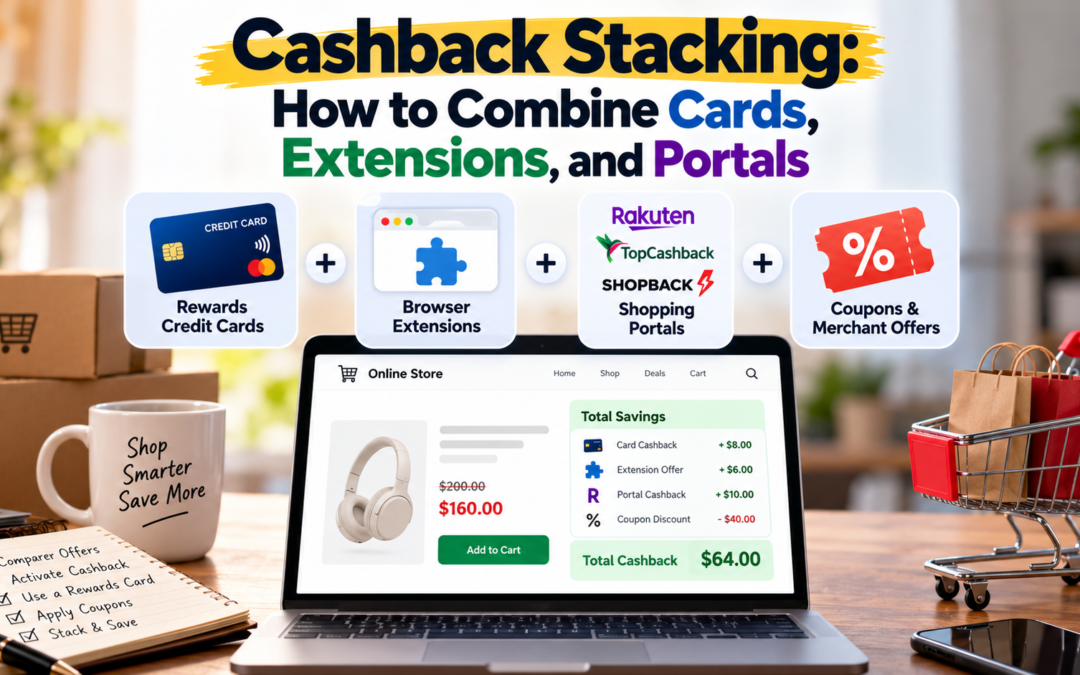
Cashback stacking means combining two or more eligible savings mechanisms on one transaction. For example, you might use a retailer coupon to reduce the purchase price, visit the store through a cashback portal, pay with a rewards credit card, and activate a qualifying bank offer.
Each layer works differently. A retailer coupon reduces the amount charged. A shopping portal may share part of its referral commission with you. Your card issuer awards points or cashback under your card’s terms, while a targeted bank offer may provide an additional statement credit.
These rewards are often calculated separately, so they can complement one another. However, stacking is never automatic across all programmes; eligibility rules, payment methods, exclusions, and tracking conditions matter.
The Four Main Layers of Cashback Stacking
1. Start with a cashback portal
Shopping portals such as Rakuten direct shoppers to participating retailers through tracked links. If the purchase qualifies, the portal awards cashback according to the merchant’s terms.
Before shopping, compare the available rates for the retailer and check whether the offer applies to your product category. A headline rate may exclude gift cards, subscriptions, sale items, or certain brands.
Click through the portal first and complete the purchase in the same shopping session whenever possible. Opening another cashback service or using an unrelated referral link afterwards may interfere with tracking.
2. Use a browser extension carefully
Browser extensions can surface coupons, compare offers, and remind you to activate cashback. They can make savings easier to find, but installing several shopping extensions does not mean all their rewards will accumulate.
Some extensions operate as cashback portals themselves. Activating one after another may replace the original referral attribution, leaving only one service eligible to receive credit.
A practical approach is to compare offers before checkout, choose the portal you want to use, and activate its cashback tracking. Use other extensions for price comparisons or coupon discovery only when doing so does not redirect the shopping session or violate the selected portal’s terms.
3. Pay with a rewards credit card
A qualifying rewards card can add another layer. Depending on the card, the transaction may earn flat-rate cashback, category bonuses, or points redeemable for travel, merchandise, or statement credits.
Check the card’s eligible spending categories and exclusions. Some cards exclude gift-card purchases, wallet loads, fees, or specific merchant categories. A purchase made through a portal does not guarantee that the card will award bonus-category rewards.
Also, pay the balance in full whenever possible. Interest charges can easily exceed the cashback earned, making the transaction more expensive overall.
4. Activate merchant and bank-linked offers
Retailers may offer promo codes, loyalty points, or discounts through their own apps. Banks may also provide targeted offers, such as a statement credit after spending a specified amount at a participating merchant.
Activate eligible offers before purchasing and read the conditions. Some require a minimum spend, a particular card, or a purchase within a set period. A bank-linked offer may combine with portal cashback, but a separate shopping programme that uses its own referral link may not.
Cashback Stacking in Practice
Consider a hypothetical online purchase priced at $200. Assume the coupon is valid, the portal tracks successfully, the card earns rewards on the eligible transaction, and the bank offer applies.
| Savings layer |
Example calculation |
Value |
| Retailer coupon |
10% off $200 |
$20.00 |
| Cashback portal |
5% of the discounted $180 |
$9.00 |
| Rewards credit card |
2% of $180 |
$3.60 |
| Bank-linked offer |
Eligible statement credit |
$10.00 |
| Total estimated benefit |
$20 + $9 + $3.60 + $10 |
$42.60 |
The effective benefit is $42.60, or 21.3% of the original $200 price. The final cost after these benefits would be $157.40, assuming every reward is approved and the card reward is calculated on $180.
This is an illustration, not a guaranteed outcome. Actual calculations may differ because taxes, shipping, reward caps, excluded products, and programme-specific definitions of eligible spending affect the result. Cashback may also arrive weeks later rather than at checkout.
Common Mistakes That Reduce Your Savings
The biggest mistake is assuming that every advertised offer can be combined.
- Before placing an order, check whether the portal permits coupon codes from outside its own platform.
- Rakuten, for example, warns that unlisted coupon codes and other shopping extensions can affect cashback eligibility.
Another mistake is choosing a higher cashback percentage without checking the purchase price.
- A competing portal offering 8% cashback may not be better if the retailer’s price is higher or the offer excludes the item you want.
Avoid buying unnecessary products just to reach a minimum-spend threshold.
- Spending an extra $40 to unlock a $10 reward is not a saving if you did not need the additional purchase.
Finally, keep order confirmations and screenshots of activated offers.
- If cashback fails to track, these records can help when contacting the portal or retailer.
- Review the programme’s claim deadlines, as missing them may make a correction difficult.
A Simple Routine for Better Results
Before checking out, compare the retailer’s direct price with prices offered elsewhere. Check one or two reputable cashback portals, read the eligible purchase terms, and select the portal with the best overall value. Activate any compatible bank offer, apply an approved coupon, and pay with a card that rewards the transaction.
After ordering, verify that the portal recorded the purchase as pending. Check the reward status again after the retailer’s return or confirmation period. If a purchase is returned or cancelled, cashback may be reduced or reversed.
The most effective cashback stacking routine is repeatable rather than complicated. A few compatible rewards on a planned purchase are usually more valuable than chasing every promotion across multiple websites.
Frequently Asked Questions
1. Can I combine cashback from a portal with credit card rewards?
Often, yes. The portal and card issuer usually operate separate reward programmes. However, both rewards must be eligible under their respective terms, and the card must recognise the transaction as qualifying spending.
2. Can I use two cashback portals for one purchase?
Usually, you should not expect both portals to pay for the same transaction. They may compete for referral attribution, meaning only one portal receives credit. Compare their offers before clicking through and choose one.
3. Do browser extensions guarantee the best deal?
No. Extensions can find coupons and highlight offers, but they may not display every promotion or account-specific deal. Check the final price, offer restrictions, and privacy permissions before installing or using an extension.
Also Read: Humble Choice Review: Is the Monthly Subscription Worth It Now?
