by parth@bidkinetic.com | Oct 12, 2026 | Uncategorized
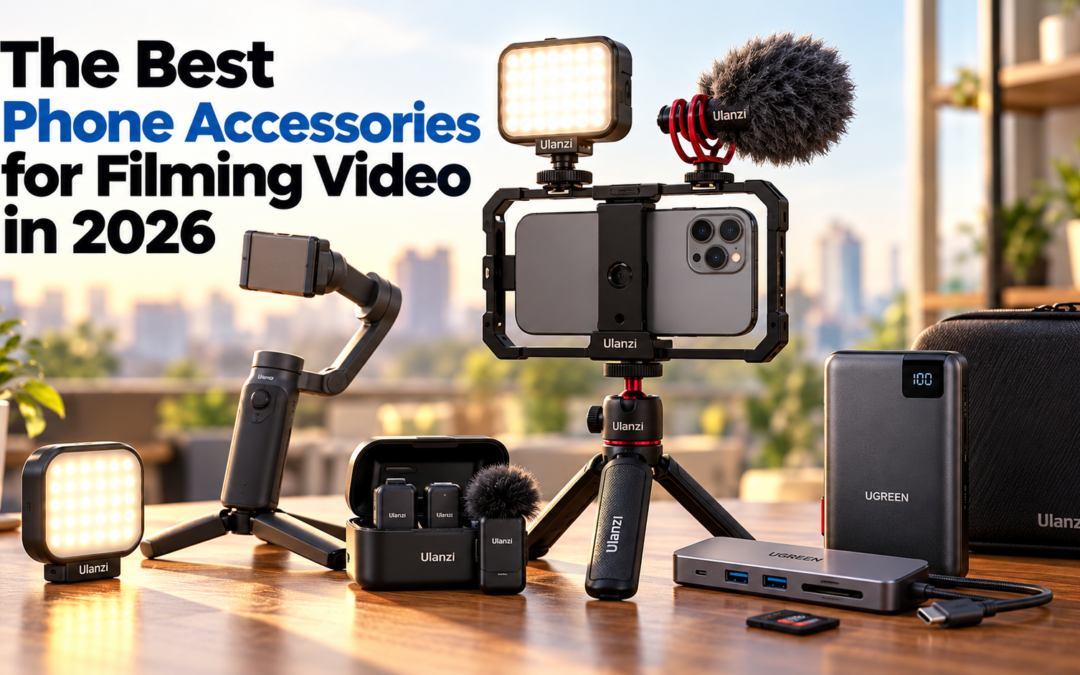
The best phone accessories for filming video solve specific problems: a wireless microphone captures clearer speech, a tripod keeps framing consistent, an LED light improves indoor footage, and a power bank prevents interruptions during longer recording sessions. Brands such as Ulanzi specialise in mobile filmmaking gear, including phone mounts, grips, lights and microphone accessories, while UGREEN offers useful charging, connectivity and mobile power solutions.
In 2026, the smartest approach is to build a setup around the type of content you shoot. A solo creator recording talking-head videos needs different equipment from someone filming moving subjects, food, unboxings or outdoor adventures. Here are seven accessories worth considering.
1. Ulanzi Phone Cage or Grip: Best for Building a Mobile Filming Setup
A phone cage or grip is a useful starting point for creators who want better control over their smartphone while filming. Ulanzi offers mobile filmmaking accessories such as phone cages, magnetic mounts and handheld grips that make it easier to hold a phone securely and attach additional equipment.
A cage is particularly useful when recording interviews, product videos or cinematic B-roll. Depending on the model, you can attach a microphone, LED light and other compatible accessories to create a compact filming rig. For casual Reels, a simple grip may be enough without adding unnecessary bulk.
Best for: Creators who want a modular setup for regular video production.
2. Wireless Lavalier Microphone: Best for Clear Audio
Viewers might tolerate average lighting, but muffled dialogue can make a video difficult to watch. A wireless lavalier microphone clips onto your clothing and captures your voice more directly than a phone microphone positioned at arm’s length.
Ulanzi’s J12 wireless microphone is one option to explore for mobile recording. Before buying, check whether the receiver supports your phone’s connector, whether the package includes the correct USB-C or Lightning version, and whether it supports one or two transmitters.
For interviews, tutorials and outdoor videos, pay attention to wind protection, transmission range and background-noise handling. A microphone with a charging case can also simplify repeated recording sessions.
Best for: Talking-head videos, interviews, tutorials and product reviews.

Lighting becomes especially important when filming indoors, where overhead lights can create harsh shadows or leave faces looking dull. A compact LED light gives you more control over brightness, colour temperature and the direction of illumination.
Ulanzi’s portable lighting range includes magnetic and rechargeable options. Its GL01 magnetic selfie light, for example, offers adjustable colour temperature from 2700K to 6500K. Magnetic mounting can make setup convenient for compatible phones, although attachment methods and compatibility vary by device.
Position the light slightly above eye level and off to one side for a more natural result. When filming products, move the light to control reflections rather than pointing it directly at shiny surfaces.
Best for: Indoor creators, beauty videos, product demonstrations and livestreams.
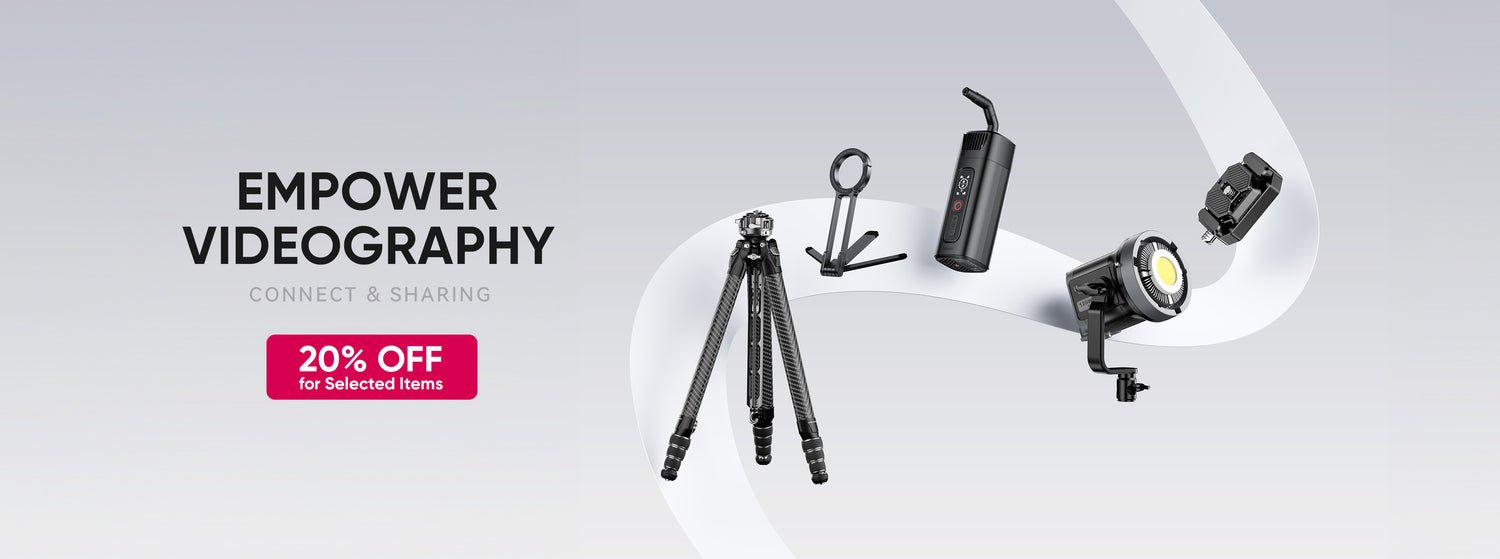
A tripod is one of the simplest upgrades for smartphone video. It keeps framing consistent, prevents the small shakes associated with handheld recording and allows you to film yourself without asking someone else to operate the camera.
The Ulanzi MT-44 is a versatile option to consider for creators who want a compact support system that can also work as an extended handheld stick. It suits stationary talking-head videos, overhead demonstrations when paired with a suitable mount, and travel content.
Check the phone holder, maximum height and stability before purchasing. For overhead food videos or heavier accessory combinations, use a support designed for that load rather than relying on a fully extended lightweight tripod.
Best for: Tutorials, solo creators, tabletop videos and travel filming.
5. Smartphone Gimbal: Best for Moving Footage
Walking shots often look shaky even when the smartphone has built-in optical or electronic stabilisation. A motorised gimbal adds another layer of stabilisation by compensating for movement across multiple axes.
The DJI Osmo Mobile series and Insta360 Flow series are worth comparing in 2026. Depending on the model, features may include subject tracking, automatic framing, panorama modes and integrated tripod legs.
A gimbal is particularly useful for walking tours, event coverage and cinematic product sequences. However, it adds weight, requires charging and may need balancing or calibration. If most of your videos are recorded from a fixed position, a tripod is usually the more economical purchase.
Best for: Travel vloggers, event creators and moving shots.
6. UGREEN Power Bank: Best for Longer Recording Sessions
Recording video can drain a phone’s battery quickly, particularly when shooting 4K footage, using wireless microphones or recording outdoors in warm conditions. A reliable power bank reduces interruptions and gives you more flexibility when working away from a socket.
UGREEN offers portable power banks alongside charging accessories. Choose capacity according to your shooting schedule, phone battery and charging requirements rather than buying the largest model automatically.
Check USB-C Power Delivery support, the phone’s maximum supported charging speed, output wattage and the power bank’s airline restrictions. During recording, avoid covering the phone’s ventilation area and monitor temperature, since charging and prolonged video capture can increase heat.
Best for: Travel videos, events, outdoor shoots and extended recording days.
7. UGREEN USB-C Hub or Card Reader: Best for Managing Video Files
High-resolution video files consume storage quickly. A compatible USB-C hub or card reader can simplify transfers to external storage and make it easier to move footage to a laptop for editing.
UGREEN’s mobile accessory range includes USB-C products and card readers. The right choice depends on your phone’s supported connections and the storage device you plan to use. Some smartphones support direct external-drive recording, but others may only support file transfers or require specific formatting.
Check transfer speeds, connector compatibility and whether the accessory needs external power. Fast transfers are particularly useful when managing multiple takes, backing up footage and freeing space before the next shoot.
Best for: Creators who record frequently or edit on a laptop.
Comparison Table: Which Accessory Should You Buy?
| Accessory |
Main benefit |
Ideal user |
| Ulanzi phone cage or grip |
Secure handling and mounting |
Mobile filmmakers |
| Wireless lavalier mic |
Clearer dialogue |
Vloggers and interviewers |
| Ulanzi LED light |
Better lighting control |
Indoor creators |
| Ulanzi MT-44 tripod |
Stable framing |
Solo creators |
| DJI or Insta360 gimbal |
Smoother movement |
Travel vloggers |
| UGREEN power bank |
Longer shooting time |
Outdoor creators |
| UGREEN hub or card reader |
Easier file transfers |
Frequent video editors |
How to Choose the Right Phone Accessories for Filming Video
Start with the problem that affects your videos most. If your voice sounds distant, buy a microphone before a new light. If your footage shakes, prioritise a tripod or gimbal. For poorly lit indoor scenes, a small LED light may deliver the biggest improvement.
When comparing phone accessories for filming video, also check your phone’s connector, mounting compatibility, charging requirements and total setup weight. Avoid buying multiple accessories that perform the same job unless your workflow genuinely requires them.
For beginners, a tripod, wireless microphone and compact light make a practical starter kit. Add Ulanzi mounting equipment or UGREEN power and connectivity accessories as your filming needs grow.
Phone Accessories for Filming Video: Frequently Asked Questions
1. What accessories do I need to start filming videos on my phone?
Start with a tripod, an external microphone and a small LED light. These address stability, sound and lighting without requiring an expensive setup.
2. Is Ulanzi good for smartphone video accessories?
Ulanzi offers a broad selection of phone grips, cages, tripods, lights and microphones. Choose individual products based on compatibility and the type of videos you create.
3. What is UGREEN best for in a mobile filming setup?
UGREEN is useful for charging, power banks, USB-C connectivity and file-transfer accessories. These products help support longer recording sessions and more efficient workflows.
Also Read: Ulike IPL Review: At-Home Hair Removal Tested Over 8 Weeks

by parth@bidkinetic.com | Oct 12, 2026 | Travel
Train travel in the UK can be one of the easiest ways to explore cities such as London, Manchester, Edinburgh, Birmingham and Bristol, but ticket prices can make longer journeys surprisingly expensive. The reason is not always the distance travelled. UK rail fares vary according to the route, operator, departure time, ticket restrictions and availability of advance fares. As a result, two tickets covering shorter sections of the same journey can sometimes cost less than one ticket for the entire route.
TrainPal is designed to help travellers find these combinations without having to compare every station manually. Its split-ticket booking tool searches for separate fares that cover a single journey, while allowing passengers to compare the total against a conventional ticket. TrainPal promotes savings of up to 40% through split-ticket options, although the actual saving depends on the route, date and available fares.
For anyone planning train travel in the UK, the appeal is straightforward: potentially pay less for the same train journey without adding unnecessary stops. Understanding how split ticketing works, when it is useful and what to check before paying can help you make a more informed booking.
What Are Split Train Tickets?
Split ticketing means buying two or more tickets for different sections of one journey instead of purchasing a single ticket from the starting station to the destination. For example, a passenger travelling from Manchester to London might find that Manchester to an intermediate station, followed by a second ticket to London, costs less than a through ticket.
This is permitted under the National Rail Conditions of Travel. You generally do not need to leave the train at the station where one ticket ends and the next begins, provided the train stops there to pick up and drop off passengers. All tickets must cover the journey correctly, and the restrictions on each ticket still apply.
The saving comes from differences in how fares are priced across individual sections, not from travelling without a valid ticket or taking an unofficial shortcut.
How TrainPal Finds Cheaper Tickets
TrainPal automates the process of checking multiple fare combinations. Instead of manually searching every station along a route, you enter your journey details and compare the available ticket options.
- Enter your route and travel date: Open TrainPal and add your departure station, destination, date and preferred time.
- Compare the available fares: Review direct tickets alongside split-ticket combinations. Check the total price rather than focusing only on the advertised saving.
- Choose a suitable journey: Consider departure times, journey duration, train changes and ticket restrictions. The cheapest option may not be the most convenient.
- Complete the booking: Confirm passenger details, any applicable Railcard discount and the final price. Follow the booking instructions to access your tickets.
- Check every ticket before travelling: Make sure the tickets cover the complete route and that your train calls at each required split station. Keep all ticket codes available during the journey.
TrainPal advertises split-ticket searches, promotional offers and app-based booking without booking fees on eligible purchases. Check the terms displayed at checkout, as offers and payment conditions can change.
How Much Can You Save with TrainPal?

TrainPal promotes savings of up to 40%, but this is a potential maximum rather than a guaranteed discount on every journey. Longer routes, peak-time fares and differences between individual fare sections can create opportunities to save. On other journeys, a direct ticket may already be the cheapest option.
The following examples illustrate how the arithmetic works; they are hypothetical, not live TrainPal quotations.
| Example journey |
Direct ticket |
Split tickets combined |
Saving |
| London to Manchester |
£80 |
£55 |
£25 (31.25%) |
| Birmingham to Edinburgh |
£70 |
£49 |
£21 (30%) |
| Bristol to Leeds |
£60 |
£42 |
£18 (30%) |
Actual prices depend on your travel date, time, operator and ticket availability. Compare fares for the same journey and equivalent restrictions before deciding.
When Is Split Ticketing Most Useful?
Split tickets are worth checking when travelling long distances, particularly between major cities. They can also help when standard advance fares are limited or when different sections of a route have more favourable pricing.
Flexibility helps, too. If you can travel outside the busiest periods, compare Off-Peak and Super Off-Peak options alongside split fares. A Railcard may provide additional savings on eligible tickets, but the discount and restrictions must apply to each relevant ticket.
For regular commuters, the calculation can be different. Season tickets, flexible season tickets and other commuter products may offer better value than buying separate tickets for each trip. Compare the cost over your actual travel pattern rather than assuming split ticketing is always the answer.
Important Things to Check Before Booking
The cheapest displayed fare is useful only if it works for your journey. Check these details before paying:
- Train stops: The train must call at the station where your tickets split, unless the applicable ticketing rules provide an exception.
- Ticket restrictions: Advance tickets may be valid only on specific trains, while flexible tickets have their own conditions.
- Seat reservations: Reservations may be issued separately for different ticket sections. Check whether you need to change seats.
- Changes and refunds: Separate tickets can have different conditions. If you miss a connection or your plans change, the rules governing each ticket matter.
- Final price: Include any applicable charges and compare the full amount with other booking options.
For disruption or compensation, split-ticket journeys remain subject to the applicable rail conditions. Keep all tickets and booking confirmations so you can demonstrate the full journey. National Rail provides official guidance on split-ticket rules and conditions.
Is TrainPal Worth Using for UK Rail Travel?
For travellers who want to reduce transport costs without driving, TrainPal is a useful way to compare split fares alongside standard tickets. Its main advantage is convenience: it automates a process that would otherwise require checking multiple stations and combinations manually.
However, no booking platform can guarantee the lowest possible fare on every route. Compare the final price with the train operator’s website, check the restrictions and consider whether a slightly more expensive ticket offers greater flexibility.
When planning train travel in the UK, the best habit is to check split-ticket options before paying for a long-distance journey. Even when the saving is below 40%, a lower fare can leave more of your travel budget available for accommodation, meals and activities.
Train travel in the UK: FAQs
1. Is split ticketing legal in the UK?
Yes. National Rail permits split ticketing under its Conditions of Travel, provided the tickets are valid for the complete journey, and the relevant stopping requirements are met.
2. Do I need to change trains when using split tickets?
Not necessarily. You can usually stay on the same train if it stops at the station where one ticket ends and the next begins. If your itinerary includes a train change, follow the specified connection.
3. Can I use a Railcard with split tickets?
Eligible Railcard discounts can generally be applied to qualifying tickets. Check the Railcard’s restrictions and ensure you carry a valid Railcard when travelling.
Also Read: Traveloka Review: Is It Worth Using for Booking Flights and Hotels?

by parth@bidkinetic.com | Oct 12, 2026 | Gadgets
Choosing between LG and Samsung in 2026 is no longer simply a question of which brand makes the better television. Both offer premium OLED models, while Samsung continues to expand its QLED and Neo QLED ranges, and LG competes with OLED evo and Mini LED-equipped QNED televisions. Samsung’s 2026 lineup includes the S95H and S90H OLED series alongside Neo QLED models such as the QN80H; LG’s OLED range includes the G6, C6 and B6. For anyone comparing LG vs Samsung TVs, understanding the technology behind the labels is a more reliable starting point than choosing by brand reputation alone.
The most important distinction is how each screen produces its picture. OLED pixels illuminate individually, allowing them to switch off for deep blacks. QLED televisions use quantum dots to improve colour in an LCD display, which relies on a backlight. Neo QLED adds Mini LED backlighting for more precise brightness control. These differences affect contrast, daytime viewing, HDR performance, gaming and price.
OLED vs QLED: What Do These Terms Actually Mean?
OLED (Organic Light-Emitting Diode) uses self-lit pixels. When a pixel displays black, it can switch off completely. This creates excellent contrast, detailed dark scenes and a cinematic image, particularly in a dimly lit room. OLED also offers wide viewing angles and fast pixel response, making it attractive for movies and gaming.
QLED (Quantum Dot LED) is an LCD television that uses quantum-dot technology to improve colour reproduction. Since it uses a backlight, the screen can produce substantial brightness, which is useful in living rooms with windows or strong ambient light. However, black levels depend on the backlighting and local-dimming system.
Neo QLED is Samsung’s premium LCD technology, combining quantum dots with Mini LED backlighting. Smaller LEDs allow more precise control over different areas of the screen, improving contrast compared with conventional LCD designs. Local dimming can still produce halos around bright objects against dark backgrounds.
LG also sells QNED televisions, including models with Mini LED backlighting. Therefore, the comparison is not simply LG OLED versus Samsung QLED: both brands offer multiple technologies at different prices.
LG vs Samsung TVs: Key Differences in 2026
Model specifications vary by screen size and region. Compare the exact model before buying.
| Feature |
LG OLED / QNED |
Samsung OLED / Neo QLED |
| Best OLED models |
G6, C6, B6 |
S95H, S90H, S85H |
| Black levels |
Excellent on OLED |
Excellent on OLED |
| Bright-room viewing |
Bright OLED and Mini LED options |
Strong OLED and Neo QLED options |
| HDR formats |
Dolby Vision, HDR10, HLG on applicable models |
HDR10+, HDR10, HLG on applicable models |
| Gaming |
HDMI 2.1, VRR, G-Sync and FreeSync on selected models |
High refresh rates, VRR, FreeSync on selected models |
| Smart platform |
webOS |
Tizen |
| LCD alternative |
QNED / QNED Mini LED |
QLED / Neo QLED Mini LED |
Picture Quality: Which Brand Looks Better?

For movies, OLED is usually the stronger choice when contrast and dark-scene detail matter most. Because each pixel controls its own light, star fields, night scenes and cinematic black bars look particularly convincing. LG’s G6 and C6 OLED models target this premium viewing experience, while Samsung’s S95H and S90H compete in the same category.
In bright rooms, the answer depends on the individual model. High-end OLED televisions have improved brightness, but a good Mini LED TV can be a practical option for a living room with substantial daylight. Samsung’s Neo QLED range uses quantum dots and Mini LED backlighting, while LG’s QNED Mini LED models provide a comparable LCD-based alternative. Screen reflections, window placement and viewing habits matter as much as peak-brightness claims.
HDR, Gaming and Smart Features
HDR stands for High Dynamic Range.
- It helps compatible content show brighter highlights and more detail across light and dark areas.
- Two important formats are Dolby Vision and HDR10+. LG supports Dolby Vision on its cited 2026 G6 model, while Samsung promotes HDR10+ across relevant ranges.
- If you stream films frequently, check which format your preferred services and devices use.
- Neither format alone guarantees better picture quality; panel performance and processing still matter.
For gaming, compare refresh rate, HDMI 2.1 connectivity, variable refresh rate (VRR) and input lag.
- LG’s G6 supports up to 165Hz VRR on specified sizes, along with NVIDIA G-SYNC compatibility and AMD FreeSync Premium.
- Samsung’s Neo QLED QN80H lists a refresh rate of up to 144Hz with VRR.
- These features benefit compatible gaming PCs and consoles, but the supported rate depends on the model, input and resolution.
The smart interface is another everyday difference.
- LG uses webOS, while Samsung uses Tizen.
- Both offer popular streaming apps and voice-assisted features, but the interface, remote control and app availability may suit different users.
- Try the menus in a store if you can; a fast, intuitive interface can matter more over time than a small specification advantage.
Which Should You Buy?
If your priority is cinematic viewing, deep blacks and a premium gaming setup, start with LG’s OLED G6 or C6 and Samsung’s S95H or S90H. For a brighter family room or a larger screen at a more manageable price, compare LG QNED Mini LED and Samsung Neo QLED models rather than assuming OLED is automatically the best value.
The practical verdict on LG vs Samsung TVs is that neither brand wins every category. LG is a compelling choice for OLED-focused movie watching and gaming features; Samsung offers strong OLED competition and a broad Mini LED range for bright rooms. Compare exact screen sizes, local prices, warranty terms and connectivity before deciding.
Frequently Asked Questions
- Is LG OLED better than Samsung QLED?
For black levels and pixel-level contrast, OLED generally has the advantage. QLED and Neo QLED can be better suited to bright rooms, depending on the model. The best choice depends on lighting and viewing habits.
- Is Samsung OLED better than LG OLED in 2026?
There is no universal winner. Compare brightness, reflection handling, HDR support, gaming refresh rate and price across equivalent models such as LG G6/C6 and Samsung S95H/S90H.
- What is the difference between QLED and Neo QLED?
QLED uses quantum dots to improve colour in an LCD display. Neo QLED adds Mini LED backlighting for more precise local dimming and improved contrast control.
Also Read: GamsGo Review: Shared Streaming Subscriptions, Legit or Risky?

by parth@bidkinetic.com | Oct 11, 2026 | Travel
The cheapest way to cross the United States depends on more than the ticket price. A coast-to-coast trip from New York to Los Angeles covers roughly 2,800 miles by road, and the choice between a Greyhound bus, a flight, or an Amtrak train can change both your budget and how much of your trip you spend in transit. Buses often have the lowest upfront fares, flights can save several days, and trains offer a middle ground for travelers who value scenery and the ability to move around.
Airfare data helps put the comparison in perspective. The U.S. Bureau of Transportation Statistics reported an average domestic airline itinerary fare of $387 for 2025, although actual prices vary widely by route, date, and booking time. That figure is a national average, not a quote for a cross-country flight, and it excludes optional charges such as baggage fees.
For anyone planning a long-distance US journey, the real question is what the complete trip costs after luggage, transfers, meals, overnight stops, and travel time are considered. Here is how Greyhound, flying, and trains compare.
1. Greyhound Bus: Usually the Best Starting Point for a Tight Budget
If your priority is keeping the ticket cost low, Greyhound deserves the first look. The company serves more than 1,600 destinations across the US, Canada, and Mexico, with routes connecting major cities such as New York, Chicago, Dallas, Houston, and Los Angeles. Its network also connects travelers to smaller cities and regional destinations.
The main advantage is the potential to travel for less without paying airport transfer costs or spending money on a rental car. Greyhound coaches offer free Wi-Fi, power outlets, onboard restrooms, and reclining seats. One carry-on and one stored bag are included under the standard allowance; additional or oversized luggage may cost extra.
The trade-off is time. A coast-to-coast bus journey can take several days, depending on the route, connections, and service schedule. Overnight travel can reduce hotel expenses, but sleeping in a coach seat is not the same as getting a full night’s rest in a bed.
Choose Greyhound when: your dates are flexible, the lowest fare matters most, and you can spare the extra travel time.
2. Flying: Best for Saving Time, Not Always Money
Flying is usually the quickest way to cross the country.
- A nonstop flight between New York and Los Angeles takes approximately six hours in the air, compared with several days by bus or train.
- Once airport arrival time, security, boarding, baggage collection, and ground transportation are included, the full journey is longer, but still dramatically faster.
The catch is that the cheapest advertised airfare may not represent the final cost.
- Depending on the airline and ticket, checked baggage, seat selection, and other optional services can increase the total.
- Getting to and from airports can add another expense, especially when they are far from city centers.
For example, a low-cost flight may look like the obvious winner until you add a checked suitcase, airport transport, and a hotel night required by an inconvenient departure time. Conversely, a well-timed flight with a reasonable baggage allowance can be excellent value when your time is limited.
Choose flying when: you have only a few days, need to cover a large distance, or find a competitive fare that includes the services you need.
Compare flights across multiple dates and nearby airports. A departure on Tuesday rather than Friday, or an early booking for a popular holiday period, can make a meaningful difference.
3. Train: Best for Comfort and Scenic Travel
Amtrak is worth considering if you want to experience the journey rather than simply reach the destination. Its network covers more than 500 destinations in 46 states, with routes such as the California Zephyr connecting Chicago and the San Francisco Bay Area through landscapes that include the Rockies and Sierra Nevada.
Train travel offers room to stretch your legs, scenic views, and the option of choosing a coach seat or a sleeping accommodation on eligible long-distance services. However, a sleeper can significantly increase the price, so budget travelers should compare coach fares first.
Train prices also fluctuate.
- Amtrak recommends booking early because fares can rise as departure approaches, particularly around holidays and peak travel periods.
- Some lower-priced fare types have stricter change and cancellation conditions than flexible tickets.
The limitation is the network itself.
- Some routes are long, service frequency varies, and trains do not reach every destination.
- A train may be a good deal between cities on the same corridor but less practical if your itinerary requires multiple connections.
Choose a train when: comfort, scenery, and a relaxed travel experience matter almost as much as the price.
Greyhound Bus vs Flying vs Train: Quick Comparison
| Factor |
Greyhound bus |
Flying |
Amtrak train |
| Upfront ticket cost |
Often the lowest |
Can be low with advance booking |
Varies by route and date |
| Coast-to-coast travel time |
Several days |
Around six hours nonstop, plus airport time |
Several days on many itineraries |
| Comfort |
Basic reclining seat |
Depends on airline and seat |
More room to move around |
| Luggage costs |
One carry-on and one stored bag included under standard allowance |
Depends on airline and ticket |
Check route-specific baggage rules |
| Best for |
Budget-first travelers |
Time-sensitive trips |
Scenic, slower travel |
| Main drawback |
Long journey and possible transfers |
Airport costs and optional fees |
Limited routes and variable fares |
Prices and journey times depend on the route, date, schedule, and ticket type. Compare the actual itinerary before booking.
Which Option Is Cheapest for Different US Trips?
The cheapest transport depends heavily on distance. On shorter routes, such as New York to Washington, D.C., compare bus fares with train tickets and flights only when they make practical sense. A bus may be inexpensive, while a train can be competitive when booked early and may offer a more convenient city-center arrival.
For a longer trip such as Chicago to Denver, a flight can save considerable time, while bus and rail fares should be checked against your flexibility and comfort requirements. For a full New York-to-Los Angeles journey, the bus may offer a low ticket price, but the train can be attractive for travelers who want to see the country along the way.
When comparing the Greyhound bus with other options, calculate the full trip cost:
- Ticket price, including taxes and booking charges.
- Luggage fees and seat-selection costs.
- Transfers between stations, airports, and accommodation.
- Meals and overnight accommodation during the journey.
- The value of time spent traveling instead of at your destination.
This last factor is easy to overlook. Saving $80 on a ticket may not be worthwhile if it requires an extra night in a hotel or costs you a day of paid work.
How to Find the Cheapest Fare
Book early where possible, compare nearby departure dates, and check the full journey rather than just the first leg. For Greyhound, review transfer times and confirm which station you will use. For flights, compare baggage-inclusive totals. For Amtrak, check whether the cheapest fare has cancellation restrictions that suit your plans.
Traveling midweek, avoiding major holiday periods, and remaining flexible about departure times can all help. If you are visiting several cities, compare the cost of separate tickets with a multi-stop itinerary before committing.
FAQs
- Is Greyhound cheaper than flying across the US?
Often, yes, particularly when booking early and traveling with standard luggage. However, discounted airfares can sometimes be competitive. Compare the complete cost rather than relying on the advertised ticket price.
- Is taking a train across the US worth it?
It can be, especially if you enjoy scenic landscapes and a slower pace. Coach travel may be affordable, but sleeper accommodations cost more. Check journey times and availability before choosing rail for a time-sensitive trip.
- How long does it take to cross the US by bus?
A coast-to-coast journey can take several days. The exact duration depends on the cities, transfers, service schedule, and delays.
Also Read: Last-Minute Travel Deals: How to Book a Trip This Week Without Overpaying

by parth@bidkinetic.com | Oct 11, 2026 | Travel
Travel in 2026 is increasingly about finding places that offer memorable experiences without the queues, inflated hotel prices, and packed viewpoints associated with the world’s biggest tourist hotspots. The opportunity is real: the Washington Post reported in January 2026 that more than 1.5 billion people travelled internationally in 2025, while travel companies are increasingly highlighting smaller cities, underrated destinations and less-visited regions as alternatives to crowded destinations.
That does not mean every lesser-known place will remain quiet. Some are already gaining attention because of improved transport, cultural events, and social media exposure. Intrepid Travel’s 2026 Not Hot List, for example, highlights destinations ranging from Kyrgyzstan’s Tien Shan mountains to Croatia’s Vis Island and India’s Arunachal Pradesh.
The smartest approach is to look beyond the obvious capital cities and choose destinations where the landscape, local culture, and pace of travel are the main attractions.
These underrated destinations are worth considering for 2026 if you want a trip that feels distinctive, whether that means mountain trails, historic towns, island life, or community-led experiences.
1. Tien Shan Mountains, Kyrgyzstan
Kyrgyzstan is an excellent choice for travellers who prefer wilderness to city sightseeing. The Tien Shan range offers alpine lakes, high-altitude hiking, mountain passes, and opportunities to stay in traditional yurts with local hosts. The experience is less about ticking off attractions and more about spending time outdoors.
What to plan: Visit during summer for trekking and accessible mountain routes. Weather can change quickly at altitude, so use experienced local guides for remote hikes and confirm road conditions before travelling.
2. Vis Island, Croatia
While Dubrovnik and Split attract substantial summer crowds, Vis offers a quieter Adriatic experience built around fishing villages, secluded coves, local wine, and boat trips. Its appeal lies in slow days rather than a packed sightseeing schedule.
What to plan: Visit in May, June, or September for a balance of pleasant weather and fewer peak-season visitors. Check ferry schedules in advance, particularly if your accommodation is on the island’s more remote side.
3. Sierra Norte, Mexico
The mountainous region north of Oaxaca City is known for forest trails, cool highland air, and community-based ecotourism. Travellers can explore walking routes, stay in locally operated cabins, and experience village life away from Mexico’s busiest beach resorts.
What to plan: Allow two or three days for hiking and village visits. Arrange transport and accommodation ahead of time, and ask local hosts about trail difficulty, weather, and guided activities.
4. Arunachal Pradesh, India
For travellers seeking a different side of India, Arunachal Pradesh offers forested mountains, remote valleys, monasteries, and distinctive local cultures. Ziro Valley is especially appealing for its green landscapes and traditional villages, while Tawang draws visitors interested in Himalayan scenery and Buddhist heritage.
What to plan: Road journeys can take longer than expected, so avoid squeezing several distant areas into a short holiday. Check current entry-permit requirements and local travel advisories before departure.
5. Via Transilvanica, Romania
Romania’s Via Transilvanica is a long-distance trail that passes through rural landscapes, historic settlements, forests, and villages. You do not need to complete the entire route to enjoy it; choosing a manageable section can provide a rewarding mix of walking, local food, and cultural discovery.
What to plan: Select a section based on your fitness and available days. Check accommodation and transport between trailheads, as services may be limited in smaller communities.
6. Tiwai Island, Sierra Leone
Tiwai Island is a compelling option for nature-focused travellers. Located in the Moa River, this forest reserve is known for biodiversity, including primates and other wildlife. It offers a very different experience from a conventional beach holiday, with forest exploration and guided nature activities at the centre of the visit.
What to plan: Confirm accommodation, transport, and guided activities before travelling. Access and facilities are more limited than in major tourist centres, so a flexible itinerary and appropriate health precautions are important.
7. Southeastern Anatolia, Türkiye
Southeastern Anatolia rewards visitors interested in history, architecture, and regional food. Mardin’s honey-coloured stone buildings overlook the Mesopotamian plains, while nearby archaeological and historic sites reveal layers of ancient and modern culture. The region offers a richer perspective on Türkiye beyond its best-known coastal resorts.
What to plan: Base yourself in Mardin and explore nearby sites with a reputable local guide. Check current travel advisories and access conditions before finalising a route.
8. Ruta de las Flores, El Salvador
This route through El Salvador’s western highlands connects small towns, coffee-growing landscapes, colourful murals, markets, and local food stops. It works particularly well for travellers who enjoy exploring by road and spending time in smaller communities rather than staying in one large resort.
What to plan: Allow two or three days to visit several towns without rushing. Check transport arrangements and current safety guidance, and use established accommodation and tour operators.
9. Oulu, Finland
Oulu offers a northern Finnish experience that combines waterfront walks, cycling, local food, and access to nearby nature. Its selection for Europe’s 2026 cultural spotlight gives travellers an additional reason to consider it this year, particularly if they want a city break that feels different from Helsinki.
What to plan: Summer is ideal for cycling and long daylight hours, while winter brings snow and a very different atmosphere. Check the cultural programme and book accommodation early around major events.
10. Great Basin National Park, USA
Great Basin National Park in Nevada is a strong choice for travellers who want dark skies, mountain scenery, hiking, and ancient bristlecone pine trees. It is far removed from the crowded urban attractions of Las Vegas, making it attractive for a nature-focused road trip.
What to plan: Summer and early autumn generally offer the most practical access to higher-elevation trails, although conditions vary. Check park alerts, road openings, and ranger-led astronomy programmes before setting out.

Quick Comparison: Where Should You Go in 2026?
| Underrated Destinations |
Best for |
Suggested time |
| Tien Shan, Kyrgyzstan |
Mountain adventures |
5-7 days |
| Vis Island, Croatia |
Beaches and island life |
3-4 days |
| Sierra Norte, Mexico |
Hiking and ecotourism |
2-3 days |
| Arunachal Pradesh, India |
Himalayan culture and scenery |
5-8 days |
| Via Transilvanica, Romania |
Walking and rural heritage |
3-5 days |
| Tiwai Island, Sierra Leone |
Wildlife and rainforest |
2-3 days |
| Southeastern Anatolia, Türkiye |
History and food |
3-5 days |
| Ruta de las Flores, El Salvador |
Small towns and coffee country |
2-3 days |
| Oulu, Finland |
Culture and northern nature |
2-4 days |
| Great Basin, USA |
Stargazing and hiking |
2-3 days |
How to Visit Before the Crowds Arrive
The appeal of these underrated destinations is not a promise that they will remain empty. It is the opportunity to experience them before demand grows further. Travel in shoulder seasons where practical, book locally operated accommodation, and build in time for slower transport.
Avoid treating remote places as quick photo stops. Research local customs, check permits and seasonal access, and spend money with local guides and businesses. Responsible planning helps preserve the very qualities that make these destinations special.
Underrated Destinations: FAQs
1. What are the best underrated destinations to visit in 2026?
Tien Shan in Kyrgyzstan, Vis Island in Croatia, Sierra Norte in Mexico, Arunachal Pradesh in India, and Oulu in Finland are strong options for travellers seeking nature, culture, or alternatives to familiar tourist hubs.
2. When should I book a trip to an emerging destination?
Book early if your dates coincide with major events or a short seasonal window. For remote areas, confirm transport and accommodation before purchasing non-refundable flights.
3. How can I avoid contributing to overtourism?
Choose locally owned accommodation, hire local guides, follow conservation rules, and spread visits across suitable areas and seasons. Respecting residents and natural environments matters just as much as choosing a less-famous destination.
Final Thoughts
The best underrated destinations are not necessarily places nobody has heard of. They are places where you can still find a meaningful connection with landscapes, history, food, and local communities without building the entire trip around crowded landmarks.
For 2026, choose the destination that matches the kind of travel you want: mountain trails in Kyrgyzstan, Adriatic island life in Croatia, cultural discovery in Türkiye, or dark-sky adventures in Nevada. Plan thoughtfully, travel responsibly, and let the place set the pace.
Also Read: Malaysia Airlines Economy Review: Seats, Food, Baggage and Service
