
by parth@bidkinetic.com | Oct 11, 2026 | Travel
Asia is one of the most competitive regions for affordable air travel. From quick weekend trips between Singapore and Kuala Lumpur to longer journeys connecting Bangkok, Tokyo, Manila, and Bali, low-cost carriers make it possible to visit multiple destinations without spending a fortune on flights. According to the International Air Transport Association (IATA), Asia-Pacific airlines recorded 7.8% growth in passenger traffic in 2025 compared with 2024, reflecting the region’s strong demand for air travel. Choosing the best budget airlines in Asia therefore means comparing the complete cost, route convenience, baggage rules, and the likelihood of needing additional services.
But a cheap ticket does not always mean a cheap journey. Budget airlines typically separate the base fare from services such as checked baggage, seat selection, meals, and ticket changes. A fare that initially looks unbeatable can become much less attractive once these extras are added.
Here are six airlines worth considering, along with the details travelers should check before booking.
1. AirAsia: Best for Southeast Asia Connections
AirAsia is one of the region’s best-known low-cost airline brands, with a broad network serving destinations across Southeast Asia and beyond. It is particularly useful for travelers building itineraries around Malaysia, Thailand, Indonesia, and other popular regional destinations.
The airline frequently promotes discounted fares, making it worth checking during sales. However, the cheapest fare may not include checked baggage, advance seat selection, or meals. Travelers connecting between separately booked flights should also leave enough time between services, as a delay on one ticket may not protect the next booking.
- What to watch: Compare the price of baggage and other add-ons before paying. A slightly higher fare that includes the services you need may offer better value.
- Best for: Backpackers, regional explorers, and travelers visiting several Southeast Asian countries.
2. Scoot: Best for Singapore-Based Regional and Longer Flights
Scoot, the low-cost subsidiary of Singapore Airlines, serves destinations across Asia and selected longer-haul markets. It can be a practical option for travelers departing from Singapore or using it as a stop on a wider itinerary.
Its fare structure makes the difference between ticket types particularly important. Scoot’s published fare information lists a Basic option with no checked baggage allowance, while higher bundles can include checked baggage and seat selection. The standard cabin baggage allowance is up to 10 kg across two pieces for eligible economy fares, subject to size restrictions.
- What to watch: On longer flights, consider whether you will need a meal, checked luggage, or a more convenient seat. Add these costs before comparing Scoot with a full-service airline.
- Best for: Singapore departures, regional holidays, and travelers comfortable paying separately for extras.
3. VietJet Air: Best for Exploring Vietnam
VietJet Air is worth considering for domestic journeys within Vietnam and selected international routes connecting Vietnam with other Asian destinations. It can be useful for travelers planning stops in cities such as Hanoi and Ho Chi Minh City or combining Vietnam with nearby holiday destinations.
The important detail is the fare’s baggage allowance. Checked luggage may need to be purchased separately, and baggage limits can vary by fare and itinerary. Travelers should also review the conditions for flight changes and confirm airport details carefully, particularly when comparing domestic and international services.
- What to watch: Do not assume that every ticket includes the same baggage allowance. Check the official fare conditions and the total cost for your actual route.
- Best for: Vietnam itineraries and travelers prioritizing low fares over bundled services.
4. Cebu Pacific: Best for Island-Hopping in the Philippines
The Philippines has thousands of islands, making flights an important part of many itineraries. Cebu Pacific is a popular low-cost option for connecting Manila and other major cities with destinations such as Cebu, Iloilo, and tourist gateways serving beach regions.
Its low headline fares can make multi-stop trips more affordable, especially when you book well in advance. However, island travel requires extra planning. Weather disruptions, limited daily departures on some routes, and onward ferry connections can make a missed flight more costly than expected.
- What to watch: Include baggage costs and any transfers needed after landing. If your flight connects with a ferry, tour, or international departure, avoid scheduling an unnecessarily tight connection.
- Best for: Domestic Philippine travel and budget-conscious island-hopping.
5. IndiGo: Best for Domestic Travel Across India
IndiGo is a major option for travelers exploring India, with an extensive domestic network and international services to selected destinations. It is particularly useful when comparing flights between major cities such as Delhi, Mumbai, Bengaluru, Hyderabad, and Chennai.
For travelers combining several Indian cities, flight frequency and departure times can matter as much as the advertised fare. Check baggage allowances, seat-selection charges, and ticket-change conditions before booking. If your trip includes a separately booked international flight, account for the possibility of delays and the cost of an overnight stay.
- What to watch: Compare the total fare across multiple departure times. A flight arriving late at night may create additional transport or accommodation expenses.
- Best for: Domestic India itineraries and regional connections.
6. HK Express: Best for Short Trips Around Hong Kong
HK Express is a low-cost carrier based in Hong Kong, serving selected destinations across Asia. It can suit short trips for travelers using Hong Kong as a starting point or adding another city to a wider itinerary.
As with other low-cost airlines, the fare you see first may not include every service you expect. Check cabin baggage dimensions, checked baggage options, seat-selection rules, and the conditions for changing a booking.
- What to watch: Compare the airport and schedule with alternatives. A cheaper flight that arrives at an inconvenient time may reduce the savings once transport is included.
- Best for: Short regional trips and travelers comfortable with a no-frills flight experience.

Quick Comparison: Which Airline Should You Choose?
| Airline |
Best for |
Main consideration |
| AirAsia |
Southeast Asia trips |
Baggage and add-on costs |
| Scoot |
Singapore-based and longer routes |
Fare bundles and meal costs |
| VietJet Air |
Vietnam travel |
Baggage and change conditions |
| Cebu Pacific |
Philippines island-hopping |
Connections and onward transfers |
| IndiGo |
India domestic travel |
Total fare and arrival time |
| HK Express |
Short regional trips from Hong Kong |
Baggage and airport convenience |
This comparison is a starting point, not a guarantee that one airline will always be cheapest. Route availability, seasonal demand, and fare promotions can change the result.
What Budget Airlines Don’t Tell You Upfront
The headline fare is only one part of the booking decision. Before choosing among the best budget airlines in Asia, consider five costs that can change the final price.
- Baggage can make or break the deal. Weigh your luggage before booking and check both the weight and dimensions permitted. Paying for baggage online is often preferable to discovering a restriction at the airport.
- Seat selection may cost extra. If you are traveling with children or want to sit beside a companion, check the airline’s seating policy rather than assuming adjacent seats are included.
- Meals are not always included. On longer flights, buying food at the airport or onboard can add up. Review meal options before departure.
- Changes can be expensive. A low fare may come with restrictive change or cancellation terms. Consider flexibility if your itinerary is uncertain.
- Separate tickets create connection risks. If you book two flights independently, the second airline may not be responsible when the first flight is delayed. Allow enough time or consider an overnight stop.
Final Thoughts
The best budget airlines in Asia depend on where you are flying, how much luggage you carry, and how flexible your plans are. AirAsia is useful for regional exploration, Scoot can suit Singapore-based journeys, VietJet Air works well for Vietnam itineraries, and Cebu Pacific is worth comparing for travel around the Philippines. IndiGo serves many domestic Indian routes, while HK Express is an option for selected short regional trips.
Compare the complete fare, not just the number displayed in search results. A little preparation can prevent surprise charges and help you spend more of your travel budget on the destination itself.
Best Budget Airlines in Asia: FAQs
1. Which is the cheapest budget airline in Asia?
There is no single cheapest airline for every route. AirAsia, VietJet Air, Cebu Pacific, IndiGo, Scoot, and HK Express are worth comparing, but the lowest total price depends on your dates, baggage, and destination.
2. Are budget airlines in Asia safe?
Low-cost carriers operate under the aviation regulations of their relevant jurisdictions. Travelers should check official airline information and current government travel guidance, rather than judging safety by ticket price alone.
3. When should I book a budget flight in Asia?
Compare fares early, monitor promotions, and check different departure dates. Booking in advance can provide more choice, but no particular booking window guarantees the lowest fare.
Also Read: Malaysia Airlines Economy Review: Seats, Food, Baggage and Service

by parth@bidkinetic.com | Oct 10, 2026 | Travel
Planning a European holiday becomes more complicated when accommodation needs to suit an entire family, a group of friends, or a longer stay. Hotels offer convenience, but a private apartment, countryside cottage, or seaside villa can provide more space, a kitchen, and a shared living area. The challenge is finding the right property without checking dozens of booking websites individually. The European vacation rental market offers millions of options, and Holidu says its platform searches more than 15 million vacation rentals through a network of providers, alongside a curated collection of over 50,000 Holidu Homes across Europe. For travelers comparing vacation rentals in Europe, Airbnb is only one place to begin.
Holidu, Vrbo, Booking.com, HomeToGo, Interhome, and Plum Guide each serve different travel needs, from family-sized holiday homes to carefully selected premium properties. Understanding how these platforms differ can help you compare availability, total costs, booking conditions, and property types before committing to a reservation.
1. Holidu: Best for Comparing Holiday Homes Across Europe
Holidu is a strong starting point for travelers who want to compare vacation rentals across multiple European destinations. Rather than limiting your search to one style of accommodation, its platform includes apartments, villas, cottages, chalets, beach houses, and other holiday properties.
Its search filters are useful when the accommodation itself is a major part of the trip. You can look for features such as private pools, sea views, pet-friendly stays, family-friendly properties, and mountain cabins. Holidu also offers destination-specific searches for popular regions, including the Algarve, Provence, Lake Como, the Greek islands, and Mallorca.
Best for: Families, groups, road trips, and travelers comparing holiday homes in different countries.
Holidu suggestions worth exploring:
- Algarve, Portugal: Search for villas and coastal apartments with terraces or pools.
- Lake Como, Italy: Compare lakeside apartments and houses for scenic, slower-paced holidays.
- Provence, France: Look for countryside cottages and homes suited to longer stays.
- Greek islands: Filter for sea views, outdoor space, and accommodation close to beaches.
- Bavarian Alps, Germany: Explore chalets and mountain homes for hiking or winter holidays.
These are destination ideas rather than guarantees of availability or low prices. Compare your exact dates, guest count, location, and property amenities before booking.
One important distinction: Holidu is a comparison and booking platform, so the provider and booking conditions can vary by listing. Read the property’s cancellation policy, payment terms, and final price carefully.

2. Vrbo: Best for Entire Homes and Family Holidays
Vrbo focuses on vacation homes, making it especially relevant when privacy and shared space matter more than hotel-style services. Larger families can search for properties with multiple bedrooms, full kitchens, gardens, and outdoor dining areas.
It can be particularly useful for beach holidays in Spain, villas in Portugal, and countryside stays in France or Italy. When comparing properties, check whether the advertised capacity reflects comfortable sleeping arrangements rather than simply the maximum number of guests permitted.
Best for: Families, multi-generational trips, and groups seeking an entire property.
3. Booking.com: Best for Mixing Apartments and Hotels
Booking.com is useful when a trip includes several stops and not every destination requires a full holiday home. Its accommodation inventory includes hotels, apartments, aparthotels, guesthouses, and other property types.
For example, you could book an apartment in Rome, a hotel in Paris, and a countryside rental in Tuscany through the same platform. Availability of free cancellation and other booking benefits depends on the individual property and rate.
Best for: Multi-city itineraries and travelers who want to compare hotels alongside apartments.
4. HomeToGo: Best for Broad Rental Comparisons
HomeToGo is a vacation-rental metasearch platform that helps travelers compare listings from different providers. It can be useful when you have flexible dates or want to explore several destinations before deciding where to stay.
Search results may lead to another booking provider, so pay attention to where the reservation will actually be completed. Confirm the final price, cancellation terms, and payment arrangements on the booking page.
Best for: Travelers who want to compare a broad selection of holiday homes in one search.
5. Interhome: Best for Traditional European Holiday Homes
Interhome specializes in holiday homes and apartments, with options across European resort areas, coastal destinations, and mountain regions. It is worth considering for longer stays where a well-equipped property and established rental arrangements are priorities.
Look at destinations such as the French Alps, Italian lakes, or Mediterranean coast, depending on the season. Check the property’s check-in arrangements, linen provisions, cleaning charges, and any local requirements before booking.
Best for: Self-catering holidays, regional escapes, and travelers who prefer a holiday-home specialist.
6. Plum Guide: Best for Curated, Premium Properties
Plum Guide takes a more selective approach to vacation rentals. It focuses on curated homes rather than simply offering the broadest possible range of listings. Its collection includes properties in destinations such as London, Lisbon, Paris, and Tuscany.
This approach may appeal to travelers who care about interior design, presentation, and a more distinctive stay. However, a curated selection does not automatically mean the best value, so compare the full price with similar properties elsewhere.
Best for: Couples, design-conscious travelers, and premium holidays.
Holidu vs. the Best Airbnb Alternatives: Quick Comparison
| Platform |
Best use case |
Main advantage |
What to check |
| Holidu |
Comparing European holiday homes |
Broad rental comparison and destination filters |
Final provider price and booking terms |
| Vrbo |
Entire homes |
Family and group accommodation |
Bedroom layout and extra charges |
| Booking.com |
Mixed accommodation |
Hotels and rentals in one search |
Rate conditions and cancellation policy |
| HomeToGo |
Comparing providers |
Broad metasearch results |
Which provider completes the booking |
| Interhome |
Holiday-home stays |
Specialist rental inventory |
Check-in, cleaning, and linen arrangements |
| Plum Guide |
Premium rentals |
Curated property selection |
Price compared with similar homes |
How to Choose the Right Rental in Europe
The best platform depends on the trip, not just the advertised nightly rate. When comparing vacation rentals in Europe, follow these steps:
- Search the same dates and guest count. A rental that looks inexpensive for two people may cost substantially more for a family of six.
- Compare the total price. Include cleaning charges, service fees, local tourist taxes, deposits, and other mandatory costs wherever disclosed.
- Check the location precisely. A cheaper property outside the city center may require extra spending on transport.
- Read recent reviews. Look for consistent feedback about cleanliness, noise, Wi-Fi, communication, and check-in.
- Understand cancellation rules. Flexible rates can be valuable when flights or plans may change.
- Confirm the essentials. Verify air conditioning, heating, parking, kitchen equipment, accessibility, and pet policies when relevant.
For longer stays, calculate the total cost for the entire period rather than relying on the nightly rate. A kitchen and laundry facilities may improve convenience, but only if the property actually includes them.
FAQs
1. Which Airbnb alternative is best for families?
Vrbo is a useful starting point for entire homes, while Holidu can help compare different property types and destinations. Booking.com is another option if you want to compare apartments with hotels.
2. Can I find affordable vacation rentals in Europe?
Yes, but affordability depends on the destination, season, group size, and property type. Compare several nearby areas, consider shoulder-season travel, and evaluate the full stay price rather than the advertised nightly rate.
3. Does Holidu offer villas and apartments?
Yes. Holidu lists a range of accommodation types, including villas, apartments, cottages, chalets, and beach houses. Availability and amenities vary by destination and travel dates.
The smartest approach to finding vacation rentals in Europe is to compare several platforms using the same dates, guest numbers, and requirements. Start with Holidu if you want to explore a wide range of holiday homes, shortlist properties that fit your itinerary, and then verify the final price and booking conditions before making a decision.
Also Read: Pelago Review: Is It Worth Using for Your Next Vacation?

by parth@bidkinetic.com | Oct 10, 2026 | Travel
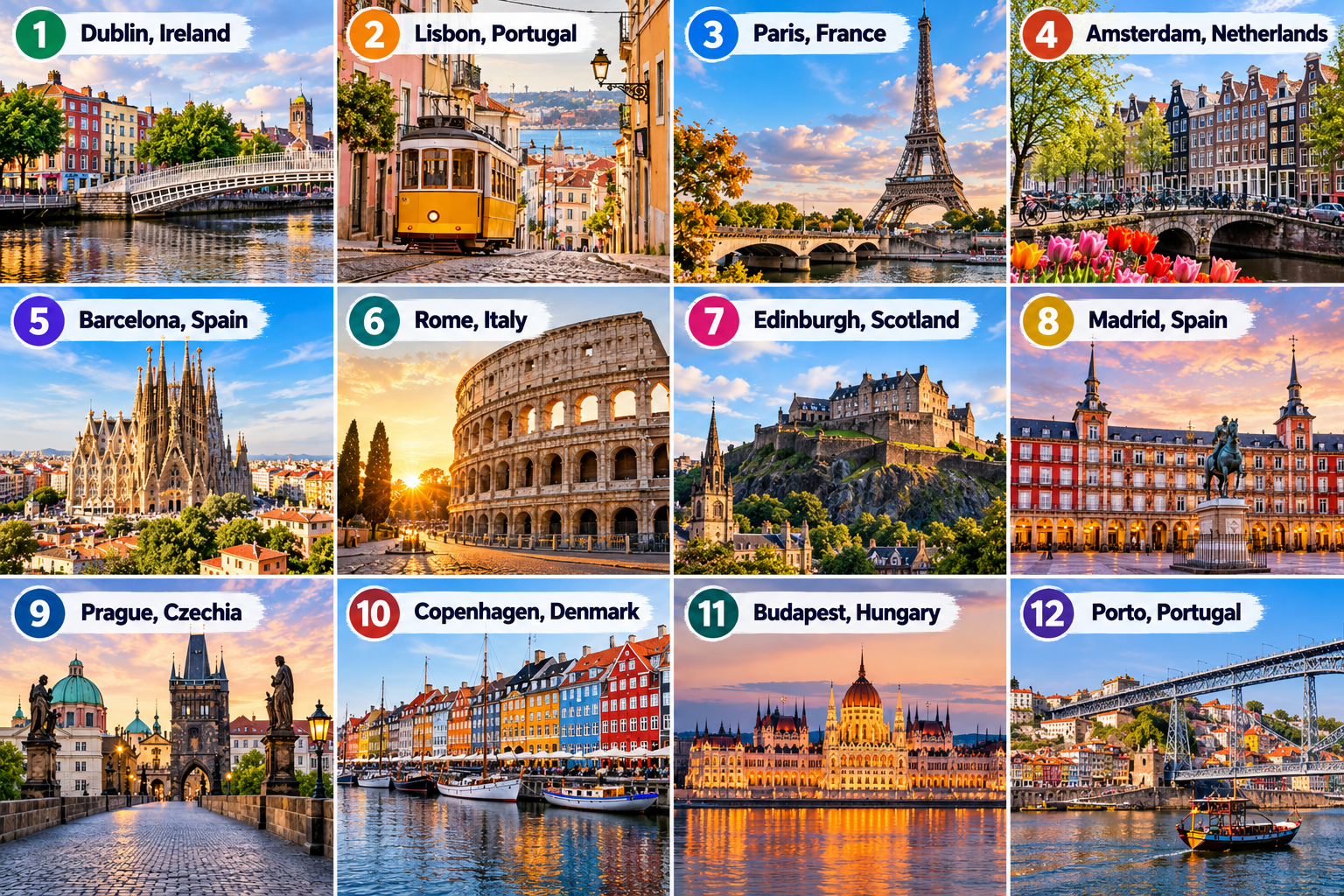
A long weekend in Europe can deliver an impressive change of scenery without requiring a two-week vacation, provided the destination is chosen carefully. For travelers departing from the US East Coast, cities such as Dublin, Lisbon, Paris and Amsterdam can often be reached on overnight flights of roughly six to eight hours, depending on the departure airport and route. That makes a Thursday-night departure and Monday return a realistic option for some itineraries, although jet lag and airport transfers still take a bite out of the trip. The best European cities for a long weekend from the US combine convenient air connections, central neighborhoods that are easy to explore, excellent food and enough major sights to fill two or three days.
The key is to resist the urge to squeeze several countries into one trip. Choose one city, stay somewhere central and plan around a few experiences you genuinely care about.
Flight times and direct routes vary significantly by US departure city. Travelers leaving New York or Boston may have more nonstop options than those flying from smaller airports, while West Coast departures usually involve longer flights. Treat travel times as broad planning guidance rather than guaranteed schedules.
At a Glance: Which City Should You Choose?
| City |
Best for |
Ideal trip length |
| Dublin, Ireland |
Pubs, literature and easy sightseeing |
2-3 days |
| Lisbon, Portugal |
Food, viewpoints and mild weather |
3 days |
| Paris, France |
Art, landmarks and romance |
3-4 days |
| Amsterdam, Netherlands |
Canals, museums and cycling |
3 days |
| Barcelona, Spain |
Architecture, beaches and tapas |
3-4 days |
| Rome, Italy |
Ancient history and Italian food |
3-4 days |
| Edinburgh, Scotland |
Castles, pubs and dramatic scenery |
2-3 days |
| Madrid, Spain |
Art, markets and nightlife |
3 days |
| Prague, Czechia |
Historic streets and architectural beauty |
2-3 days |
| Copenhagen, Denmark |
Design, dining and relaxed city life |
3 days |
| Budapest, Hungary |
Thermal baths and river views |
3 days |
| Porto, Portugal |
Riverside scenery and local cuisine |
2-3 days |
1. Dublin, Ireland: The Easiest Introduction to Europe
Dublin is an appealing first choice for Americans who want an English-speaking destination with a distinct European atmosphere. Explore Trinity College, walk along the River Liffey and spend an evening listening to live music in a traditional pub. Its compact center makes it possible to see plenty without spending the entire weekend on public transport.
Best for: First-time visitors, literary history and lively evenings.
2. Lisbon, Portugal: Sunshine, Seafood and Scenic Views
Lisbon rewards travelers who enjoy wandering rather than following a packed schedule. Ride the historic trams, explore Alfama’s narrow streets, sample pastéis de nata and watch the sunset from a hilltop viewpoint. Its food scene and waterfront atmosphere make three days feel satisfying without rushing between attractions.
Best for: Couples, food lovers and travelers seeking a relaxed pace.
3. Paris, France: Art, Architecture and Classic Cafés
Paris remains a strong choice for a short escape built around world-famous landmarks. Spend time around the Eiffel Tower and Seine, choose one major museum such as the Louvre or Musée d’Orsay, and leave room for neighborhood cafés and bakeries. Book popular attractions ahead of time, especially during busy travel periods.
Best for: Art, romance, shopping and first European city breaks.
4. Amsterdam, Netherlands: Canals and Culture
Amsterdam’s canal belt, independent shops and excellent museums make it particularly rewarding over three days. Visit the Rijksmuseum or Van Gogh Museum, take a canal cruise and explore the Jordaan neighborhood. The city is easy to navigate by foot, bicycle and tram, although accommodation can be expensive during popular dates.
Best for: Museum lovers, architecture and relaxed exploration.
5. Barcelona, Spain: Architecture Meets the Beach
Barcelona combines Gaudí’s extraordinary architecture with Mediterranean food and a beachside atmosphere. Visit the Sagrada Família, stroll through the Gothic Quarter and make time for tapas. Park Güell is another highlight, but timed-entry tickets are worth arranging in advance.
Three days work well for the main sights; a fourth gives you time to enjoy the waterfront without rushing.
Best for: Architecture, food, beach walks and groups with varied interests.
6. Rome, Italy: A Living History Lesson
Rome packs ancient ruins, monumental churches, lively piazzas and memorable meals into a relatively compact central area. The Colosseum and Roman Forum can easily occupy half a day, while the Vatican Museums and St Peter’s Basilica deserve their own planning. Avoid trying to cover every landmark in one visit.
Best for: History enthusiasts, Italian cuisine and iconic sightseeing.
7. Edinburgh, Scotland: Castles and Atmospheric Streets
Edinburgh offers a change of pace from Europe’s sunlit capitals. Explore the Royal Mile, visit Edinburgh Castle and climb Arthur’s Seat if the weather cooperates. The Old Town’s historic streets and traditional pubs create an enjoyable weekend even without a long attraction checklist.
Best for: History, walking, whisky experiences and dramatic scenery.
8. Madrid, Spain: Art, Markets and Late Nights
Madrid suits travelers who prefer a major cultural capital with a lively dining scene. Visit the Prado Museum, walk through Retiro Park and browse food stalls at Mercado de San Miguel. Evenings often run late, making it easy to combine sightseeing with long dinners and neighborhood bars.
Best for: Art, nightlife and Spanish food culture.
9. Prague, Czechia: Old-World Charm Without a Huge Itinerary
Prague’s historic center, Charles Bridge and castle complex provide plenty to explore over two or three days. Much of the experience comes from simply walking between squares, cafés and riverside viewpoints. Compared with several Western European capitals, Prague can offer better value, though prices rise during peak dates and major events.
Best for: Architecture, photography and travelers watching their budget.
10. Copenhagen, Denmark: Design and Everyday Scandinavian Life
Copenhagen is ideal for travelers interested in contemporary design, cycling, bakeries and thoughtful dining. Walk around Nyhavn, explore the city’s neighborhoods and visit a museum or food market. Costs can be higher than in Central Europe, so plan accommodation and restaurant spending before booking.
Best for: Design, food experiences and stylish urban exploration.
11. Budapest, Hungary: Thermal Baths and Danube Views
Budapest delivers grand architecture, riverside views and historic thermal baths. Walk along the Danube, explore the Castle District and set aside time for a bathhouse visit. Its combination of sightseeing and relaxation makes it an excellent three-day destination, with a range of accommodation and dining options.
Best for: Couples, architecture and value-conscious travelers.
12. Porto, Portugal: A Slower, Food-Focused Escape
Porto is a rewarding choice if your ideal weekend revolves around riverside walks, traditional food and beautiful streets. Explore the Ribeira district, cross the Dom Luís I Bridge and visit the port-wine cellars in Vila Nova de Gaia. The city is hilly, so comfortable shoes matter.
Best for: Food lovers, scenic strolls and a more relaxed short break.
How to Plan a Long Weekend from the US
The best European cities for a long weekend from the US are those that minimize wasted travel time. A few practical decisions can make a three-night trip far more enjoyable.
- Choose flights carefully: An overnight flight can help you arrive in Europe in the morning, but allow time for immigration, baggage and hotel check-in.
- Stay centrally: A slightly more expensive hotel near major sights can save hours of commuting.
- Book major attractions early: Popular museums, monuments and guided tours may have limited entry slots.
- Keep the itinerary focused: Choose two major activities per day and leave time for meals and unplanned discoveries.
- Check entry requirements: US citizens should verify passport validity and current European entry rules before departure.
Spring and early autumn are often appealing for comfortable walking weather, while summer brings longer days but typically more crowds. Your best dates will depend on airfare, hotel rates and the experiences you want.
Best European Cities for a Long Weekend from the US: FAQs
1. What is the easiest European city to visit for a long weekend from the US?
Dublin is a convenient choice for many East Coast travelers because of its English-speaking environment and manageable city center. Lisbon, Paris and Amsterdam are also strong options when nonstop flights align with your dates.
2. Is three days enough for a European city?
Yes, if you focus on one city. Three days can cover major landmarks, local neighborhoods and a few memorable meals, although cities such as Rome and Paris have enough attractions to justify a longer stay.
3. Which European cities are best for a budget weekend?
Prague and Budapest are worth comparing for accommodation, food and sightseeing costs. Porto can also be appealing, although airfare and lodging can change the overall budget significantly.
The best European cities for a long weekend from the US are not necessarily the ones with the longest attraction lists. They are the places where a few well-planned days can deliver a genuine sense of discovery without turning the trip into a race.
Also Read: Traveloka Review: Is It Worth Using for Booking Flights and Hotels?

by parth@bidkinetic.com | Oct 10, 2026 | Tech
The internet knows everything about you. Every search query, every purchase, every location ping paints a surprisingly accurate digital portrait, which is then bought, sold, and used to influence your behavior. If that makes you uneasy, it should. But taking back control doesn’t require being a tech wiz or disconnecting entirely. This 30-minute guide will show you exactly how to protect your privacy online, with simple, effective steps you can take right now.
Let’s start with a crucial truth: complete anonymity online is a myth. However, you can significantly reduce your digital footprint and stop being such an easy target for data miners. In 2023 alone, there was a 78% increase in data breaches, exposing the personal information of millions. From invasive targeted advertising to identity theft, the risks are real and growing. The most alarming part? We voluntarily hand over much of this data. A recent study revealed that popular free apps can share your data with an average of 100+ distinct third parties. Your location history, contacts, and browsing habits are up for grabs. Learning how to protect your privacy online isn’t just about avoiding annoying ads; it’s about regaining your digital autonomy and securing your personal information.
Phase 1: Browser Basics (10 Minutes)
Your web browser is your primary window to the online world, and often, it’s also the biggest leak in your data bucket. The default settings in popular browsers like Chrome or Edge prioritize convenience (and Google’s data collection) over your privacy. Here’s how to fix it:
1. Tighten Browser Settings:
-
Firefox: The most privacy-friendly major browser. Go to settings > privacy & security. Set “Enhanced Tracking Protection” to Strict. This blocks social media trackers, cross-site cookies, and cryptominers.
-
Brave: Built on Chromium but strips out Google’s tracking code. Out-of-the-box privacy is excellent. Just ensure the “Brave Shields” are active.
-
Chrome: If you must use it, go to settings > privacy & security. Under “Third-party cookies,” select ” Block third-party cookies in Incognito mode” or (Block all third-party cookies). Turn off “Allow Google to sign you in.” Under “Ad privacy,” disable all topics.
2. Install Privacy-Enhancing Extensions (Essential): These are like armor for your browser. You only need a couple, but they are crucial.
-
uBlock Origin: The absolute gold standard for content blocking. It’s not just an ad blocker; it efficiently blocks trackers, malware domains, and annoying scripts, all without killing your browser’s performance. It’s light, open-source, and verified by countless security audits. It’s truly an essential tool in understanding how to protect your privacy online. Don’t install generic “AdBlock” extensions, many of which are paid by companies to allow their ads through.
-
Privacy Badger: Developed by the Electronic Frontier Foundation (EFF), it automatically learns to block invisible trackers that don’t respect your browser’s “Do Not Track” signal. It’s an intelligent tool that complements uBlock Origin perfectly.
3. Choose a Private Search Engine: Google tracks and logs every single one of your searches. It’s how they build their targeted ad profile. Stop feeding the machine. Use DuckDuckGo or Startpage. They don’t track your searches, don’t store your IP address, and give you unfiltered results. The quality is excellent, and you can switch the default search engine in your browser’s settings in 30 seconds.
Phase 2: Mobile Cleanliness (10 Minutes)
Your smartphone tracks your location, contacts, and daily habits. Secure it with these three steps:
1. Clean Up App Permissions:
-
iPhone: Go to Settings > Privacy & Security > Permission Manager. Revoke non-essential permissions (Camera, Mic, Contacts). Under Settings > Privacy & Security > Tracking, turn OFF “Allow Apps to Request to Track.”
-
Android: Go to Settings > Privacy > Permission Manager. Limit permissions strictly, setting location access to “Only while using the app.”
2. Audit Location History:
-
Google Maps: Open app > Profile > Your Timeline > Menu (…) > Settings and privacy. Turn OFF “Location History” and enable auto-delete (3 months).
-
iPhone: Go to Settings > Privacy & Security > Location Services > System services. Turn OFF “Significant Locations.”
3. Switch to Private Messaging:
Phase 3: Online Accounts & Essential Setup (10 Minutes)
Lock down your main accounts to build a strong defense across all web services:
1. Enable Multi-Factor Authentication (MFA/2FA):
-
Turn on 2FA for your email, bank, social media, and password manager.
-
Use authenticator apps like Aegis (Android), Google Authenticator, or Microsoft Authenticator instead of vulnerable SMS codes.
2. Use a Password Manager:
3. Review Account Privacy Settings:
-
Google: Visit myaccount.google.com > Data and privacy. Run the “Privacy Checkup” and turn OFF “Web & App Activity” and “YouTube History.”
-
Facebook: Go to Settings & Privacy > Settings > Privacy Checkup to limit post visibility and app data sharing.
Summary Table: Your 30-Minute Privacy Plan
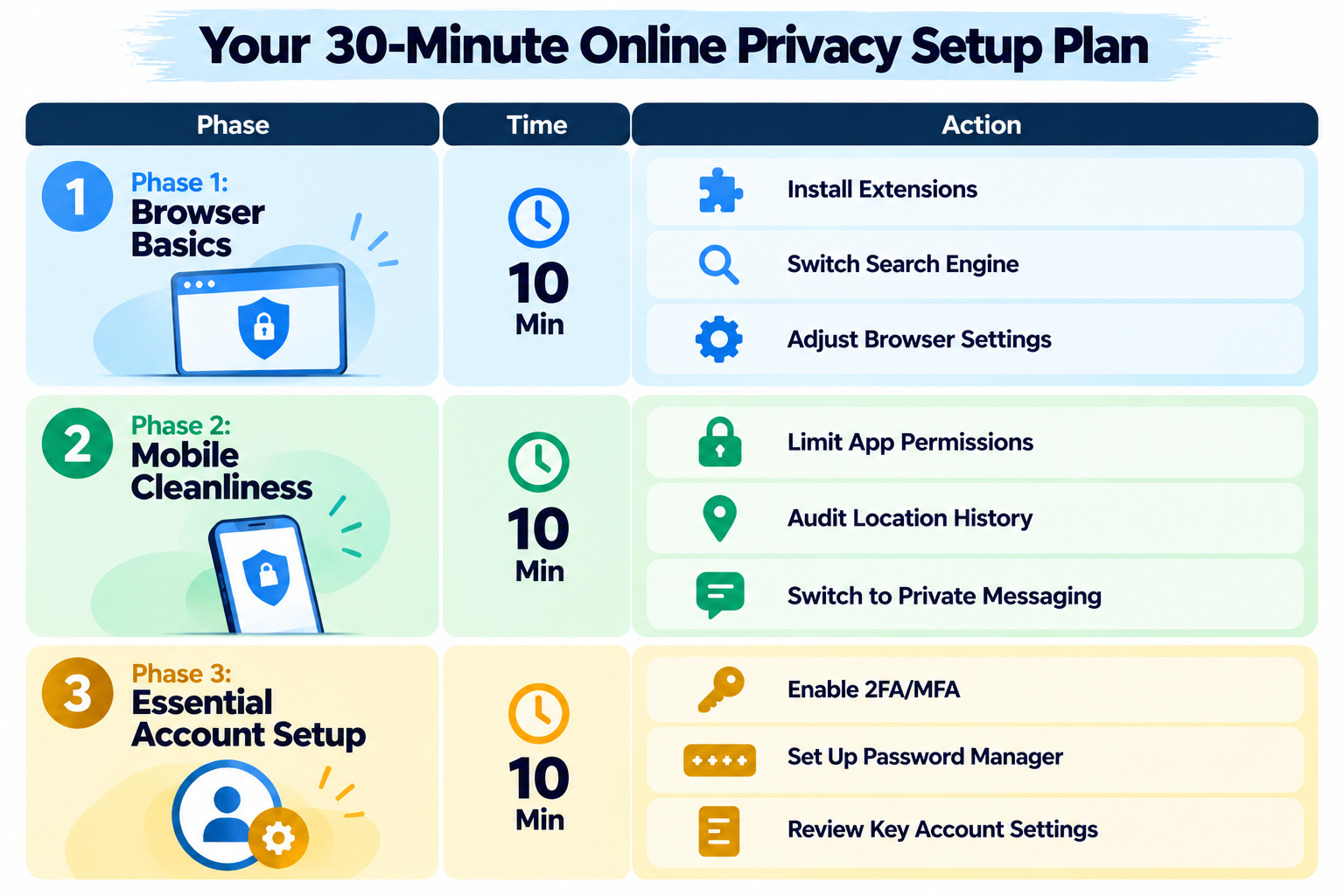
| Phase |
Time |
Action |
Recommended Tools/Settings |
| Phase 1: Browser Basics |
10 Min |
Install Extensions |
uBlock Origin, Privacy Badger |
|
|
Switch Search Engine |
DuckDuckGo, Startpage |
|
|
Adjust Browser Settings |
Strict Tracking Protection (Firefox/Brave), Block third-party cookies |
| Phase 2: Mobile Cleanliness |
10 Min |
Limit App Permissions |
Deny non-essential access (Location, Camera, Contacts) |
|
|
Audit Location History |
Turn off Google Location History, iPhone “Significant Locations” |
|
|
Switch to Private Messaging |
Signal |
| Phase 3: Essential Account Setup |
10 Min |
Enable 2FA/MFA |
Aegis, Google/Microsoft Authenticator (avoid SMS) |
|
|
Set Up Password Manager |
Bitwarden |
|
|
Review Key Account Settings |
myaccount.google.com > Data & privacy |
Conclusion
Congratulations! By spending just 30 minutes following these simple, verifiable steps, you’ve made significant progress in taking back your digital autonomy. You’ve stopped your browser from constantly leaking your browsing data, locked down your phone’s most sensitive information, secured your critical accounts, and most importantly, you’ve learned how to protect your privacy online. This isn’t just about being paranoid; it’s about making a conscious choice to limit the invasive reach of data miners and corporate surveillance. Your online privacy is worth fighting for, and as you can see, it doesn’t have to be a full-time job. This simple guide on how to protect your privacy online is just the beginning. Stay curious, stay vigilant, and continue to prioritize your digital sovereignty.
Frequently Asked Questions (FAQs)
1. Is complete privacy online really possible?
No, complete privacy is a myth. Total anonymity is extremely difficult to achieve and maintain. However, you can significantly reduce your data footprint and stop making yourself such an easy target for surveillance and data miners. The goal is risk reduction, not perfection.
2. Is using a free VPN safe?
Generally, no. Running a VPN infrastructure is expensive. If they’re not charging you, they are almost certainly monetizing your data, often by selling your browsing history. When a service is free, you are the product. Paid, reputable VPNs like Mullvad or Proton VPN are much safer.
3. Why is everyone talking about uBlock Origin?
Because it’s the most effective, efficient, and trusted content blocker available. It’s open-source, light on system resources, and blocks not just ads but also a wide range of trackers and scripts. It’s not just an ad blocker; it’s a foundational privacy tool.
Also Read: Termly Review: Is It Worth Using for Website Privacy Compliance?

by parth@bidkinetic.com | Oct 9, 2026 | Tech
A VPN subscription that advertises a 70% or 85% discount can look like an obvious bargain, but the headline percentage rarely tells the whole story. The real cost depends on how long you commit, how much you pay upfront, whether bonus months are included, and what happens when the introductory offer expires. As of October 2026, advertised long-term VPN offers include Surfshark at around $2.49 per month, NordVPN at $3.49, ExpressVPN at $2.99, and Proton VPN at $2.99 on selected two-year promotions. These are promotional US-dollar rates, not guaranteed prices in every country. The smartest way to find the best VPN deals is to compare the total amount charged during the first term, the renewal rate, the features included and the refund policy.
For example, a VPN advertised at $2.49 per month for two years may require a payment of roughly $60 or more upfront, depending on bonus months, taxes and billing terms. That is very different from paying $2.49 for one month. Renewal prices can also be substantially higher: a recent October 2026 price comparison found that several services’ renewal costs were at least double their promotional monthly equivalents. A cheap plan is only good value if the service works for your devices, privacy needs and streaming habits.
Best VPN Deals: Quick Comparison
The prices below are examples of offers reported in late September and October 2026. Promotions change frequently, so verify the final price and terms on the provider’s checkout page before paying.
| VPN provider |
Example promotional rate |
Best for |
What to check |
| Surfshark |
$2.49/month |
Multiple devices and budget-conscious households |
Renewal rate and total upfront charge |
| NordVPN |
$3.49/month |
All-round privacy and streaming |
Bonus months and renewal pricing |
| ExpressVPN |
$2.99/month |
Simple apps and everyday use |
Plan tier and device limit |
| Proton VPN |
$2.99/month |
Privacy-focused users |
Features included in the discounted tier |
| CyberGhost |
$2.19/month |
Budget plans and streaming servers |
Subscription length and renewal terms |
| Private Internet Access |
$2.03/month |
Advanced settings and low introductory cost |
Longer commitment and total billed amount |
Rates are drawn from recent deal roundups and may vary by region, currency, plan and eligibility. (October 2026)
1. Surfshark: Best Deal for Multiple Devices
Surfshark is worth checking first if you want one subscription for a laptop, phone, tablet and other household devices. Its promotional two-year offer has recently been listed at $2.49 per month, with additional months included in some campaigns. The provider’s unlimited simultaneous-connection policy can make the overall value attractive for families or people who use several devices.
Before subscribing, compare the full amount due today rather than judging the deal by its monthly equivalent. Also check whether the offer includes the VPN alone or a bundle with additional security features. A bundle is worthwhile only if you will use what it includes.
2. NordVPN: Best All-Round Long-Term Offer
NordVPN is a strong option for people who want a balance of speed, privacy features and streaming support. Recent promotions have listed two-year plans at approximately $3.49 per month, sometimes with three extra months.
Its monthly equivalent may be higher than Surfshark’s, but the better choice depends on performance, server locations and the features you actually need. Check the renewal price carefully, especially if you plan to keep the subscription for several years. A low first-term price can become less appealing if the renewal is substantially more expensive.
3. ExpressVPN: A Premium Service at a Lower Introductory Price
ExpressVPN is worth considering if ease of use and consistent everyday performance matter more than getting the absolute lowest price. Its two-year promotional offer has recently appeared at around $2.99 per month, with extra months included in some deals.
The important detail is the plan tier. Device limits, included features and subscription terms can differ, so compare the actual package rather than assuming every ExpressVPN promotion offers identical benefits. If you are switching from another provider, use the refund period to test your usual websites, video calls and streaming services before deciding to keep the subscription.
4. Proton VPN: Best for Privacy-Conscious Buyers
Proton VPN’s two-year VPN Plus promotion has been listed at $2.99 per month, representing a reported 70% discount from its standard monthly rate. It also offers a free plan, giving users a way to try VPN protection without immediately committing to a paid subscription.
The free plan and discounted paid tier are not interchangeable. Check server availability, device limits and advanced features before purchasing. If your needs are basic, free access may be sufficient; if you require broader server choice or specific streaming capabilities, compare the paid offer against competing services.
5. CyberGhost: A Budget Option for Streaming
CyberGhost has appeared in recent deal roundups at around $2.19 per month on selected long-term plans. Its streaming-oriented server options may appeal to people who want a VPN for watching content while travelling.
However, look beyond the headline price. Confirm how long the offer lasts, whether the full subscription is charged upfront and what the renewal costs. Also test the services you use most, since streaming access can vary by platform, server and location.
6. Private Internet Access: Worth Comparing for Low Upfront Rates
Private Internet Access (PIA) is another option for buyers who want a low introductory rate and more configurable VPN settings. Recent promotions have listed long-term plans around $2.03 per month, although the total price depends on the length and terms of the offer.
PIA can be a useful shortlist candidate for technically confident users. Before buying, check the number of months covered, the total billed amount and the renewal cycle. A lower initial cost should not outweigh important requirements such as device compatibility, dependable connections or the features you need.

How to Get More Value From a VPN Deal
Finding the best VPN deals is easier when you compare the complete subscription rather than the discount banner.
- Calculate the upfront total: Multiply the advertised monthly equivalent by the covered period, then confirm the actual checkout amount.
- Check renewal pricing: Look for the future charge and billing interval before completing payment.
- Compare bonus months: Extra months can improve value, but only if the service meets your needs.
- Review the refund policy: Confirm the deadline, eligibility and any conditions that apply.
- Skip unnecessary bundles: Antivirus, cloud storage, or identity tools add value only if you plan to use them.
- Check regional pricing: US-dollar promotions may not be available at the same rate in India or other markets.
If you are not in a hurry, watch for seasonal promotions around Black Friday. However, do not assume every later sale will beat today’s offer; compare the total cost and terms when the promotion actually appears.
Final Verdict
Surfshark is a compelling value option for multi-device households, NordVPN is a strong all-round choice, ExpressVPN suits users who prioritise simplicity, Proton VPN appeals to privacy-conscious buyers, and CyberGhost or PIA are worth comparing for lower introductory costs.
The best VPN deals are the ones that combine a reasonable total payment with useful features and transparent renewal terms. Check the full cost before checkout, and choose a plan you will still be happy to use after the discount ends.
Best VPN Deals: FAQs
1. What is the cheapest VPN deal right now?
Recent October 2026 roundups list several long-term plans below $3 per month, including Surfshark, CyberGhost and PIA. The cheapest option can change by region and promotion, so verify the checkout total.
2. Do VPN discounts apply at renewal?
Usually, the advertised introductory rate applies only to the first term. Read the renewal terms carefully and set a reminder before the next billing date if you intend to reassess or cancel.
3. Is a free VPN better than a discounted paid plan?
Not necessarily. A free plan can suit light browsing, while a paid subscription may offer more server choices, device connections or streaming support. Choose based on actual needs, not price alone.
