
by parth@bidkinetic.com | Oct 16, 2026 | Fashion
Affordable fashion in the UK is no longer just about finding the cheapest item on the rail. With clothing costs competing against rising household expenses, shoppers increasingly need pieces that work across several occasions, last beyond a few washes and fit easily into an existing wardrobe. The best approach to UK high street fashion is to focus on cost per wear rather than the price on the label. A £25 cardigan worn twice a week may offer better value than a £12 top that loses its shape after a month.
This season, the smartest budget buys are practical layers, versatile trousers, everyday knitwear, easy dresses and footwear that can be styled in more than one way. Retailers such as Primark, H&M, New Look, Matalan and Marks & Spencer cater to different budgets, while sale sections and online clearance pages can make better-quality pieces more accessible. Prices and stock vary by collection, so it pays to compare fabrics, construction and return policies before buying.
The aim is not to recreate every runway trend. It is to build a wardrobe that feels current without spending heavily on items that will soon be forgotten.
1. Primark: Everyday Basics That Earn Their Place
Primark is a useful starting point for affordable wardrobe essentials, particularly plain T-shirts, ribbed tops, leggings, casual trousers and simple layering pieces. These are the items that get worn repeatedly, so a sensible fit and comfortable fabric matter more than decorative details.
Look for neutral colours such as black, white, grey, navy and beige. They pair easily with existing clothes and make a small wardrobe feel more flexible. Check the stitching around seams, the thickness of jersey fabric and whether the garment becomes transparent when stretched.
- Best budget buys: Basic T-shirts, long-sleeved tops, leggings and simple knitwear.
- Shopping tip: Buy trend-led colours in small quantities, but spend more attention on the basics you wear every week.
2. H&M: Trend-Led Pieces Without a Designer Price Tag
H&M is worth browsing for seasonal updates that can refresh familiar outfits. Depending on the current collection, useful options include oversized shirts, tailored-looking trousers, fine-knit jumpers, waistcoats and relaxed blazers.
The trick is to choose one trend at a time. For example, an oversized striped shirt can work with straight-leg jeans, tailored trousers or a skirt. A neutral waistcoat can be worn alone in warmer weather or layered over a fitted top when temperatures drop.
Not every inexpensive trend piece is a good investment. Check whether the fabric hangs properly and whether the cut suits clothes you already own. A garment that requires several new purchases to complete an outfit is rarely the bargain it first appears to be.
- Best budget buys: Oversized shirts, versatile trousers, knitwear and lightweight tailoring.
- Shopping tip: Check the sale section before paying full price for a seasonal trend.
3. New Look: Affordable Outfits for Work and Weekends
New Look is a good option when you want clothes that feel a little more styled than everyday basics. Its ranges are worth checking for wide-leg trousers, midi skirts, fitted tops, occasion dresses and shoes that can transition from daytime plans to evenings out.
For work, pair wide-leg trousers with a fine-knit top and loafers. For weekends, wear the same trousers with a plain T-shirt and trainers. A midi skirt can work with a jumper and ankle boots when the weather cools.
- Best budget buys: Midi skirts, everyday dresses, wide-leg trousers and versatile footwear.
- Shopping tip: Check the garment length and size guide carefully when ordering online. An inexpensive item that needs costly alterations may not be such a bargain.
4. Matalan: Practical Layers for Cooler Days
Matalan deserves a look for everyday clothing that prioritises comfort and practicality. Think long-sleeved tops, casual knitwear, jeans, lightweight jackets and simple accessories that can handle regular use.
As the weather changes, layering becomes more useful than buying a completely new wardrobe. A cardigan over a cotton top, for example, can work indoors and outdoors without the bulk of a heavy coat. Dark jeans and neutral knitwear also make reliable foundations for casual outfits.
- Best budget buys: Cardigans, jeans, basic tops and transitional jackets.
- Shopping tip: Choose layers that fit comfortably over your existing tops, rather than buying pieces that only work as standalone outfits.
5. Marks & Spencer: Spend Carefully on Better Everyday Quality
Marks & Spencer can be worth considering when durability and fit matter more than getting the lowest possible price. Its everyday clothing ranges are useful for straight-leg jeans, cotton shirts, trousers, knitwear and comfortable wardrobe staples.
It may not always be the cheapest UK high street fashion option, but a well-fitting pair of jeans or a jumper that keeps its shape can offer better long-term value. Look for discounts on core styles rather than assuming every full-price item is worth the extra spend.
- Best budget buys: Straight-leg jeans, cotton shirts, classic jumpers and everyday trousers.
- Shopping tip: Compare the fabric composition and care instructions with cheaper alternatives before deciding whether the price difference is justified.
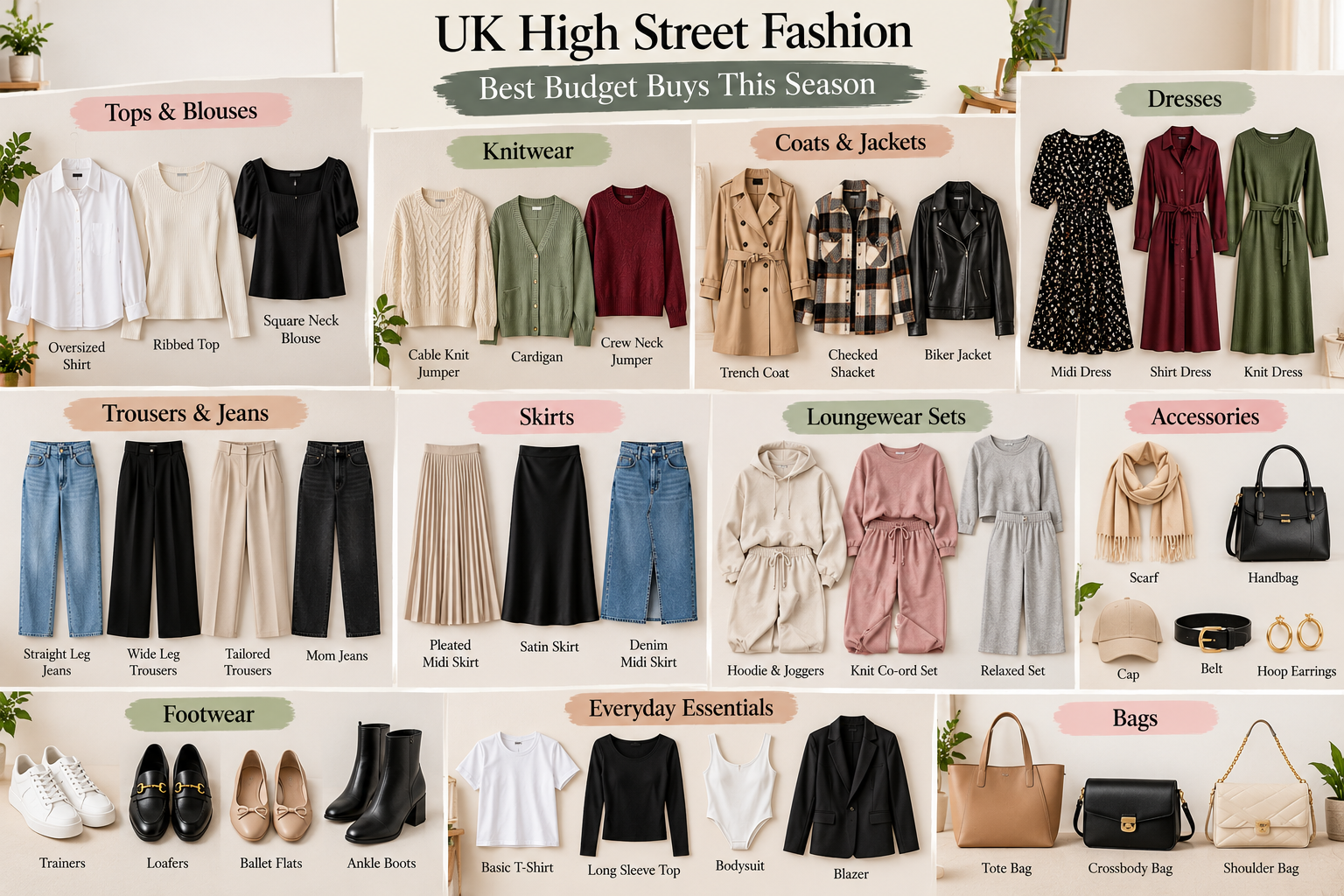
The Best Budget Buys to Prioritise This Season
These are the pieces worth looking for first when shopping for UK high street fashion. Price ranges below are indicative shopping budgets, not guaranteed current prices; check each retailer for the latest availability.
| Clothing item |
Target budget |
Why it is worth buying |
| Basic cotton T-shirt |
£5-£12 |
Works under shirts, cardigans and jackets |
| Fine-knit jumper |
£10-£25 |
Adds warmth without excessive bulk |
| Straight-leg jeans |
£15-£35 |
Pairs with trainers, boots and loafers |
| Wide-leg trousers |
£12-£30 |
Suitable for work and casual outfits |
| Cardigan |
£10-£25 |
Easy to layer across changing temperatures |
| Everyday dress |
£15-£35 |
One-piece outfit for several occasions |
| Loafers or ballet flats |
£15-£35 |
Smartens up simple outfits |
| Scarf or statement accessory |
£5-£15 |
Refreshes existing clothes affordably |
How to Shop Smarter Without Overspending
Start with what you already own.
- Before shopping, identify the gaps in your wardrobe.
- If you have three pairs of jeans but no suitable layer for cold mornings, another pair of jeans is unlikely to improve your everyday outfits.
Build around a small colour palette.
- Black, navy, cream, grey, olive and burgundy can work together without much planning.
- You do not need every colour; choose a few that suit your existing clothes.
Read the fabric label.
- Cotton can be comfortable and breathable, while wool blends may offer warmth.
- Polyester is not automatically poor quality, but fabric thickness, lining, seam construction and how the garment hangs all matter.
- For knitwear, check whether the fibres are likely to pill and whether the care instructions suit your routine.
Use sales strategically.
- Search for specific items instead of browsing discounts without a plan.
- A reduced coat you will wear every winter is more useful than an impulse purchase chosen only because the original price was high.
Calculate cost per wear.
- A £30 pair of trousers worn 30 times costs £1 per wear.
- A £10 top worn twice costs £5 per wear.
- The numbers will not tell you everything about quality, but they can help you distinguish genuine value from a low sticker price.
Check returns before ordering.
- Online shopping makes comparison easier, but sizing can vary between retailers and styles.
- Review return windows, delivery charges and whether sale items have different conditions before placing an order.
UK High Street Fashion: Frequently Asked Questions
1. Which UK high street shops are best for budget fashion?
Primark is useful for low-cost basics, while H&M and New Look offer trend-led clothing. Matalan is worth checking for practical everyday pieces, and Marks & Spencer can be a good option for selected staples where fit and durability matter. The best choice depends on the specific item, fabric and current offers.
2. What should I buy first when updating my wardrobe on a budget?
Start with items you can wear repeatedly: a comfortable pair of jeans or trousers, plain tops, a versatile jumper and a layer suitable for the weather. Add a dress or statement accessory only if it fills a genuine gap.
3. How can I make affordable clothes look more expensive?
Prioritise fit, neat seams, fabrics that hold their shape and colours that coordinate. Keep outfits simple, avoid overcrowding them with accessories and make sure shoes and clothes are clean and well maintained.
by parth@bidkinetic.com | Oct 15, 2026 | Fashion
A good work-from-home wardrobe needs to solve two different problems: comfort during long hours at a desk and a polished appearance on video calls. The challenge is that these requirements do not always overlap. Soft lounge clothes may feel great but look too casual on camera, while structured office wear can become uncomfortable after several hours of sitting. The best work-from-home wardrobe combines breathable fabrics, easy-to-coordinate pieces, flattering necklines, and comfortable fits that work for both meetings and everyday tasks.
Remote work has become a lasting part of modern employment. Gallup’s research on US employees has consistently found that hybrid work remains common among workers whose jobs can be done remotely, making adaptable everyday clothing a practical consideration rather than a temporary trend. Instead of buying a separate outfit for every workday, build a small collection of versatile pieces that can be mixed and matched, look presentable on screen, and still feel comfortable after a full day.
1. Polished Tops That Make Video Calls Easier
If your workday includes client calls, presentations, or team meetings, start with tops that look structured without feeling restrictive. A ribbed knit top, a collared shirt, a fine-knit sweater, or a simple blouse can look professional without the stiffness of traditional office wear.
Choose necklines that sit neatly on camera. Crew necks, modest V-necks, and open collars are generally easy to style. Avoid fabrics that crease heavily or become transparent under bright lighting, particularly if your workspace receives direct sunlight.
Where to shop: SHEIN offers a broad selection of blouses, knit tops, and casual shirts at different price points. Check the garment measurements and fabric composition rather than relying on the model photographs alone.
2. Stretch Trousers for Long Hours at Your Desk
A comfortable waistband can make a noticeable difference during a full day of sitting. Straight-leg trousers, pull-on tailored pants, and soft ponte trousers offer a more polished appearance than basic pyjama bottoms without restricting movement.
Look for fabric with a little stretch, a waistband that does not dig in, and enough room through the hips and thighs. If you regularly stand up during calls or step away from your desk, choose trousers that look presentable from every angle.
SHEIN and Noon are useful places to compare affordable trousers, although availability and sizing vary by listing. Check customer reviews for comments about length, waistband comfort, and whether the material becomes see-through when stretched.
3. Soft Matching Sets for Busy Mornings
A coordinated top-and-bottom set removes the guesswork from getting dressed.
- Matching knitwear, a relaxed co-ord, or a soft lounge set can feel comfortable enough for desk work while appearing intentional on camera.
The key is choosing a set with a clear shape.
- A relaxed top with neat trousers often looks more polished than oversized pieces worn together.
- Neutral shades such as navy, charcoal, cream, and olive are easy to combine with other wardrobe items.
For a matching set, check whether both pieces have useful fits independently. If one item wears out first, you should still be able to pair the remaining piece with something else.
4. One Lightweight Layer for Instant Polish
A cardigan, unstructured blazer, or lightweight overshirt can transform a basic outfit before a meeting. Keep one near your desk and put it on when a video call appears unexpectedly.
A soft blazer works well for presentations, while a fine-knit cardigan is more suitable for everyday internal meetings. Choose a layer that fits comfortably across the shoulders and does not pull when you reach forward to type.
If you prefer dresses, SHEIN is worth exploring for dressier silhouettes, though its formal styles may be less practical for everyday desk work. Look for simple cuts and breathable materials rather than heavily structured designs.
5. Dresses That Work Beyond the Meeting
A comfortable midi dress can simplify your routine because it creates a complete outfit in one step.
- Jersey, cotton-blend, and soft knit dresses are useful choices when they allow easy movement and do not require constant adjustment.
- Choose sleeves and necklines that suit your workplace, and consider whether the dress remains comfortable when sitting for several hours.
- A dress that looks excellent while standing may crease across the waist or ride up when seated, so try the seated fit before making it a regular work outfit.
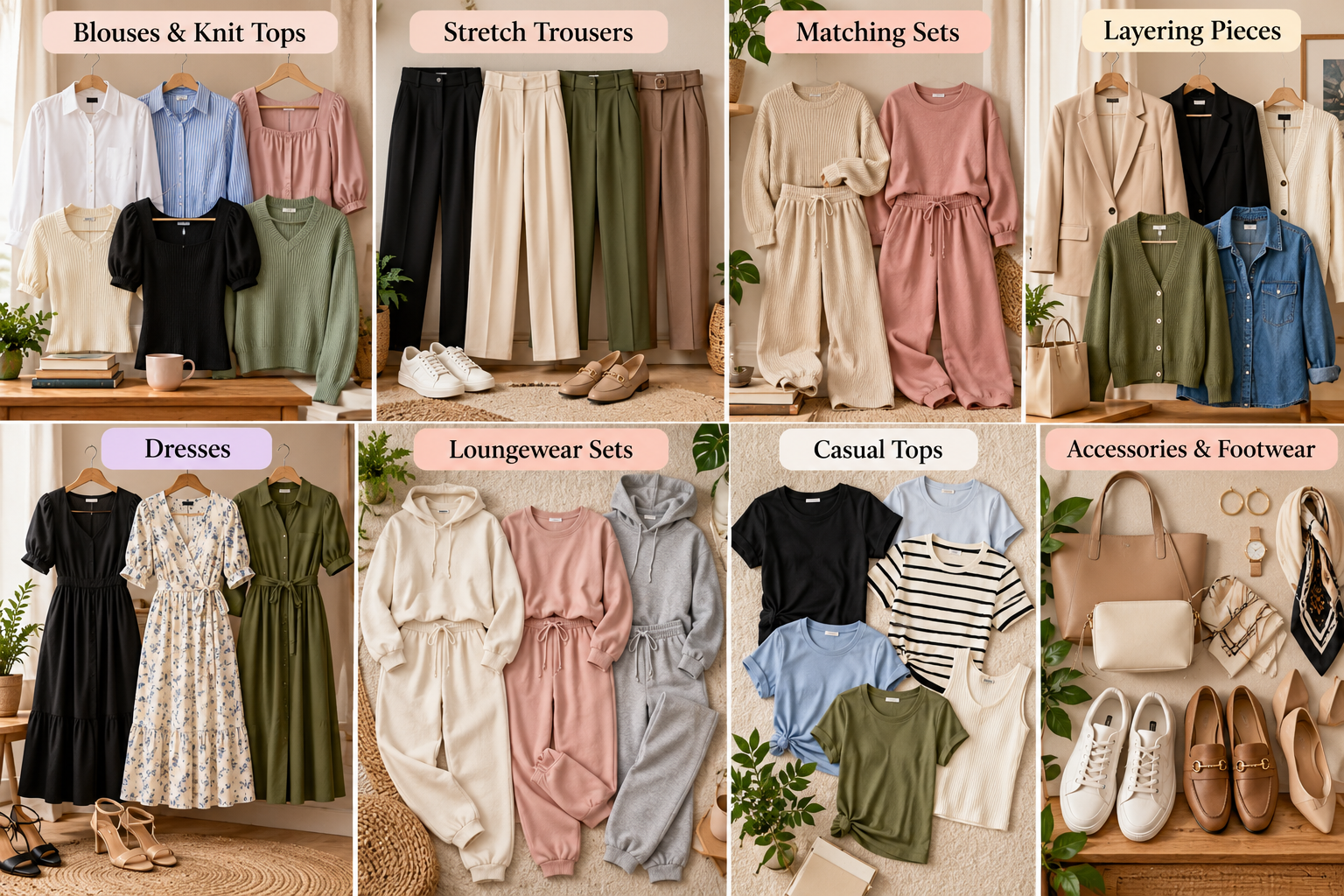
Quick Comparison: What Belongs in Your Work-From-Home Wardrobe?
| Clothing item |
Best use |
What to prioritise |
| Blouse or knit top |
Video calls and presentations |
Neckline, opacity, fabric |
| Stretch trousers |
Full workdays |
Waistband, movement, fit |
| Matching co-ord |
Quick everyday dressing |
Versatility and comfort |
| Cardigan or blazer |
Unexpected meetings |
Shoulder fit and layering |
| Midi dress |
One-step outfits |
Seated comfort and breathability |
6. Build a Small Wardrobe That Actually Works
The best work-from-home wardrobe does not need dozens of new purchases.
- Start with three or four tops, two comfortable bottoms, one matching set, and a lightweight layer.
- Choose colours that work together so that most pieces can be combined without much thought.
Fabric deserves as much attention as appearance.
- Cotton and linen blends can feel breathable in warm weather, while modal and soft knits may offer a comfortable drape.
- Polyester blends can resist creasing, but comfort depends on the fabric construction and climate.
- Always check the care label and washing instructions.
Before ordering from marketplaces such as AliExpress or DHgate, inspect seller ratings, garment measurements, delivery estimates, and return terms. Product photographs alone are not enough to judge fabric quality or fit.
Final Thoughts
The best work-from-home wardrobe balances comfort with a little structure. Invest in tops that look good on camera, trousers that allow you to sit comfortably, and layers that make quick outfit changes easy. Build around pieces you will wear repeatedly rather than buying clothes for hypothetical occasions. When getting dressed takes less effort, you can focus on the workday instead of deciding what to wear.
FAQs
1. What should I wear for video calls while working from home?
Choose a neat top, a comfortable neckline, and colours that contrast with your background. Keep a cardigan or blazer nearby for formal meetings.
2. Is SHEIN a good place to buy work-from-home clothes?
It offers a wide range of affordable styles. Check measurements, fabric composition, customer reviews, and return policies before ordering.
3. Should work-from-home clothes be formal?
Not necessarily. Aim for clothing that suits your workplace, feels comfortable throughout the day, and looks presentable whenever you need to appear on camera.
Also Read: Chicsew Bridesmaid Dresses Review: Affordable Wedding Party Looks
by parth@bidkinetic.com | Oct 15, 2026 | Homestyle
Buying furniture online offers more choice, but a well-photographed chair does not always translate into comfortable seating at home. When comparing recliners and accent chairs, buyers need to look beyond colour, shape, and price. Seat dimensions, frame construction, upholstery, ergonomics, delivery access, and return policies can determine whether a purchase remains satisfying for years or becomes an expensive inconvenience.
The measurements matter more than many shoppers realise. A standard recliner can extend to approximately 60-70 inches (152-178 cm) in depth when fully opened, compared with a much smaller footprint in its upright position. Wall-hugger models may require only around 3-6 inches (8-15 cm) of rear clearance, although the exact requirement depends on the mechanism. These differences can affect furniture placement, walking space, and everyday usability.
Before placing an order, understand how the chair will fit your body, your room, and the way you actually use your living space.
1. Measure the Space, Not Just the Chair
Product listings generally display overall width, depth, and height, but these figures do not tell the whole story.
For a recliner, check the upright dimensions and the fully extended footprint. Measure the distance from the intended position to the nearest coffee table, wall, television unit, or walkway. If the chair will sit against a wall, confirm its required clearance rather than assuming every model can recline close to it.
Also measure the delivery route. Doorways, staircases, lift interiors, narrow corridors, and sharp turns can prevent a chair from reaching the room even when it fits perfectly once assembled. Ask the seller for packaged dimensions and whether the backrest or other components can be removed for delivery.
For accent seating, consider how much space remains around the chair. A generously sized armchair may look balanced in a product photograph but overwhelm a compact living room.
2. Choose Comfort That Matches Your Body
Comfort is personal, but the specifications provide useful clues.
Check seat height first.
- When seated, your feet should rest comfortably on the floor, with your knees positioned naturally.
- A seat that is too high can leave your feet unsupported, while one that is too low may make standing up difficult.
Seat depth matters just as much.
- If the cushion extends too far behind your knees, you may slide forward to sit comfortably.
- If it is too shallow, your thighs may lack adequate support.
- Check seat width as well, particularly if you prefer to sit cross-legged or need extra room.
For recliners, inspect the lumbar support, headrest position, armrest height, and footrest extension. The chair should support your back and legs without forcing your body into an awkward angle.
With accent chairs, examine the backrest shape and cushioning. A sculptural chair with a low back may suit occasional seating, while a supportive, upholstered design is often more practical for reading or extended conversations.
3. Understand the Reclining Mechanism
Not all recliners work in the same way. A manual model uses a lever, pull handle, or push-back action, while a powered version uses a motor and controls to adjust the position.
Manual mechanisms are usually simpler and do not require an electrical connection. Power models can offer more controlled adjustments and may include features such as adjustable headrests, lumbar support, or USB charging. However, additional features can increase the price and create more components that may eventually require servicing.
Before buying, check whether the footrest opens smoothly, whether the chair locks into the desired position, and whether the controls are easy to reach. For powered models, confirm the cable length, outlet location, warranty coverage, and availability of service support.
4. Check Upholstery and Frame Quality
A chair’s appearance is only one part of its construction. The upholstery and frame determine how well it handles daily use.
| Material or component |
What to check before ordering |
| Fabric upholstery |
Cleaning instructions, abrasion resistance, colourfastness, and stain resistance |
| Leather or synthetic leather |
Exact material type, surface finish, maintenance needs, and resistance to cracking or peeling |
| Solid wood frame |
Joinery, structural stability, and finish quality |
| Metal frame |
Construction quality, stability, and corrosion protection where relevant |
| Foam cushioning |
Cushion density, resilience, and whether specifications are disclosed |
| Reclining mechanism |
Smooth operation, weight capacity, spare parts, and warranty terms |
Do not assume that a product described as “premium leather” is made entirely from genuine leather. Read the material specification carefully. Similarly, terms such as “high-density foam” are more useful when supported by actual specifications.
For homes with children or pets, removable covers, easy-clean upholstery, and stain-resistant fabrics can be more practical than delicate decorative materials.
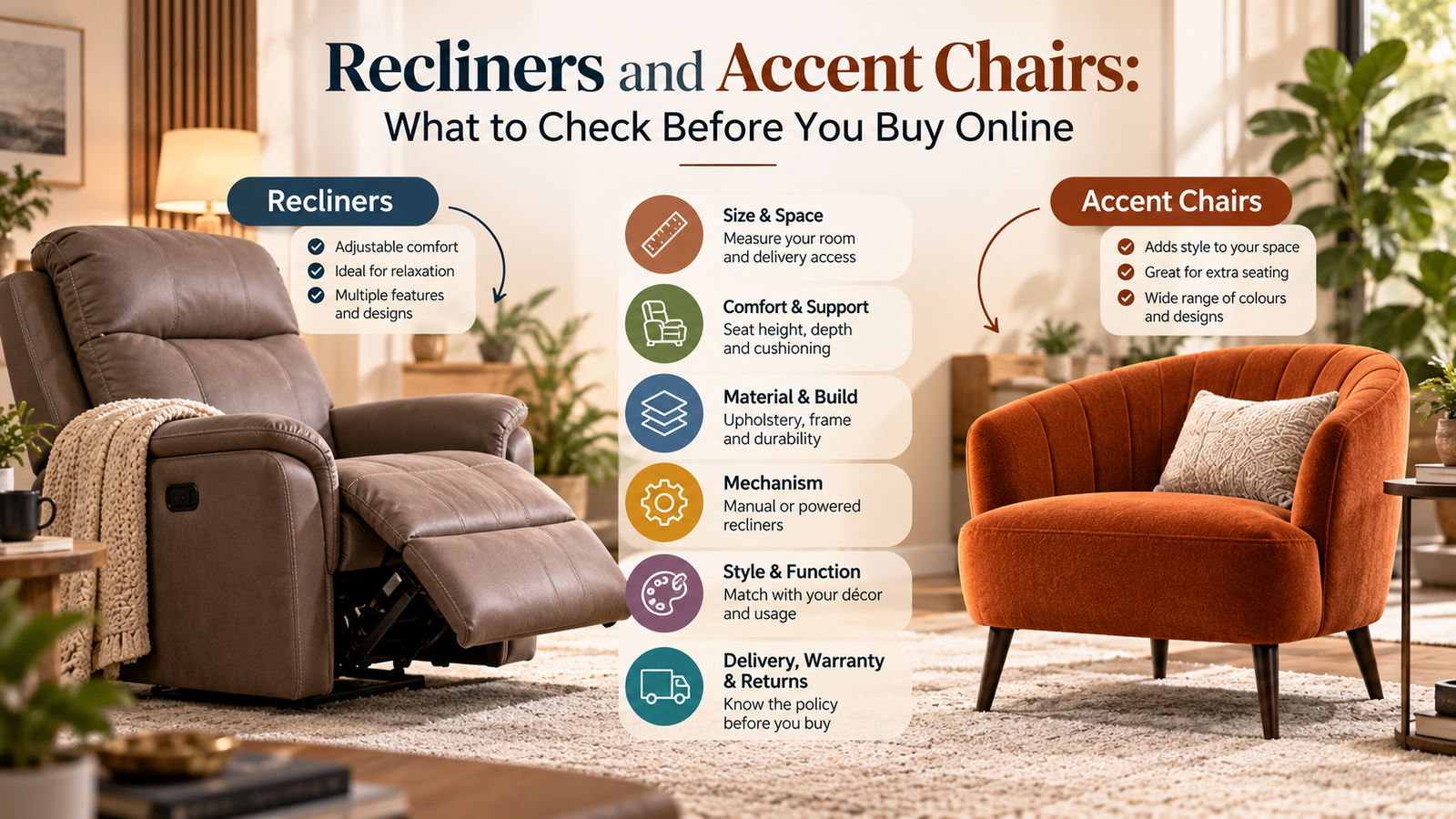
5. Compare Style With Everyday Function
Recliners and accent chairs serve different purposes, even when their designs look similar. A recliner prioritises adjustable comfort, while an accent chair can introduce colour, texture, and visual contrast to a room.
Think about placement before selecting a design. A recliner near a television may need a suitable viewing angle and access to a power socket. A chair beside a window may benefit from breathable upholstery and a comfortable reading position. In a smaller room, raised legs and a visually open frame can make an accent chair feel less bulky.
Check the product’s actual colour and finish against your existing furniture. Screen brightness, photography, and lighting can make fabrics appear different from their real-life appearance. Look for close-up photographs, multiple viewing angles, and customer images where available.
6. Read the Warranty, Delivery, and Return Conditions
Online furniture purchases involve more than the listed price.
- Check whether delivery, installation, packaging removal, and assembly are included or charged separately.
- Read the return policy before ordering, especially for large or made-to-order furniture.
- Confirm the return window, collection charges, refund conditions, and whether the product must remain unused or in its original packaging.
- Keep the order confirmation and product specifications in case the delivered item differs from the listing.
- Review warranty coverage separately for the frame, upholstery, cushioning, electrical components, and reclining mechanism.
- A long warranty is not necessarily comprehensive; exclusions and service procedures matter just as much.
Quick Comparison: Which Chair Suits Your Needs?
| Requirement |
Recliner |
Accent chair |
| Primary purpose |
Relaxation and adjustable seating |
Additional seating and interior styling |
| Space planning |
Requires clearance for reclining |
Usually needs less operating space |
| Key comfort check |
Lumbar support, headrest, and footrest |
Seat depth, back support, and armrest height |
| Important specifications |
Mechanism, extended dimensions, weight capacity |
Frame, upholstery, dimensions, and stability |
| Best suited to |
Lounging, watching television, and relaxing |
Reading corners, living rooms, and occasional seating |
Recliners and Accent Chairs: Final Thoughts
A successful furniture purchase balances comfort, construction, proportions, and practical details. Compare the specifications carefully, measure the room and delivery route, and understand the seller’s warranty and return conditions before paying. The right chair should not only look good online; it should fit your space, support your everyday routine, and remain comfortable long after delivery.
Recliners and Accent Chairs: FAQs
1. What should I check first when buying a chair online?
Start with the exact dimensions, intended use, seat measurements, and delivery access. For reclining models, check the fully extended footprint before comparing finishes or additional features.
2. Are powered recliners better than manual ones?
Neither is automatically better. Manual models offer straightforward operation, while powered versions provide motorised adjustment. Choose according to your comfort preferences, budget, electrical access, and maintenance expectations.
3. Which upholstery is best for homes with pets?
Durable, tightly woven fabrics and easy-clean surfaces are often practical choices. Consider snag resistance, cleaning instructions, and how the material handles pet hair rather than choosing by appearance alone.
Also Read: How to Choose a Mattress for Back Pain: Firmness, Position, and Fit
by parth@bidkinetic.com | Oct 15, 2026 | Homestyle
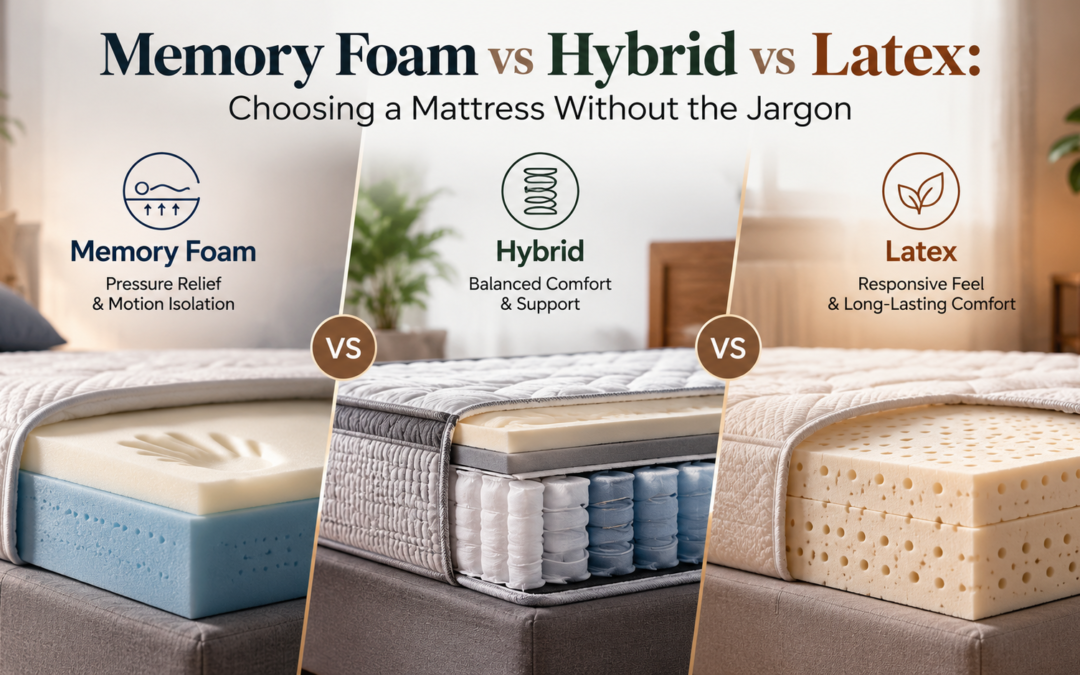
Choosing a mattress is not just about deciding whether you prefer a soft or firm bed. The material underneath you affects how much pressure your shoulders and hips experience, whether you feel your partner moving, how easily you change sleeping positions, and how warm the bed feels overnight. For example, a queen mattress measures 60 × 80 inches, giving two adults just 30 inches of width each if they divide the surface equally. In a shared bed, motion isolation and usable sleeping space can matter as much as cushioning. The comparison of Memory Foam vs Hybrid vs Latex comes down to three different approaches to comfort.
Memory foam moulds closely around the body, hybrid mattresses combine foam with a spring system, and latex offers a more buoyant, responsive feel. None is automatically the best choice for everyone. Your sleeping position, body weight, sensitivity to heat, budget, and preference for a mattress that hugs or gently pushes back all influence the decision.
Instead of getting caught up in technical descriptions, focus on how each mattress behaves during an ordinary night’s sleep and what to check before spending your money.
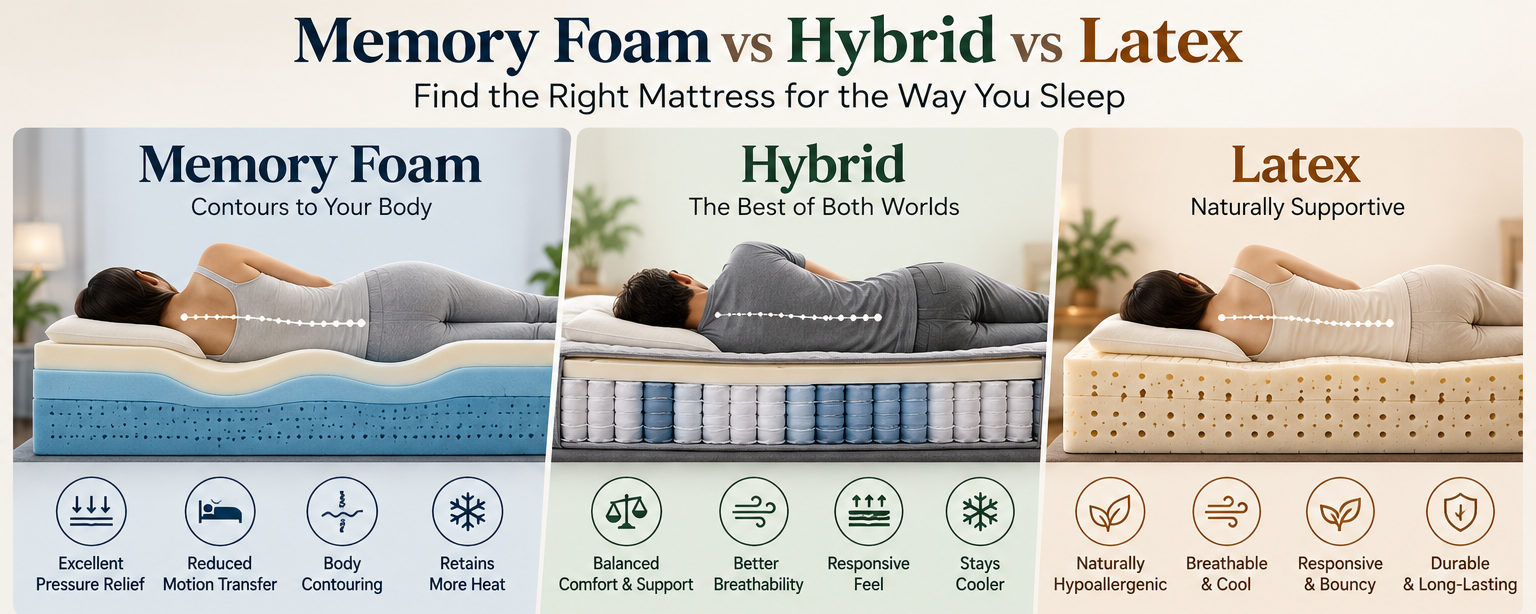
1. Memory Foam: Best for Pressure Relief and Minimal Movement
Memory foam responds to body heat and pressure, gradually moulding around your shape. Instead of pushing back immediately, it creates a close, cushioned sensation that many people describe as sinking into the mattress.
This can be particularly useful for side sleepers, whose shoulders and hips press more firmly into the bed. Memory foam can help distribute that pressure across a wider area. It also absorbs movement well, making it a popular choice for couples who wake easily when the other person turns over.
The trade-off is responsiveness. If you frequently switch between sleeping positions, the close-fitting foam may feel restrictive. Traditional memory foam can also retain heat, although some models use gel infusions, ventilated layers, or specialised covers to address this issue.
- Choose memory foam if: You prefer a cushioned, body-hugging feel, need good motion isolation, or primarily sleep on your side.
- Think twice if: You sleep particularly hot or prefer a mattress that feels springy and makes movement easy.
2. Hybrid: Best for a Balance of Cushioning and Support
A hybrid mattress combines a coil support system with comfort layers made from materials such as memory foam, latex, or other foams. Think of it as combining the cushioning of foam with the responsiveness of a traditional spring mattress.
The coils provide support and bounce, while the upper layers cushion the body. Many hybrids use individually wrapped pocketed coils, which can help reduce movement transfer while allowing air to circulate through the support core. Reinforced edges on some models also make it easier to sit on the side of the bed or use more of the sleeping surface.
However, not every hybrid feels the same. One with thick memory foam layers may feel soft and contouring, while a latex hybrid can feel springier. Coil construction, comfort-layer thickness, and firmness all influence the result.
- Choose a hybrid if: You want a middle ground between cushioning and bounce, change sleeping positions often, or prefer a more traditional mattress feel.
- Think twice if: You have a strict budget, need a lightweight mattress, or are especially sensitive to movement and noise.
3. Latex: Best for Responsiveness and Long-Term Use
Latex mattresses offer a different experience from memory foam. Rather than slowly moulding around the body, latex responds quickly when you move. The result is a buoyant surface that cushions you without the same deep, sinking sensation.
Latex can provide pressure relief while making it easier to change positions during the night. It also tends to resist heat buildup better than traditional memory foam, although the mattress cover and overall construction still influence temperature. Quality latex can be durable, but lifespan depends on the material, manufacturing, and how the mattress is used.
One important detail is that not every mattress marketed as latex is made entirely from it. Some use latex only in the comfort layer, while others combine it with foam or coils. Natural, synthetic, and blended latex also differ in composition and price.
- Choose latex if: You prefer a responsive, buoyant feel, dislike sinking into foam, or want a mattress designed for long-term use.
- Think twice if: You want deep body contouring, are highly sensitive to movement, or find latex models outside your budget.
Memory Foam vs Hybrid vs Latex: At a Glance
| Feature |
Memory foam |
Hybrid |
Latex |
| Feel |
Close and cushioning |
Balanced and responsive |
Buoyant and springy |
| Pressure relief |
Generally very good |
Depends on comfort layers |
Good, with less deep contouring |
| Motion isolation |
Usually excellent |
Varies by coil and foam design |
Moderate, depending on construction |
| Temperature |
Can retain heat |
Often better airflow |
Generally good temperature regulation |
| Ease of movement |
Can feel restrictive |
Usually easy |
Very easy |
| Edge support |
Often moderate |
Often strong |
Varies by design |
| Price |
Available across budgets |
Often mid-range to premium |
Often more expensive, especially natural latex |
These are general tendencies, not guarantees. The firmness and construction of an individual mattress can change how it performs.
How to Choose the Right Mattress for Your Sleeping Style
When comparing Memory Foam vs Hybrid vs Latex, start with how you sleep rather than the material’s marketing claims.
- Side sleepers: Look for sufficient cushioning around the shoulders and hips. Memory foam is a useful starting point, while a softer hybrid or latex model may also work.
- Back sleepers: Prioritise balanced support that allows your hips to settle without sinking excessively. Medium-firm models are worth testing, but comfort depends on body weight and personal preference.
- Stomach sleepers: Consider a firmer surface that limits excessive sinking around the midsection.
- Combination sleepers: If you turn frequently, hybrid or latex mattresses may feel easier to move on than deeply contouring memory foam.
- Couples: If one person’s movements regularly disturb the other, memory foam is a strong starting point. Hybrids with pocketed coils and substantial comfort layers can also perform well.
Budget matters, too. Compare the total price for your mattress size, trial period, warranty, delivery arrangements, and return fees. If possible, test the mattress in person or choose a retailer with a clearly explained trial policy.
Final Verdict
The choice between Memory Foam vs Hybrid vs Latex becomes easier when you focus on the feel you want rather than technical terminology. Memory foam suits sleepers who value contouring and motion isolation, hybrids offer a blend of cushioning and bounce, and latex appeals to those who prefer a responsive surface with good durability potential.
Before making a purchase, compare firmness, construction, temperature regulation, and return terms. The right mattress is the one that supports your sleeping style comfortably night after night, not simply the one with the most impressive specifications.
Frequently Asked Questions
1. Is memory foam better than a hybrid mattress?
Neither is universally better. Memory foam generally excels at contouring and absorbing movement, while hybrids often provide more bounce, airflow, and edge support. The better option depends on your sleeping habits.
2. Does a latex mattress last longer than memory foam?
Quality latex is generally considered durable, but lifespan depends on material quality, construction, usage, and maintenance. Check the manufacturer’s warranty and care instructions before buying.
3. Which mattress is best for hot sleepers?
Latex and many hybrid mattresses are worth considering because their construction can allow better airflow. However, a hybrid with thick memory foam layers may still retain heat, so examine the complete design.
Also Read: JustFit App Review: Can a 10-Minute Workout App Deliver Results?
by parth@bidkinetic.com | Oct 14, 2026 | Homestyle
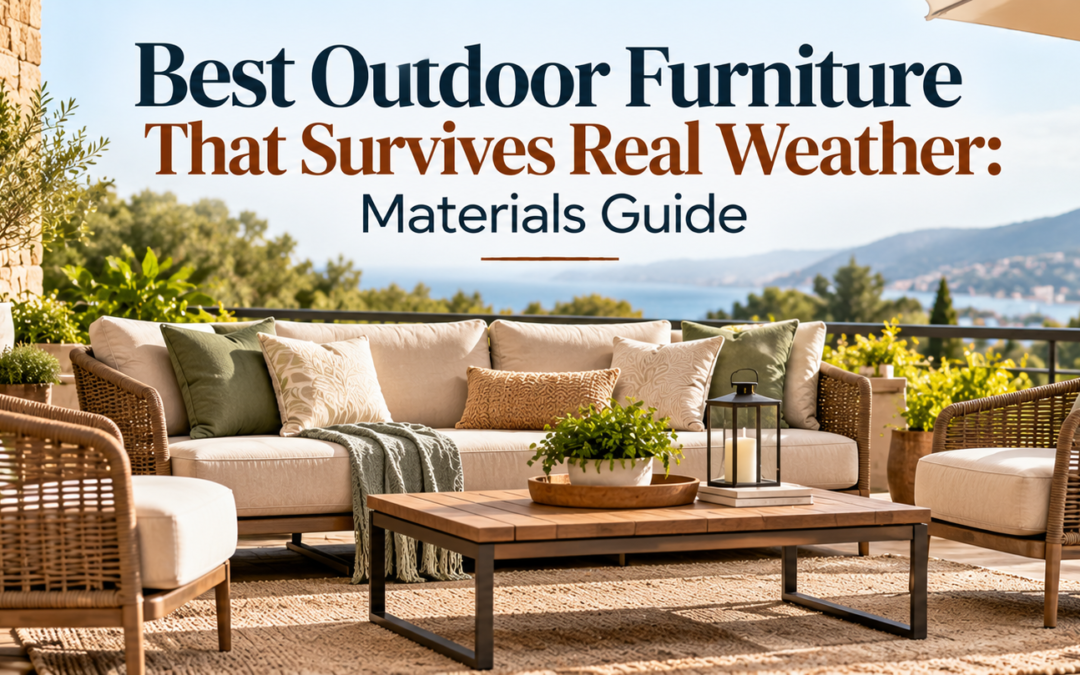
Outdoor furniture looks impressive in a showroom, but a terrace exposed to intense sunlight, a balcony facing coastal winds, or a garden that gets soaked during the monsoon puts every material to the test. Choosing the best outdoor furniture means understanding how its frame, surface finish, cushions, and fasteners respond to moisture, ultraviolet (UV) radiation, heat, and humidity. These factors influence fading, corrosion, cracking, mould growth, and long-term structural stability.
The challenge is that weather resistance is not a single product feature. A teak table can withstand rain yet gradually turn silver-grey. A metal chair may have a durable frame but develop rust where its coating gets scratched. Synthetic wicker can handle wet conditions, but its performance depends on the quality of the weave and the frame beneath it. The right purchase starts with your local climate and how much maintenance you are willing to do.
1. Teak Wood: Best for Natural Beauty and Long-Term Use
Teak is a popular choice for outdoor dining tables, benches, loungers, and premium garden seating. Its natural oils help it resist moisture and decay, making it more suitable for outdoor exposure than many untreated woods.
- What it handles well: Humidity, rain, and everyday temperature changes, provided the furniture is properly constructed and maintained.
- What to consider: Teak is relatively expensive and heavy. When left untreated, it gradually develops a silver-grey patina. If you prefer its original golden-brown appearance, periodic cleaning and suitable teak treatments may be necessary.
- Buying tip: Check the wood grade, joinery, drainage, and hardware. A teak label alone does not guarantee consistent quality or responsible sourcing. Look for credible sustainability certification where available.
Best for homeowners who value natural materials and are comfortable paying more upfront.
2. Powder-Coated Aluminium: Best for Rain and Low Maintenance
Aluminium furniture offers a useful combination of light weight, strength, and corrosion resistance. A powder-coated finish adds colour and protects the surface, making it a practical option for balconies, patios, and outdoor dining areas.
- What it handles well: Rain, humidity, and frequent repositioning. Aluminium does not rust like ordinary iron or steel, although its coating and fittings can still deteriorate.
- What to consider: The finish matters. Scratches, poor coating quality, and neglected joints can reduce durability. Metal surfaces may also become hot in direct sunlight, so shade and cushions improve comfort.
- Buying tip: Inspect welds, joints, underside coating, and the quality of the fasteners. For coastal locations, choose corrosion-resistant hardware and rinse away salt deposits regularly.
For buyers who want the best outdoor furniture with relatively little routine upkeep, powder-coated aluminium is often a sensible starting point.
3. Synthetic Wicker: Best for Comfortable Lounge Seating
Synthetic wicker recreates the woven appearance of natural rattan using plastic resin strands. It is commonly used for outdoor sofas, lounge chairs, and conversation sets.
- What it handles well: Rain and humidity when the weave is designed for outdoor use, and the frame resists corrosion.
- What to consider: Not all synthetic wicker is equally durable. Low-quality strands can fade, crack, or become brittle after prolonged sun exposure. Water can also collect in poorly designed frames or cushion bases.
- Buying tip: Look for UV-stabilised polyethylene (PE) or high-density polyethylene (HDPE) strands over a corrosion-resistant aluminium frame. Ask whether the cushions have removable covers and quick-drying filling.
Natural rattan and indoor wicker are different: they generally need protection from prolonged rain and moisture. Do not assume every woven chair is suitable for year-round outdoor use.
4. HDPE and Recycled Plastic: Best for Easy Care
High-density polyethylene (HDPE) furniture and recycled plastic lumber are useful alternatives to wood. They are available in dining chairs, benches, picnic tables, and loungers, often with finishes designed to resemble painted wood.
- What they handle well: Moisture, routine cleaning, and outdoor use when made with UV-stabilised material.
- What to consider: Basic plastic furniture can fade or become brittle in strong sunlight. Heavier recycled-plastic lumber may be more stable, but it can cost more and weigh more than moulded plastic.
- Buying tip: Check the UV-resistance claims, weight capacity, frame construction, and whether the product is made from outdoor-grade HDPE rather than unspecified plastic.
This category suits households that prefer simple cleaning and do not want to oil or seal furniture regularly.
5. Stainless Steel and Wrought Iron: Best for Different Structural Needs
Stainless steel provides a clean, modern appearance and good corrosion resistance. Marine-grade 316 stainless steel is especially useful in coastal settings, although it costs more than many alternatives.
Wrought iron is heavy and can remain stable in windy areas. However, ordinary iron is vulnerable to rust if its protective coating chips or wears away.
- Buying tip: For stainless steel, confirm the grade rather than relying on a generic “stainless” description. For wrought iron, inspect coating quality and ask about rust protection and touch-up requirements. Keep drainage points clear so water does not sit in joints.
Choose these materials when their weight, appearance, or structural characteristics suit the location and when their maintenance requirements are realistic for you.
6. Outdoor Fabrics and Cushions: The Detail That Often Fails First
A durable frame cannot compensate for cushions that stay wet for days or fabric that fades after one summer. Outdoor textiles need to withstand sunlight, moisture, frequent use, and cleaning.
Solution-dyed acrylic and other outdoor-rated fabrics are worth considering because colour is incorporated into the fibres during manufacturing. Performance still varies by product, so check the manufacturer’s UV and mildew-resistance specifications.
Look for removable covers, washable fabric, quick-drying foam, and cushion designs that allow water to drain rather than collect. Water-resistant fabric does not automatically mean waterproof cushioning.
- Buying tip: If your outdoor area receives heavy rain, choose cushions you can bring indoors easily. A breathable cover and proper drying are more useful than leaving damp cushions under a waterproof sheet.
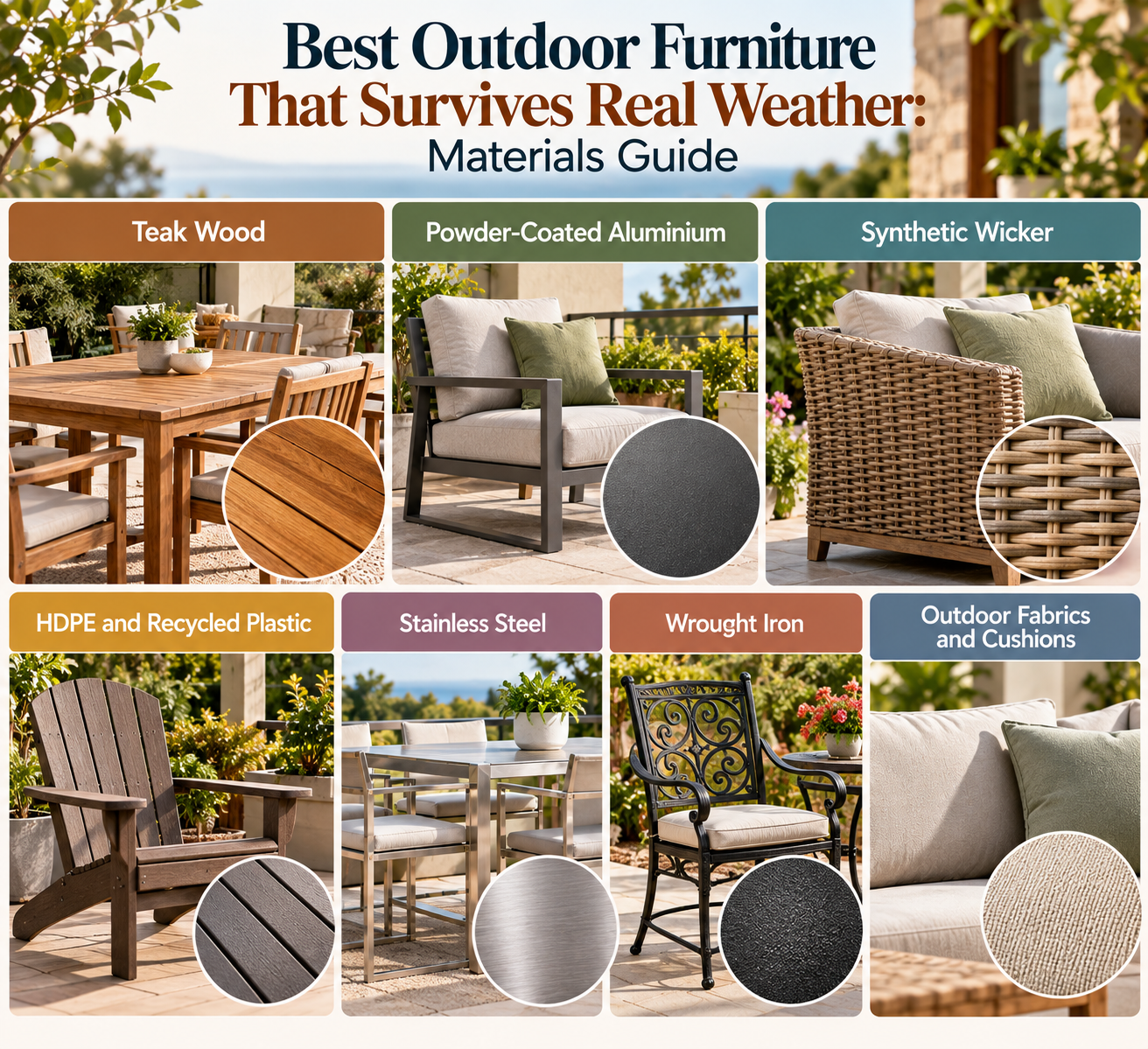
Which Material Performs Best in Different Weather?
| Material |
Sun and UV |
Rain and humidity |
Maintenance |
Best suited for |
| Teak |
Good |
Very good |
Periodic cleaning; oil if desired |
Natural, premium outdoor seating |
| Powder-coated aluminium |
Good with quality coating |
Very good |
Low; inspect coating |
Balconies, patios, coastal areas |
| Synthetic PE/HDPE wicker |
Good if UV-stabilised |
Good with suitable frame |
Low |
Lounge sets and conversation areas |
| HDPE or recycled plastic |
Good if UV-stabilised |
Very good |
Very low |
Benches, dining chairs, everyday use |
| Stainless steel |
Good |
Very good; grade matters |
Low; clean salt deposits |
Modern and coastal settings |
| Wrought iron |
Good with intact coating |
Fair to good; rust risk |
Regular coating checks |
Heavy, stable garden furniture |
| Outdoor-rated fabric |
Depends on UV rating |
Depends on fabric and filling |
Regular cleaning and drying |
Cushions and upholstered seating |
These are general comparisons, not guarantees. Construction quality, exposure, drainage, and maintenance can change how long a particular product lasts.
What to Check Before Buying Outdoor Furniture Online
Before deciding which best outdoor furniture option suits your home, examine the complete product rather than relying on its headline material.
- Frame and joints: Look for solid construction, secure joints, and drainage openings where appropriate.
- Finish and hardware: Check coating quality, corrosion protection, and the availability of replacement fittings.
- Weather specifications: Look for explicit UV-resistance and outdoor-use claims. “Weatherproof” without supporting details is not enough.
- Dimensions and weight: Measure the available space, access route, and storage area. Lightweight furniture is easier to move but may need securing in windy locations.
- Cushions and covers: Confirm whether these are included, removable, washable, and suitable for outdoor exposure.
- Warranty and spare parts: Check what the warranty covers, especially finishes, frames, fabric, and moving components.
If you live in a coastal or monsoon-prone area, prioritise corrosion-resistant frames, UV-stable materials, and cushions that dry quickly. In a dry, sunny location, UV protection and surface temperature deserve more attention.
How to Make Outdoor Furniture Last Longer
Even the best outdoor furniture benefits from routine care. Clean dirt and bird droppings before they damage surfaces, tighten loose fittings, and inspect metal coatings for scratches. Dry cushions thoroughly after rain, and store them indoors during prolonged wet weather.
Use breathable furniture covers that fit properly rather than wrapping damp furniture tightly. Avoid dragging heavy pieces across tiles, and follow the manufacturer’s instructions for wood oils, protective coatings, and cleaning products.
During severe storms, move lightweight furniture to a sheltered location or secure it appropriately. Weather resistance does not mean immunity to high winds, standing water, or extreme conditions.
FAQs
1. What is the most weather-resistant material for outdoor furniture?
There is no universal winner. Powder-coated aluminium is a strong low-maintenance choice, teak offers natural weather resistance, and outdoor-grade HDPE performs well with minimal upkeep. Your climate and the product’s construction determine the best fit.
2. Is wooden outdoor furniture better than metal?
Not necessarily. Teak offers natural warmth and can age beautifully, while aluminium is lighter and usually requires less maintenance. Choose based on appearance, exposure, budget, and willingness to care for the material.
3. Can synthetic wicker stay outside in the rain?
Quality UV-stabilised synthetic wicker can handle outdoor exposure, but the frame, joints, and cushions matter too. Remove or dry cushions after heavy rain and check the manufacturer’s care guidance.
Also Read: Kovo Credit Builder Review: How Does It Work?
